

Table of Contents
- Understanding Age-Appropriate Puzzles for Toddlers
- Puzzles for 2-Year-Olds: What Works at This Stage
- Toddler Puzzle Piece Count by Age: A Progression Plan
- Puzzle Safety for Toddlers: What Every Parent Needs to Know
- Benefits of Puzzles for Toddlers: Why They Matter
- Assessing Your Toddler's Readiness and Skill Level
- Guided and Independent Play: Supporting Puzzle Success
- Frequently Asked Questions
Last Updated: October 10, 2026
Understanding Age-Appropriate Puzzles for Toddlers
Choosing age-appropriate puzzles toddlers can handle supports their development while building confidence and fine-motor skills. The right puzzle at the right time makes a real difference in your child's learning journey.
The challenge is knowing which puzzles suit your child's stage: too simple and they lose interest, too complex and frustration sets in. This guide shows you how to select puzzles that work right now and progress as skills grow.
Puzzles for 2-Year-Olds: What Works at This Stage
Two-year-olds are ready for puzzles that challenge without overwhelming. At this age, they're developing hand-eye coordination, learning to manipulate objects with intention, and building patience.
For two-year-olds, simple puzzles with bold images and thick pieces work best. Your child can grasp the concept of fitting pieces together, and the satisfaction of completion is powerful.
Piece counts and progression
Two-year-olds typically manage 4 to 6 large pieces. Watch your individual child: if they complete 4-piece puzzles with ease, 6-piece puzzles are the natural next step.
Wooden puzzles with thick pieces are ideal, durable, comfortable to grip, and less frustrating. Cardboard puzzles work but wear faster.
Material choices: wooden versus cardboard
Wooden puzzles offer superior durability through repeated drops and water exposure, with thicker pieces easier for small hands. Cardboard puzzles are lighter and less expensive but wear faster. For multiple children or long-term use, wood is the better investment.
Toddler Puzzle Piece Count by Age: A Progression Plan
Understanding how puzzle complexity scales with age helps you select appropriately. This progression isn't rigid; every child develops at their own pace, but it provides a useful framework.
12 to 18 months: knob puzzles and jumbo pieces
Knob puzzles are designed for this age with built-in handles toddlers can grasp. Large, chunky pieces teach the concept of removing and replacing without fine-motor demands.
Jumbo-piece puzzles with 2 to 4 pieces work alongside knob puzzles, building hand-eye coordination and introducing how pieces fit together.
18 to 24 months: four- to six-piece puzzles
Your toddler is ready for standard puzzle pieces. Four-piece puzzles are the natural starting point with thick, easy-to-hold pieces and bold, recognisable images. By 20-22 months, many progress to 6-piece puzzles if they complete 4-piece puzzles independently.
Two to three years: six- to twelve-piece puzzles
Two-year-olds typically manage 6 to 8 pieces; by 2.5, many handle 10 to 12. This is the sweet spot for building confidence and problem-solving. Your toddler begins understanding shape matching and recognising how pieces fit together.
Three to four years and beyond: 10 to 20-piece puzzles
Three-year-olds often tackle 12 to 20-piece puzzles; by four years, many manage 20 to 30 pieces. Progression becomes less about age and more about individual skill. Your child develops spatial reasoning, can mentally rotate pieces, and engages with complex scenes.
Puzzle Safety for Toddlers: What Every Parent Needs to Know
Safety is non-negotiable. Puzzles designed for toddlers meet strict safety standards, but age labels are a starting point, not a substitute for your own assessment.
Small-parts safety: beyond age labels
Age labels reflect testing against small-parts safety standards. A puzzle marked "18 months and up" ensures pieces are of a size that minimises choking hazards for that age group.
However, age labels don't account for individual behaviour. A child who mouths everything needs stricter piece-size standards. Here's how to assess safety yourself:
Practical piece-size checks:
- Use the toilet-paper tube test: if a puzzle piece fits inside a standard toilet-paper tube, it's too small for children under 3 years. This is a quick, physical way to verify piece dimensions without relying on manufacturer claims.
- Check the smallest dimension of each piece, not just the largest. A thin, narrow piece can be a choking hazard even if one dimension is large.
- Inspect the entire puzzle, not just the obvious pieces. Look for any detachable parts: knobs, decorative elements, or loose components that could separate during play.
Age-label guidance in practice:
- Respect age labelling, but understand what it means. "18 months and up" reflects safety testing, not developmental readiness. A 15-month-old with advanced fine-motor skills might be developmentally ready for an 18-month puzzle, but the piece size is still the safety standard.
- Never give a toddler a puzzle marked for older ages, even if they seem "careful." Impulse and curiosity override caution at this age. A 2-year-old who can solve a 4-year-old puzzle may still mouth pieces.
- If you're uncertain, err on the side of older-age recommendations. A puzzle that's slightly too easy is safer than one that's slightly too advanced.
Supervision and play environment
During puzzle play:
- Stay within arm's reach while your toddler plays with puzzles. You don't need to hover, but you should be able to intervene quickly if a piece goes into their mouth.
- Watch for signs of mouthing behaviour. If your toddler regularly puts puzzle pieces in their mouth, they're not ready for that puzzle, regardless of age label. Switch to larger-piece or knob puzzles.
- Remove puzzles from play if pieces become loose, chipped, or damaged. A piece that was safe when new may become a hazard as it wears.
Storage and access:
- Store puzzles with all pieces accounted for. A missing piece changes the safety profile of the puzzle. If you can't find a piece, remove the puzzle from circulation.
- Keep puzzles away from younger siblings or visiting toddlers who may be at different developmental stages. A puzzle safe for your 3-year-old may not be safe for a 15-month-old visitor.
- Store puzzles in a way that prevents toddlers from accessing them unsupervised. A puzzle left on a low shelf is an invitation for independent play without supervision.
Material safety and non-toxic finishes
Wooden puzzles should use non-toxic, child-safe finishes. Cardboard puzzles should use food-safe inks. Look for EN 71 certification, which covers toy safety including toxic substances and small-parts requirements.
What to check on packaging:
Speedy Monkey Snail Educational Game →
- Look for "CE marked" or "EN 71 compliant" statements, which indicate the puzzle has been tested against safety standards.
- Check for statements about non-toxic finishes, FSC-certified wood (for wooden puzzles), or food-safe inks (for cardboard).
- Read the small-parts warning. If it says "Not suitable for children under 3 years" or "Choking hazard: small parts," take that seriously.
Regular inspection:
- Check puzzles regularly for splinters, loose pieces, or peeling paint. Run your fingers along wooden edges and surfaces.
- Replace puzzles that show wear in ways that compromise safety: paint that's chipping, pieces that are cracked, or wood that's splintering.
- If a wooden puzzle has been exposed to water or humidity, inspect it for warping or mould before returning it to play.
Benefits of Puzzles for Toddlers: Why They Matter
Puzzles do far more than keep your toddler occupied. They're powerful tools for development across multiple domains.
Fine-motor skills and hand-eye coordination
Picking up, positioning, and inserting puzzle pieces strengthens hand and finger muscles, building coordination for writing, drawing, and self-care skills. Puzzles develop hand-eye coordination by repeatedly demanding guided hand movements.
Problem-solving and cognitive development
Puzzles teach problem-solving through practical challenges: Where does this piece go? How do I turn it? A child who practices working through puzzle challenges develops confidence in tackling other difficulties.
Concentration, persistence, and confidence
Completing a puzzle builds concentration and persistence. The cycle of challenge, effort, and success builds confidence and resilience, teaching your toddler that effort produces results.
Assessing Your Toddler's Readiness and Skill Level
Age is a guide, not a rule. Your individual toddler's readiness depends on their development, interest, and temperament.
Signs your toddler is ready for puzzles
Your toddler is ready for puzzles when they can pick up objects with a pincer grip, show interest in fitting things together, sit focusing on a task, and follow simple instructions. Interest matters as much as ability.
What to do when a puzzle is too difficult or too easy
If your toddler shows frustration or loses interest quickly, the age-appropriate puzzles toddlers need are simpler, offering an easier option. If they complete it without effort and show no interest in repeating it, they're ready to progress.
Guided and Independent Play: Supporting Puzzle Success
How you interact with your toddler during puzzle play shapes their confidence and willingness to tackle challenges.
How to help without doing it for them
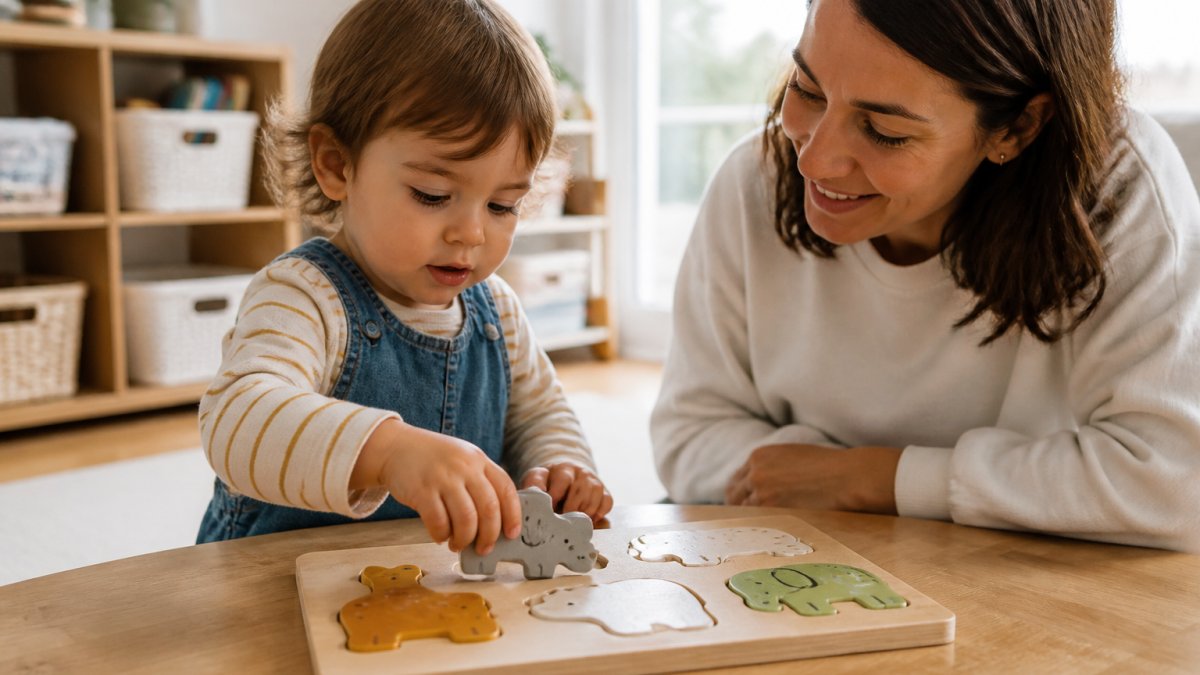
Sit alongside your toddler but let them lead. Ask questions like "Where do you think this piece goes?" rather than placing pieces. Offer small hints if stuck. Celebrate effort, not just completion: "You kept trying even when that was tricky" builds resilience and growth mindset.
Inclusive and accessible puzzle choices
Some toddlers have difficulty with standard puzzle pieces due to fine-motor challenges or sensory preferences.
Puzzles with textured pieces or varied materials appeal to toddlers who seek sensory input.
There's no single "right" puzzle for all toddlers.
Choosing the right puzzle for your toddler removes the guesswork from supporting their development. The Nook and Nurture Company has carefully selected educational toys, including options like the Speedy Monkey Snail Educational Game (£15.99), that combine learning with the durability and safety standards every parent deserves.

| Age | Typical Piece Count | Best Material | Key Focus |
|---|---|---|---|
| 12-18 months | Knob puzzles, 2-4 pieces | Wood with handles | Hand-eye coordination |
| 18-24 months | 4-6 pieces | Thick wood | Piece placement |
| 2-3 years | 6-12 pieces | Wood or thick cardboard | Shape matching |
| 3-4 years | 12-20 pieces | Wood or cardboard | Spatial reasoning |
According to NHS guidance on child development, fine-motor skills develop progressively through toddlerhood, with most children achieving key milestones between 18 and 36 months.
Research from the American Academy of Pediatrics on play-based learning emphasises that play is essential for cognitive development, and puzzles offer structured play that builds problem-solving skills.
The toy safety regulations set strict requirements for small-parts safety in toys intended for children under 3 years.
Frequently Asked Questions
At what age should toddlers start doing puzzles?
Toddlers can begin with puzzles around 12 months using knob puzzles with jumbo pieces. By 18 months, many are ready for simple four- to six-piece puzzles. Every child develops at their own pace, so watch for signs of interest and the ability to grasp and manipulate pieces rather than focusing solely on age. Starting with age-appropriate puzzles builds confidence and keeps play enjoyable.
How many pieces should puzzles for 2-year-olds have?
Two-year-olds typically manage four- to twelve-piece puzzles best. Start with four- to six-piece options if your child is newer to puzzles, then progress to six- to twelve-piece puzzles as they gain confidence and skill. The goal is finding the sweet spot where the puzzle is challenging enough to hold their interest but not so difficult that it causes frustration.
What skills do toddlers develop by doing puzzles?
Puzzles build fine-motor skills, hand-eye coordination, and spatial reasoning as toddlers manipulate pieces and fit them together. They also develop problem-solving abilities, concentration, and persistence. Puzzles encourage cognitive development through shape and colour recognition, boost confidence when completed, and support independent play. These foundational skills transfer to writing, self-care tasks, and learning.
Are wooden puzzles safer for toddlers than cardboard ones?
Both can be safe when chosen carefully. Wooden puzzles are durable and often have smooth, rounded edges, making them less likely to splinter or tear. Cardboard puzzles are lighter and easier for small hands to manage but can wear faster with frequent use. Look for non-toxic finishes on wooden puzzles and check age labels on both types. Quality matters more than material; choose puzzles with safe paints and finishes.


