

Table of Contents
- Why Affordable Organic Baby Essentials Matter for New Parents
- Your Baby Essentials Checklist: What You Actually Need
- Affordable Baby Essentials That Earn Their Place
- Organic Baby Clothes: What to Buy and What to Skip
- Organic Newborn Essentials for Sleep, Bathing and Nappy Changes
- How to Verify Organic and Sustainable Claims
- How to Save Money on Organic Baby Essentials
- Conclusion: Building Your Organic Essentials Without Overspending
- Frequently Asked Questions
Last Updated: October 14, 2026
Why Affordable Organic Baby Essentials Matter for New Parents
Building a nursery around affordable organic baby essentials for new parents is easier than most high street price tags suggest. At The Nook and Nurture Company, parents often seek natural materials and fewer chemicals, and we believe it doesn't have to cost twice as much.
The case for organic is about what sits against a newborn's skin for 20 hours a day. Organic baby essentials means clothing, bedding, feeding and care products made from certified organic fibres and gentler formulations, without the pesticide residues and finishing chemicals used in conventional manufacturing. The common mistake is buying organic everywhere at once: focus on what touches skin and mouth, and buy conventional elsewhere.
Below, we break down what you actually need, what it costs, and how to spot a genuine organic claim from a marketing one.
Your Baby Essentials Checklist: What You Actually Need
A baby essentials checklist for the first six months fits into roughly 25 items. Most lists online run to 80 or more, and the extra 55 sit unused. Build yours by stage, not category: newborns need very little, and what changes at six weeks is volume, not variety.
Stage 1: The First Six Weeks
Buy small quantities and repeat. Babies outgrow newborn sizes within weeks, so six to eight vests and sleepsuits go further than twenty.
- 6-8 short-sleeve bodysuits in newborn size
- 6 sleepsuits, front-opening for night changes
- 2 cellular blankets or 1 swaddle
- 2 packs of newborn nappies
- 1 changing mat and a caddy for supplies
- 1 pram suit or 2.5 tog sleeping bag
Stage 2: Two to Six Months
Sizes jump and so does the mess. This is when you add feeding and play items.

- 8-10 bodysuits in 3-6 month size
- 4-6 sleep bags in the correct tog for the season
- 4-6 muslins for burping and spills
- Play mat and a small sensory toy
- Teething rings and a few soft cloths
Affordable Baby Essentials That Earn Their Place
The items that justify their cost are the ones used daily, not the ones photographed for the nursery. Our shelves are built around that test.
A Nappy Caddy Organiser at £19.99 is the clearest example. It holds nappies, wipes, creams, bags and a spare vest in separate compartments, so a 3am change stops being a search through drawers. The dividers come out when your needs change.

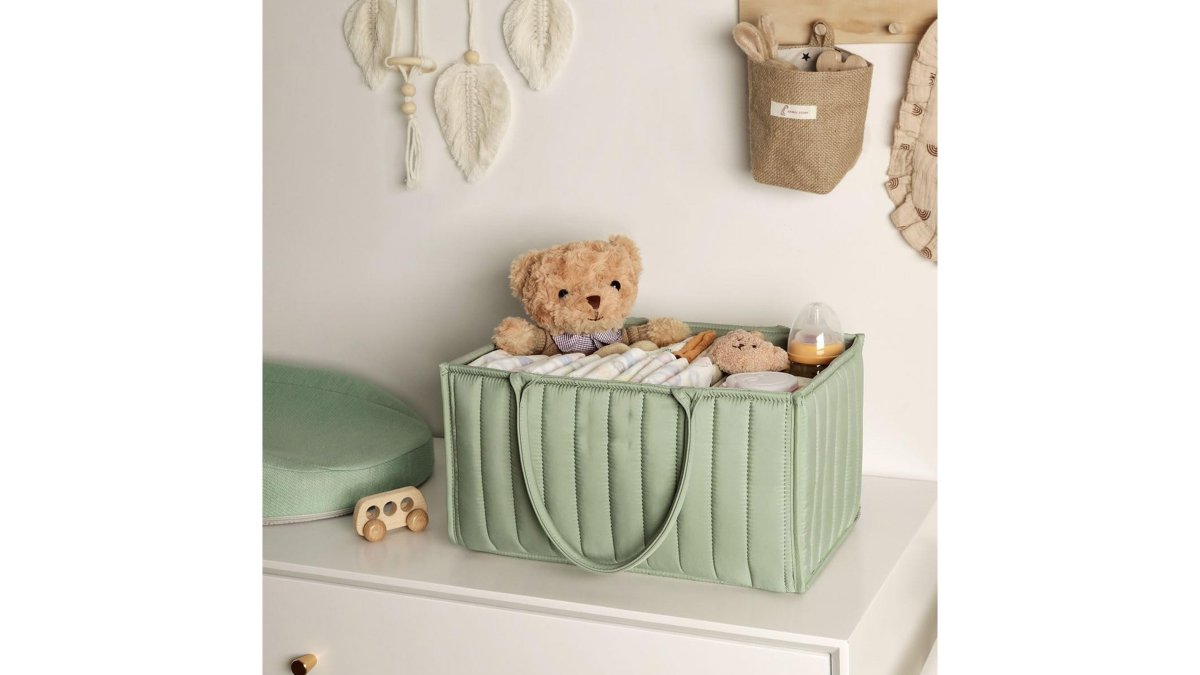
Pair it with a Baby Changing Mat at £15.99: 70cm by 50cm, folds into a changing bag, and has a waterproof, leak-proof surface you can wipe clean.
| Item | Price | Why It Earns Its Place |
|---|---|---|
| Nappy Caddy Organiser | £19.99 | Ends the 3am supply hunt |
| Baby Changing Mat | £15.99 | Folds flat, wipes clean, leak-proof |
| AIYAPLAY Play Mat | £25.19-£36.20 | Padded, waterproof, EN71 approved |
| Newborn Sensory Box | £48.99 | Used from day one, not month three |
Organic Baby Clothes: What to Buy and What to Skip
Organic baby clothes are worth the premium on anything worn next to skin overnight. Skip them on outerwear, which sits over a vest and gets outgrown in weeks. Look for cotton certified to a recognised standard rather than the word "natural" on a label: certifications are audited, which makes them a more reliable signal than packaging copy. Buy fewer, better pieces, six organic cotton sleepsuits that survive 50 washes beat twenty thin ones that pill after five. Check the seams and poppers, because those fail before the fabric does.

Organic Newborn Essentials for Sleep, Bathing and Nappy Changes
Organic newborn essentials for sleep, bathing and nappy changes come down to three things: natural fibres, fragrance-free formulations and correct sizing. The affordability question is not whether organic costs more, but which items repay the premium.
Sleep: bedding, tog ratings and safe-sleep basics
For sleep, choose cotton, bamboo or merino wool bedding and match the tog rating to room temperature rather than the season on the calendar. UK nurseries often swing between 16°C on a winter night and 24°C in a summer heatwave, and a single 2.5 tog bag cannot cover both.
- 1.0 tog for rooms around 24°C and above
- 1.5 tog for roughly 20-22°C
- 2.5 tog for roughly 16-20°C
- 3.5 tog for unheated rooms below 16°C
A safe-sleep rule worth stating plainly: use a fitted sheet and a sleeping bag or cellular blanket, keep the cot clear of pillows, bumpers, toys and loose bedding, and place babies on their back with feet at the foot of the cot. The safety comes from the fit, the tog and the absence of loose items.
Bathing: what to buy and what to skip
For bathing, pick baby wash and shampoo labelled fragrance-free, since added perfume commonly irritates newborn skin. One fragrance-free wash does the job for the first six months, you do not need separate bubble bath, shampoo and body wash. A soft towelling layer after the bath keeps heat in without trapping moisture; a hooded towel is enough. Skip anything marketed as "chemical-free", that phrase has no legal definition and tells you nothing about what is in the bottle.
Nappies: the real cost-per-change maths
The reusable-versus-disposable trade-off is where affordability gets decided, and most guides skip the numbers. Many families run cloth at home and disposables when out, which splits the difference and still cuts the annual spend. If you buy cloth secondhand, check the elastic and waterproof layer and strip-wash before use. If you buy disposables, look for fragrance-free and chlorine-free options rather than organic branding, which adds cost without changing the absorbent core.
For the parent side of the same routine, our 100% Organic Cotton Eco Bath London Natural Towelling Slippers at £9.99 are GOTS-certified, unbleached and machine washable, the standard we would hold baby clothing to as well.
How to Verify Organic and Sustainable Claims
Verifying an organic claim takes about two minutes, and most shoppers never do it. Check the certification body, the certificate number and whether the claim covers the whole product or one component. Treat "chemical-free" and "eco-friendly" with caution, neither has a legal definition. A genuine organic claim names the standard and the certifying body.
- Look for a named certification on the label, not a leaf logo
- Check whether the certificate covers the finished product or the raw fibre
- Search the certifying body's public register for the licence number
- Treat vague terms like "natural" and "pure" as marketing, not evidence
- Ask the retailer directly which standard applies
Reputable retailers publish this information. Others will not, and that silence tells you something.
100% Organic Cotton Eco Bath London Natural Towelling Slippers →
How to Save Money on Organic Baby Essentials
Saving on organic comes from buying less, buying secondhand where it is safe, and accepting that not every item needs certification. What most guides leave out is what to spend, in what order, and how to tell a genuine saving from a false one.
Budget tiers: what a realistic first-six-months spend looks like
Prices vary by retailer and season, but the shape of a sensible budget is consistent. Treat these as ranges, not quotes.
| Tier | What it covers | Typical range |
|---|---|---|
| Lean | Secondhand clothing, borrowed sleep bags, cloth nappies, one fragrance-free wash | £150-£300 |
| Balanced | New organic vests and sleepsuits, two sleep bags, mixed cloth and disposable nappies | £350-£600 |
| Comfortable | Full organic clothing set, premium sleep bags, reusable nappy system, organic bedding | £700-£1,200 |
The lean tier is not a compromise on safety. It is a compromise on newness, which is a different thing.
Cost per use: the only comparison that matters
A £30 organic sleeping bag used every night for a year costs about 8p per night. A £12 going-home outfit worn twice costs £6 per wear. The organic premium is only worth paying on the first kind of item.
Apply the same test to everything:
- Vests and sleepsuits: worn daily for weeks, organic premium justified
- Sleep bags: worn nightly for months, organic premium justified
- Muslins: used multiple times a day, organic premium justified if the price gap is small
- Outerwear, pram suits, going-home outfits: worn briefly, buy conventional or secondhand
- Nursery furniture and plastic hardware: no skin contact, organic certification adds nothing
Secondhand: what is safe and what is not
Buy secondhand on items with no safety function: sleep bags, blankets, play mats, muslins and clothing. Wash at 60°C where the care label allows, and check sleep bags for flattened padding, broken zips and worn seams.
Borrowing and resale: the cheapest organic is often free
Borrow the short-lived items. A pram suit used for eight weeks, a Moses basket used for four months and a baby bath used for six months are all candidates for a loan from a friend, a local parent group or a library of things, none need to be organic to be safe.
Prioritise the daily-use items
A caddy, a changing mat and a play mat get used every day for years, a different value calculation from a going-home outfit worn once. Our The Newborn Sensory Box at £48.99 is built for the newborn stage rather than sitting unused until three months, with high-contrast cards, tactile fabrics and soft rattles for tummy time.
Verify before you pay a premium
Before paying more for an organic claim, check the certification body, the certificate number and whether the claim covers the whole product or one component. A genuine organic claim names the standard and the certifying body. If a retailer will not tell you which standard applies, the premium is not justified, and that silence is your answer.
Conclusion: Building Your Organic Essentials Without Overspending
The pressure to buy everything at once is the real cost driver, not the organic label. Buy small, buy by stage, and put your budget where fabric meets skin.
If you would rather not assemble the list yourself, The Nook and Nurture Company curates baby and home essentials with parents in mind. Every order comes with a 30-day risk-free trial and a full refund if you are not satisfied, guaranteed next-day shipping, and 100% secure payments with SSL encryption.
Get started with The Nook and Nurture Company and build a nursery that works from day one.
Frequently Asked Questions
What organic baby essentials do new parents actually need?
Focus on items that touch your baby's skin or go in their mouth. Organic cotton clothing, muslins, swaddles, blankets and bedding cover most of the day. For nappy changes, a wipe-clean mat and a caddy organiser keep things calm. Add fragrance-free wash and a sensory toy for development. You do not need organic versions of everything, just the items used daily and closest to your baby.
How can I buy organic baby products on a budget?
Buy fewer, better items rather than filling every category. Prioritise organic cotton for clothing and bedding, accept hand-me-downs for outer layers, and use a 30-day trial to test before committing. A nappy caddy at £19.99 or a changing mat at £15.99 costs less than replacing cheap items twice.
Are organic baby clothes worth the extra cost?
For items worn against the skin daily, yes. Organic cotton is grown without synthetic pesticides and processed without chlorine bleaching or harsh dyes, which matters for babies with sensitive skin or eczema. You do not need an entirely organic wardrobe. Prioritise vests, sleepsuits, hats and anything worn next to the skin, then use non-organic for outer layers and fast-growing sizes.
What should I look for when buying organic baby clothes?
Check for a certification logo on the label or product page, such as GOTS or the Soil Association. Look for the words 'certified organic' rather than 'made with organic cotton', which can mean as little as 5% organic fibre. Check fibre percentages, avoid unclear 'eco' claims, and favour undyed or naturally coloured fabrics. Enclosed feet and popper fastenings make night changes faster.
Which baby essentials are worth buying new?
Buy second-hand or accept hand-me-downs: clothing, blankets, play mats, bouncers and nursery furniture, provided they meet current safety standards. A foldable play mat from £25.19 with EN71-1-2-3 certification is a safe second-hand candidate if the surface is intact and wipe-clean.


