

Table of Contents
- Why Baby Proofing Matters in Small Spaces
- Prioritise Hazards: What to Baby Proof First in Limited Space
- Renter-Friendly Baby-Proofing Solutions That Don't Damage Walls
- Baby-Proofing a One-Bedroom Apartment: Room-by-Room Approach
- Baby Safety Gates for Stairs and Doorways
- Complete Baby-Proofing Checklist for Small Apartments
- Common Mistakes to Avoid When Baby Proofing Small Apartments
- Frequently Asked Questions
Last Updated: October 13, 2026
Why Baby Proofing Matters in Small Spaces
Baby proofing tips for small apartments differ from traditional home safety guides: with limited square footage, every hazard feels closer and every device takes up precious space. A toddler can reach the kitchen in three steps, the bathroom is metres away, and stairs sit directly off the main room, no separate playroom, no gated-off zones, no buffer between your child and danger.
At The Nook and Nurture Company, we know baby proofing in compact homes isn't about doing everything. It's about doing the right things, in the right order, with solutions that don't make your home feel like a padded cell.
This guide covers how to prioritise hazards, choose rental-friendly solutions that don't damage walls, and work through each room systematically.
Prioritise Hazards: What to Baby Proof First in Limited Space
With limited space and budget, identify which hazards pose the greatest risk right now.
Next, secure cabinets and drawers. Once crawling and pulling up, children open every reachable cabinet, kitchen ones hold cleaning supplies, bathroom ones medicines and sharp items, bedroom drawers choking hazards.
Then address impact hazards. Sharp corners, hard furniture edges and hearth surfaces all become targets when a toddler learns to walk and inevitably falls.
Cover electrical outlets. Toddler curiosity about outlets is nearly universal; covers are inexpensive and take seconds to install.
Keep cords out of reach. Blind, lamp and charging cords pose strangulation risks, move them behind furniture or use cord organisers.
This order tackles the most serious injury risks first, protecting your child without overwhelming you.
Renter-Friendly Baby-Proofing Solutions That Don't Damage Walls
If you're renting, you can't drill, screw or permanently alter the space, but you can still baby proof effectively by choosing the right products.
Adhesive-backed solutions are your foundation. Safety latches, corner protectors, outlet covers, and cord organisers all come in adhesive versions that peel off cleanly when you move out.
The 10x Door Safety Latches from The Nook and Nurture Company (£12.99) install in seconds with strong adhesive backing, no tools, no drilling, no damage.

Pressure-fit gates work without installation. They use pressure rather than bolts or screws, leaving no marks and moving with you if you relocate.
Furniture anchors with adhesive strips. Adhesive-based anchors secure a tall bookshelf or chest of drawers against tipping without drilling.
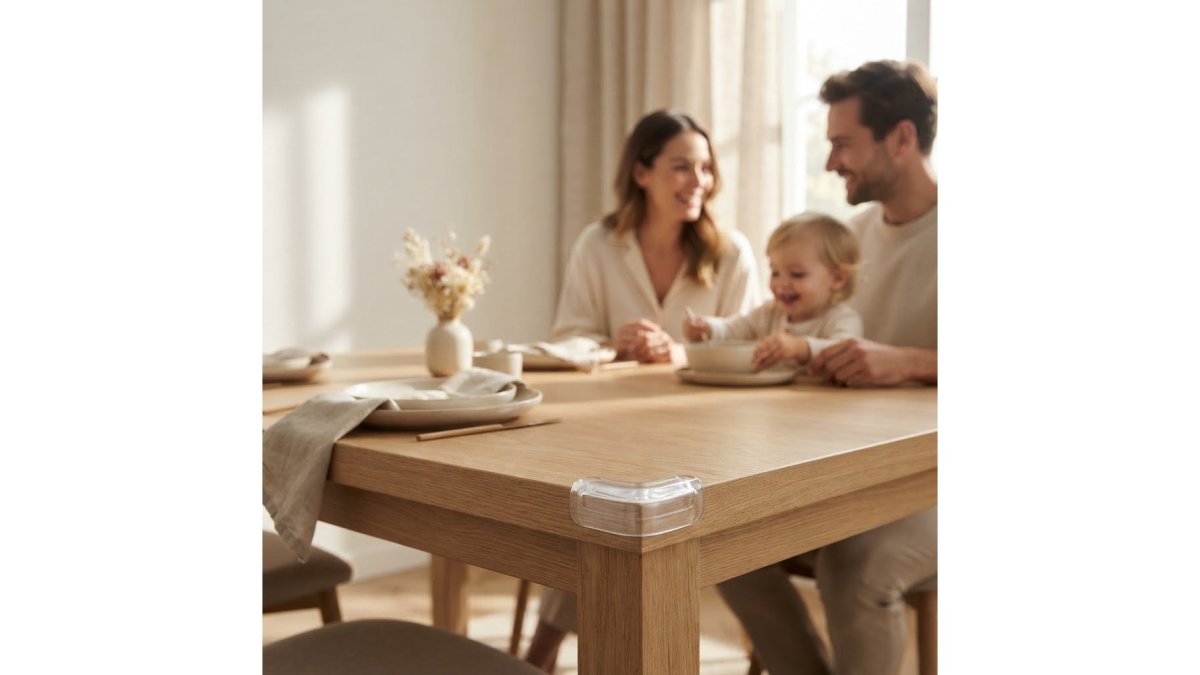
Removable corner protectors. The 10x Silicone Table Corner Protectors (£7.99) use adhesive strips and food-grade silicone, so they're safe if your teething baby gnaws on them.
Baby-Proofing a One-Bedroom Apartment: Room-by-Room Approach
A one-bedroom flat isn't a smaller house, it's a different risk map. The same four walls hold kitchen, sleep and play space, so hazards you'd normally contain behind a door sit two metres from the cot. Work through the layout in this order: sleep zone, cooking zone, wash zone, then shared living zone.
The sleep zone
If your baby sleeps in the same room, treat the whole room as a sleep environment. Use a cot or bedside crib meeting the current British Standard (BS EN 716 for cots, BS EN 1130 for cribs), with a firm, flat mattress and no pillows, bumpers, loose blankets or soft toys. Keep the cot at least 50 cm from radiators, blind cords, plug sockets and anything your baby could pull in once they can stand.
Because the room doubles as storage, the real work is containment. Move anything small enough to pass through a toilet-roll tube, coins, hair clips, button batteries, earrings, pen lids, into a lidded box on a high shelf or a latched drawer. Button batteries are especially dangerous: if swallowed they can cause serious internal burns within hours, so call 999 or go straight to A&E.
The cooking zone
In an open-plan or galley kitchen, the cooker is usually the highest-risk object. Create one hard boundary rather than child-proofing every surface: a pressure-fit gate across the doorway where possible, or a freestanding playpen or room divider where the kitchen opens onto the living area.
On the appliances themselves:
- Fit a stove guard or hob guard so pans cannot be pulled forward, use the back rings, turn pan handles inward, and never leave hot liquid at the front edge.
- Fit an oven door lock or heat-resistant oven guard. Many ovens have a built-in child-lock, check your manual before buying an add-on.
- Keep the kettle, toaster and hot drinks at the back of the worktop, with flexes shortened so nothing dangles.
- Store knives in a block or magnetic strip well back from the edge, not in a low drawer.
The wash zone
The bathroom concentrates more hazards per square metre than any other room. Move all medicines, including vitamins and topical creams, into a high, latched cupboard. Keep cleaning products out of the under-sink cupboard, the first place a crawling child investigates, and store them high or latched.
Fit a toilet lock if your child has any unsupervised access, and keep the lid down. Never leave a bath unattended, and empty it as soon as bath time ends. Set the hot water cylinder or combi boiler to around 48°C if your system allows. Non-slip mats in the bath and on the floor reduce falls on wet tiles.
The shared living zone
In a studio or open-plan space, the living area is also the play area, dining area and route to the front door. Anchor every tall item, bookcases, chests of drawers, TV units, shelving, with furniture anchors, choosing adhesive ones if you cannot drill. Fit corner protectors to coffee tables, side tables and hearth edges at head height, and route lamp and charger cables behind furniture or through cable trunking.

Doors, hallways and the front door
In a flat, the front door is a safety device as much as an exit. Fit a door latch or high bolt so your child cannot open it, and keep keys out of reach but in a known spot for emergencies. Internal doors to the bathroom, kitchen and storage cupboards should carry latches. With a shared hallway or communal stair, treat the front door as the boundary, a gate or latch stops your child reaching shared space where you cannot control the hazards.
Windows and balconies
Windows and balconies are the apartment-specific hazards general guides skip. Fit window restrictors so a window cannot open more than about 10 cm, and never rely on a mesh screen alone. Keep climbable furniture, beds, sofas, chests, away from windows. On a balcony, check railing height and the gap between balusters; if a child can pass a fist through, they may pass more. Keep balcony doors locked or latched, and never leave a child unsupervised on one.
Work through these zones in order and you'll cover the highest-risk areas before spending a penny on optional extras.
Baby Safety Gates for Stairs and Doorways
Safety gates create boundaries in small apartments without taking up permanent space.
At the top of stairs, a safety gate is non-negotiable. A fall down stairs is one of the most serious injuries a toddler can sustain. Install a gate that's securely mounted and can't be pushed or climbed over.
At the bottom of stairs, a gate prevents unsupervised climbing, especially in multi-storey apartments where you can't always supervise.
For doorways, pressure-fit gates work well in rentals: firm against a child, easy for adults to remove. Use them to restrict access to the kitchen, bathroom or laundry area.
The JOY Collapsible Playpen (£59.99) creates a safe, enclosed play space where your child can play independently while you're nearby. Mesh sides let you see them, the zip-down front door lets them crawl in and out, and it folds flat for storage, ideal where a separate playroom doesn't exist.
Complete Baby-Proofing Checklist for Small Apartments
Use this checklist to track your progress, working room by room.
| Safety Area | Action | Completed |
|---|---|---|
| Stairs | Install safety gate at top and bottom | ☐ |
| Doors | Install latches on doors to unsafe areas | ☐ |
| Cabinets & Drawers | Secure all cabinets with hazardous contents | ☐ |
| Electrical Outlets | Cover all accessible outlets | ☐ |
| Sharp Corners | Install corner protectors on tables and furniture | ☐ |
| Furniture | Anchor tall furniture to prevent tipping | ☐ |
| Cords | Secure or hide all electrical and blind cords | ☐ |
| Kitchen | Restrict access to oven and cooktop | ☐ |
| Bathroom | Lock medicine cabinet and secure cleaning products | ☐ |
| Small Objects | Remove coins, batteries, and choking hazards from reach | ☐ |
| Windows | Secure blind cords and consider safety locks | ☐ |
| Balcony | Secure railings and prevent access if unsafe | ☐ |
Print this checklist and check items off as you go. In a small apartment you might finish in a weekend, the key is doing it systematically rather than reacting to close calls.
Common Mistakes to Avoid When Baby Proofing Small Apartments
Most baby-proofing advice is written for houses. In a flat, mistakes tend to be about layout, tenancy and shared space rather than which gadget to buy.
Treating every room as equally urgent. In a flat you can't gate off a wing, so the temptation is to buy a device for every surface at once.
Buying before measuring. Small flats have awkward geometry, narrow doorways, angled walls, boxed-in pipework, doors that open against a cabinet.
Forgetting the tenancy agreement. Before you drill, screw or stick anything to a wall, check your lease.
Underestimating reach and climb. Parents protect the height their child is now, then get caught out two months later.
Ignoring the building itself. Windows, balconies, communal stairs and shared roof terraces are hazards a room-by-room checklist will miss.
Skipping maintenance. A loose safety gate, a failed latch adhesive, a chewed-off corner protector, these are common and easy to miss.
Choosing looks over function. It's reasonable to want safety devices that don't make your flat look like a nursery, neutral corner protectors, slim latches and fabric playpens all blend in. But don't let aesthetics decide which hazards you address. Fit the device that works first, then choose the version that looks best.
Frequently Asked Questions
What should you baby proof first in a small apartment?
Start with the highest-risk areas: stairs, kitchen access, electrical outlets, and sharp furniture corners. In small spaces, focus on the rooms your baby spends the most time in. Install door safety latches on bathrooms and kitchens, secure furniture to walls, and cover outlets before adding lower-priority items like edge guards on every surface. This prioritisation approach maximises safety within space and budget constraints.
Are renter-friendly baby-proofing solutions as effective as permanent installations?
Yes. Adhesive-backed products like door safety latches, corner protectors, and outlet covers provide the same protection as drilled or screwed options without damaging walls or doors. The Nook and Nurture Company's 10x Door Safety Latches (£12.99) use strong adhesive backing and remove cleanly, making them ideal for renters. The key is choosing products designed specifically for no-damage installation and ensuring they're securely applied.
How do you set up a one-bedroom apartment safely for a crawling baby?
Divide your space into zones: a safe play area (consider a collapsible playpen like the JOY Foldable Playpen at £59.99), a sleeping area with firm mattress and back sleeping position, and restricted areas sealed with door latches. Use corner protectors on furniture edges, secure loose cords, keep small objects and hazardous items in locked cabinets or high shelves, and install outlet covers. Keep pathways clear and use vertical storage to maximise safety without cluttering your limited floor space.
What baby safety gates work best for stairs in small apartments?
Pressure-fit gates are ideal for small spaces as they require no drilling or permanent installation. However, for top-of-stair protection, hardware-mounted gates are safer as they're more stable. Measure your stairwell width before purchasing, some compact apartments have non-standard measurements. Ensure any gate you choose meets safety standards and is installed at the correct height. Consider dual gates (top and bottom of stairs) if your apartment layout allows.


