

Table of Contents
- Why Formaldehyde in Furniture Matters for a Nursery
- Where Formaldehyde Hides in Baby Room Furniture
- How Formaldehyde Off-Gassing from Furniture Works
- Step 1: Build a Room-by-Room Shopping Checklist
- Step 2: Choose Genuinely Low-Formaldehyde Nursery Furniture
- Step 3: Verify Formaldehyde Claims Before You Buy
-
Step 4: How to Reduce Formaldehyde Exposure at Home
- 1. Ventilate deliberately, not just occasionally
- 2. Keep new furniture out of the sleep zone while it settles
- 3. Control heat and humidity
- 4. Do not disturb sealed surfaces unnecessarily
- 5. Wash new textiles before they go in the room
- 6. Use a fan to move air, not to mask the problem
- 7. Prioritise what you replace
- 8. Know what not to bother with
- Common Mistakes to Avoid
- Frequently Asked Questions
Last Updated: October 21, 2026
Why Formaldehyde in Furniture Matters for a Nursery
Formaldehyde is a colourless gas released by glues and resins in many furniture boards, and avoiding formaldehyde in baby room furniture starts with understanding how it can build up in the small, warm, sealed room where a baby sleeps.
Babies spend most of their day asleep and their lungs are still developing, so nursery air deserves extra attention.
Formaldehyde Emissions and Indoor Air Quality
Formaldehyde emissions are the amount of gas a product releases over time. New furniture releases the most in its first weeks, and in a small sealed room those emissions have nowhere to go.
Ventilation is the simplest fix. A window cracked open for part of each day does more than most gadgets.
What the Evidence Says About Infant Exposure
Official guidance treats formaldehyde as a recognised indoor air pollutant, and health bodies flag it as a concern for young children because they breathe faster and weigh less. Lower exposure is better, and it is easy to lower.
Where Formaldehyde Hides in Baby Room Furniture
Most of it is in the board, not the paint. Knowing which parts of a cot, dresser or changing unit carry the risk helps you ask better questions in the shop.

Engineered Wood: MDF and Particleboard
Engineered wood is board made from wood fibres or chips bonded with resin. MDF (medium-density fibreboard) and particleboard are the two you will meet most often in nursery furniture, affordable, stable and everywhere.
The resin holding them together is usually where formaldehyde comes from. Cheaper boards generally use more of it.
Adhesives, Glues and Formaldehyde-Based Resins
Formaldehyde-based resins are the bonding agents in many composite wood panels, strong, cheap and water-resistant, which is why manufacturers use them.
Look for glues described as formaldehyde-free or low-emission. It is a genuine difference, not marketing fluff.
Paints, Finishes and Other VOCs
VOCs (volatile organic compounds) are a wider family of chemicals that evaporate from paints, varnishes and finishes. Formaldehyde is one of them, but not the only one.
A water-based, low-VOC paint on a well-sealed surface is a good sign. A strong chemical smell on a new unit is not.
How Formaldehyde Off-Gassing from Furniture Works
Off-gassing is the slow release of trapped chemicals from a new product into the air.
Warmth, humidity, a closed door and a radiator all speed it up.
That is why a new cot can smell of nothing in the shop and fill a small bedroom by day three.
Step 1: Build a Room-by-Room Shopping Checklist
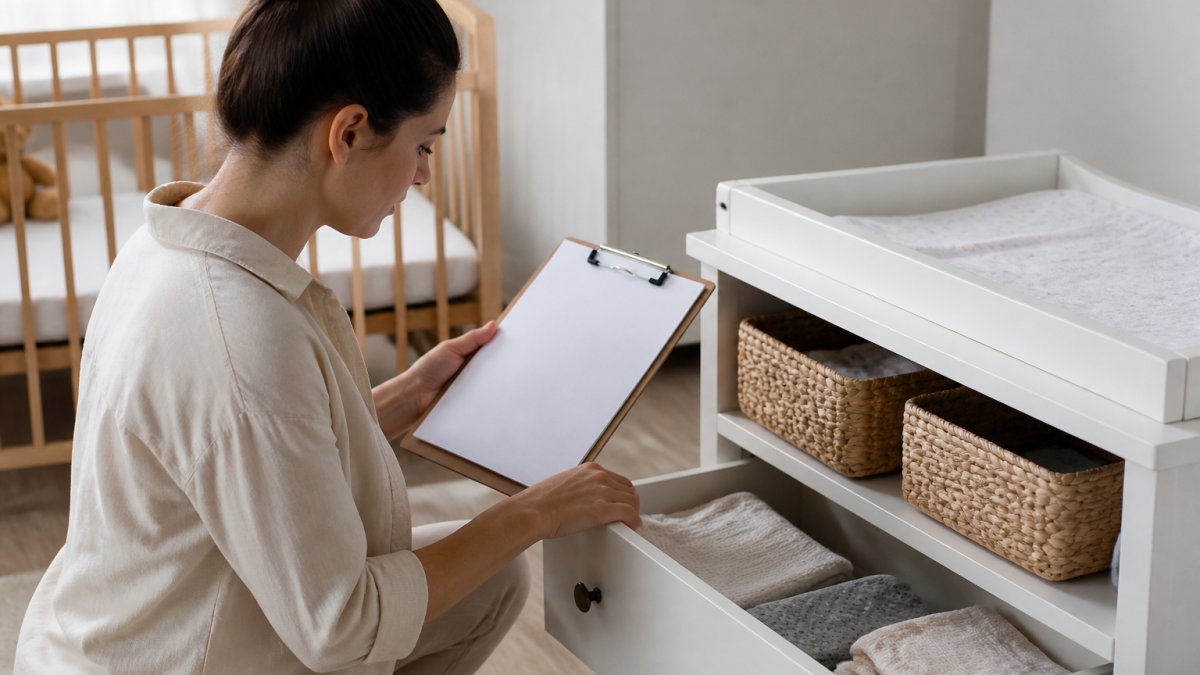
Work through the nursery item by item before you buy. A short list on your phone beats a vague plan.
Cribs, Bassinets and Mattresses
- Ask what the cot frame is made from: solid wood, MDF or particleboard
- Check the mattress filling and any waterproof backing
- Confirm the finish is water-based and low-VOC
Changing Units, Dressers and Storage
- Check the carcass material, not just the doors
- Look for edge banding, which seals cut board
- Prefer metal handles and legs over glued fittings
Step 2: Choose Genuinely Low-Formaldehyde Nursery Furniture
Solid wood is the safest bet because there is no resin-heavy board to off-gas. Pine, beech and oak cots cost more but are the straightforward choice.
Where you want engineered wood, ask for low-emission board. Many manufacturers now offer it as standard.
| Priority | What to look for | Why it matters |
|---|---|---|
| Best | Solid wood frame and slats | No resin binder in the main structure |
| Good | Low-emission MDF with sealed edges | Lower release, sealed surfaces |
| Check | Particleboard backing panels | Often the cheapest, highest-emitting part |
| Avoid | Strong chemical smell on unboxing | Sign of fresh off-gassing |
Our own range includes pieces you can live with for years, like the Shefa Kids 880 Baby Changing Unit, which converts to a dresser once nappy days end.
Step 3: Verify Formaldehyde Claims Before You Buy
A label that says "eco", "natural" or "low-VOC" proves nothing on its own. These are marketing terms, not regulated guarantees. What you need is the specific standard the board was tested to, the test method used, and a document that names the actual product rather than the factory that made it.
What the common standards and labels actually mean
Formaldehyde emissions from wood-based panels are measured in Europe under harmonised test methods and sorted into classes, including E1, E0 and, for some products, E0/5 or super E0. In broad terms:
- E1 is the baseline class that most panels sold for indoor use in the UK and EU must meet. It is a legal floor, not a premium claim.
- E0 is a stricter voluntary class used by manufacturers who want to signal lower emissions. It is not a single universal legal requirement, so ask which test method and which limit the supplier is quoting.
- Super E0 or E0/5 labels are manufacturer or trade-body claims that sit below E0. Treat them as useful signals only once you have seen the test report behind them.
None of these classes means "formaldehyde-free". They describe a measured emission rate under standard conditions, not the absence of the chemical. A panel can meet E0 and still release some formaldehyde over time.
What a real test report contains
When you request documentation, ask for the emissions test report, not a certificate of conformity for the factory's quality management system. A useful report will show:
Shefa Kids 880 Baby Changing Unit - Grey/White →
- The product name and board type tested, ideally matching the item you are buying
- The test method used (for example, the chamber or gas-analysis method referenced in the standard)
- The measured emission value and the class or limit it is compared against
That last point matters: a board can pass a low-emission test, but cut edges, drill holes, backing panels and assembly adhesives can change what the finished unit releases. Ask whether the report covers the assembled product or only the panel.
What "low-VOC" and "formaldehyde-free glue" do not guarantee
- "Low-VOC" is a broad claim about a wide family of chemicals. It says nothing specific about formaldehyde unless the documentation names formaldehyde and gives a measured value.
- "Formaldehyde-free glue" may be true for the adhesive, while the board itself still contains a formaldehyde-based binder. Ask about the board, not just the glue.
- "Solid wood" is a good sign, but check the drawer bases, backing panels and shelf supports, which are often engineered board even on solid-wood frames.
Questions to put in writing
A short email before you buy sorts most of this out:
- Which standard and class is the board tested to, and can you send the test report?
- Does the report cover the finished item or only the raw panel?
- What are the drawer bases, backing panels and shelf supports made from?
- Are cut edges and drill holes sealed or edge-banded?
- Can you confirm the finish is water-based and low-VOC in writing?
If a seller cannot answer, treat the claim as unproven. That is not a reason to panic. It is a reason to choose the solid wood option instead, or to budget for a longer airing period.
Where to look for product-specific data
Some manufacturers publish emissions data or material declarations on their own websites, and larger retailers increasingly hold this information for buyers who ask. If you cannot find data for a specific item, compare it with a similar product from a brand that does publish it, the difference in transparency is itself useful.
Step 4: How to Reduce Formaldehyde Exposure at Home
You can lower exposure in a nursery that is already furnished without replacing everything. The actions below are ordered roughly by impact, so start at the top if you are short on time.
1. Ventilate deliberately, not just occasionally
Opening a window for 15 to 20 minutes a day helps, but the pattern matters more than the gesture.
A common pattern is to air the nursery first thing in the morning and again before bedtime, when the room has been closed up. If the room has been sealed all day, give it 20 minutes before the baby goes in.
2. Keep new furniture out of the sleep zone while it settles
Off-gassing is highest in the first weeks. If you can, assemble a new dresser or changing unit in a spare, well-aired room and let it settle before moving it into the nursery. Otherwise, position new composite-wood pieces away from the cot and the baby's head end, and keep the door open when the room is not in use.
3. Control heat and humidity
Warmth and humidity speed up off-gassing. Keep the nursery at a comfortable, moderate temperature and avoid placing furniture against a radiator or in a sun-baked bay window, a warm, stuffy room concentrates emissions more than a cool, aired one.
4. Do not disturb sealed surfaces unnecessarily
Cut edges, drill holes and unsealed backing panels release more than factory-finished faces. If you drill into a composite board unit to fit a wall strap or shelf, seal the raw edge with a water-based sealant. Avoid sanding or cutting composite panels inside the nursery; if you must, do it outdoors or in a garage and wipe down surfaces afterwards.
5. Wash new textiles before they go in the room
Curtains, bedding, mattress covers and soft storage bins can carry residues from manufacturing and finishing. A wash at the temperature on the care label removes loose surface material and reduces the load in the room, a small step, but cheap and quick.
6. Use a fan to move air, not to mask the problem
A fan does not remove formaldehyde, but it stops air stagnating in corners and behind furniture. In warm weather, a fan directed at a partially open window can help push room air out. Do not rely on air fresheners or scented candles, they add their own VOCs and do not reduce formaldehyde.
7. Prioritise what you replace
If you are replacing furniture over time, start with the pieces closest to where the baby sleeps and the ones most likely to be cheap composite board, the cot mattress base, the changing unit carcass, and any flat-pack storage. A solid wood cot frame with a low-emission mattress base is a bigger win than replacing a decorative shelf.
8. Know what not to bother with
- Air purifiers with standard HEPA filters do not remove formaldehyde. Only units with a suitable activated carbon or chemical filter stage will make a difference, and even then the effect is limited in a normally ventilated room.
- Houseplants are not a practical way to reduce formaldehyde in a nursery. The effect is negligible at the scale of a room.
- Sealing every surface is not necessary and can trap moisture. Focus on raw edges and cut faces.
If you are setting up storage at the same time, natural materials help. Our Padstow storage unit with six water hyacinth drawers brings woven baskets into the room instead of another sealed board carcass.

Common Mistakes to Avoid
The biggest error is assuming a high price means low emissions. An expensive particleboard unit can off-gas more than a plain pine cot.
Second is skipping the airing-out stage. People build the nursery the night before and shut the door. Give it time.
Third is confusing "VOC-free" with "formaldehyde-free". They are not the same claim.
Frequently Asked Questions
How can I tell whether nursery furniture contains formaldehyde?
Ask the retailer for the material specification and any emissions documentation. Composite boards such as MDF and particleboard bonded with formaldehyde-based resins are the usual source, so check whether the listing names the board type and resin. Look for a stated E1 or E0 board class, and ask whether the finish seals all exposed edges. Solid wood pieces joined with mechanical fixings carry far less risk. If a seller cannot tell you what the board is or where it was made, treat that as a warning sign rather than a reassurance.
How long does formaldehyde take to off-gas from furniture?
Formaldehyde off-gassing from furniture is highest when a piece is new and falls gradually over weeks and months, but it does not stop on a fixed date. Composite boards can keep releasing small amounts for years, with the rate dropping as the piece ages. Practically, the first few weeks matter most: air the room daily, keep the nursery warm and ventilated before the baby arrives, and avoid sealing a new room shut. If you can, order furniture well ahead of the due date so it has time to settle.
Does solid wood furniture contain less formaldehyde than composite wood?
Usually, yes. Solid wood is held together with joints and fixings rather than formaldehyde-based resins, so the board itself is not an emission source. Finishes can still release VOCs, so check what the piece is painted or oiled with and let it air before use. Engineered options are not automatically unsafe: a well-sealed MDF unit with a stated low-emission board class behaves very differently from an unsealed cheap particleboard one. Material, board class and finish quality all matter together.
What should I ask a furniture retailer about formaldehyde emissions?
Ask four things: what the board is made of, which emissions class it meets, whether all edges and cut surfaces are sealed, and what the finish contains. A retailer selling low-formaldehyde nursery furniture should answer these without hesitation. Request the product testing documentation or a declaration of conformity if it exists. Also ask about the return window, so you can air a piece and still send it back if the smell or finish concerns you. Vague answers about being natural or chemical-free are not the same as a specification.
Setting up a nursery means juggling a hundred decisions, and the air your baby breathes should not be the one you guess at. At The Nook and Nurture Company, we choose pieces with parents and babies in mind, back them with a 30-day risk-free trial, and ship next day so your setup is not delayed. Start with the cot and the changing unit, air them well, and build the rest of the room around them. Get started with The Nook and Nurture Company and furnish the nursery with a little more peace of mind.


