

Last Updated: November 3, 2026
Quick Summary
Untreated wood is timber left in its natural state, with no paint, lacquer, varnish or synthetic finish, so it adds no layer of chemistry between your baby and the cot and releases no volatile organic compounds into the nursery air. Bare timber also buffers humidity swings slightly and gives a teething baby an unpainted surface to mouth, with no lacquer layer to chip or ingest.
- Solid timber has no resin binder, so it carries no formaldehyde risk from the wood itself.
- Dense woods such as beech, ash, oak, maple or Nordic pine resist dents and hold fixings securely.
- Dust weekly, wipe spills promptly, and re-oil with a child-safe wood oil once or twice a year.
- Never soak a bare wood cot, because water in the end grain causes swelling and cracking.
- Smell the wood and check the grain, since bare timber should smell of timber, not chemicals.
Table of Contents
- Why Untreated Wood Suits a Nursery Environment
- Choosing Non-Toxic Baby Cot Materials
- Solid Wood Cot vs MDF: What the Difference Means in Practice
- The Best Wood for a Baby Cot and Why Wood Density Matters
- Baby Cot Paint and Finishes Safety Explained
- Humidity Regulation, Teething and the Sensory Case for Bare Timber
- How to Care for Untreated Wood and Check It Yourself
- Choosing Your Untreated Wood Cot at The Nook and Nurture Company
- Frequently Asked Questions
Why Untreated Wood Suits a Nursery Environment
Untreated wood is timber left in its natural state, with no paint, lacquer, varnish or synthetic finish applied to the surface.
The case for bare timber rests on what it doesn't add. A finished cot introduces a layer of chemistry between your child and the material; an unfinished one doesn't.
At The Nook and Nurture Company, new parents ask us the same question again and again: how do I know what's actually in the cot? Untreated wood is one of the few answers you can check with your own eyes and nose.
Choosing Non-Toxic Baby Cot Materials
Non-toxic baby cot materials are woods and finishes that don't off-gas harmful chemicals into the nursery. The safest starting point is solid, unfinished timber, followed by solid wood with a certified water-based finish. Engineered boards and solvent-based lacquers sit further down the list.
- What is the core material? Solid timber, or a board made from glued particles or fibres?
- What is on the surface? Nothing, a water-based coating, or a solvent-based lacquer or varnish?
- Can you verify it? Look for recognised safety standards and independent testing rather than marketing language.
Certifications are where most shoppers get stuck, because "eco-friendly" on a product page means very little on its own. If you want to know which marks actually prove a cot's wood and finishes are safe, our guide to non-toxic baby product certifications explains what each one covers.
Solid Wood Cot vs MDF: What the Difference Means in Practice
A solid wood cot is cut from a single piece of timber, while MDF and particleboard are engineered wood: small fibres or chips glued together and pressed into boards.
MDF and particleboard rely on resin binders to hold their shape.
The drawbacks are real, though. If you want the full picture on the formaldehyde risk that makes MDF a concern, our guide to avoiding formaldehyde in baby room furniture covers it in detail.
| Material | Core Construction | Formaldehyde Risk | Repairability | Best For |
|---|---|---|---|---|
| Solid untreated wood | Single piece of timber | None from the wood itself | High, can be sanded | Cots and long-term nursery furniture |
| Solid wood, water-based finish | Single piece, coated | Low if certified | Moderate | Families wanting a wipe-clean surface |
| MDF | Glued fine fibres | Can be significant when new | Low, edges crumble | Budget or temporary pieces |
| Particleboard | Glued wood chips | Can be significant when new | Very low | Flat-pack storage, not sleeping |
The Best Wood for a Baby Cot and Why Wood Density Matters
The best wood for a baby cot is a hardwood or a dense softwood with a tight, closed grain: beech, ash, oak, maple or Nordic pine.
Density is weight per volume, and denser timber resists dents, moisture and wear more effectively. It also holds screws and fixings more securely, which matters on a cot because the joints take repeated load.
There is a trade-off.
Baby Cot Paint and Finishes Safety Explained
Baby cot paint and finishes are safe when they are water-based, certified low-emission, and fully cured before use.
The finish is often a bigger issue than the wood. A beautifully made solid timber cot coated in a solvent lacquer still introduces a chemical layer, while the same cot left bare introduces none.
Watch out: a cot that smells strongly of paint or solvent when you unbox it should be aired in a well-ventilated room before it goes into the nursery, and never placed in a small, closed room straight away.
Humidity Regulation, Teething and the Sensory Case for Bare Timber
Bare timber absorbs and releases moisture through its surface, which can slightly moderate humidity swings around the cot. It also gives a teething baby a natural, unpainted surface to mouth, and offers the sensory richness of real grain under small hands.
This is the angle most buying guides skip. Wood is hygroscopic, meaning it takes in and gives out moisture with the air around it. If you're managing a dry room, our round-up of the best baby humidifiers for nursery covers options that pair well with bare timber.
How the humidity buffering actually works
Wood cells contain tiny voids and bound water in the cell walls. When the air becomes more humid, those cell walls take up moisture and the wood swells very slightly; when the air dries out, the wood releases moisture back into the room.
The same mechanism explains the trade-off. Because the wood moves with moisture, a cot in a very dry, centrally heated room can shrink slightly at the joints, and one in a damp room can swell. Good design accounts for this with slatted sides and floating joints rather than rigid glued panels.
Teething: what bare timber does and doesn't solve
Babies mouth everything within reach, and an untreated rail has no coating to chip or ingest. That is the genuine advantage: there is no lacquer layer to flake off into a baby's mouth. The trade-off is that teething leaves marks, because a baby's bite compresses the soft fibres at the surface.
Check what has been applied to any rail before you let a baby mouth the surface, and ask the maker if you are unsure.
The sensory case
Beyond humidity and teething, bare timber offers something synthetic finishes cannot: a surface with real variation. Grain, knots and subtle colour shifts give a baby's hands and eyes something genuinely textured to explore, and the faint smell of natural timber is itself part of the sensory environment.
How to Care for Untreated Wood and Check It Yourself
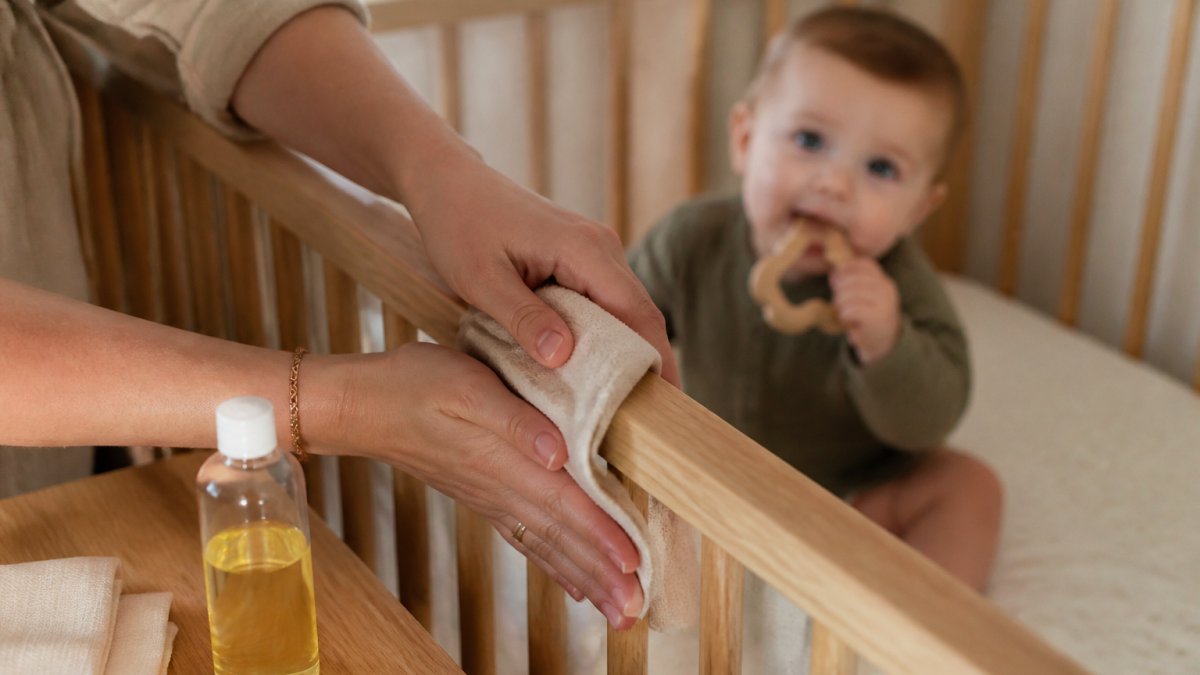
Untreated wood needs occasional care: dust it with a soft, dry cloth, wipe spills promptly, and re-oil with a food-safe or child-safe wood oil once or twice a year. Avoid soaking it, and keep it out of direct sunlight to limit drying and cracking.
A simple maintenance routine keeps bare timber looking good for years:
- Dust weekly with a dry microfibre cloth
- Wipe spills immediately with a barely damp cloth, then dry
- Check joints and fixings every few months and tighten as needed
- Re-oil lightly once or twice a year, buffing off the excess
- Keep the cot away from radiators and direct sun
Dealing with stains and marks on bare timber
This is the part most guides skip, and it is the question parents actually ask once the cot is in the nursery. The right response depends on what caused the mark.
- Water rings: a faint white ring from a damp cup or wipe usually lifts with a light rub of fine abrasive pad followed by a re-oil of that spot. Do not sand the whole rail for one ring.
- Teething marks: shallow bite marks can be smoothed with fine sandpaper along the grain, then re-oiled. Deep gouges are better left alone than sanded aggressively, because sanding a rail thin weakens it.
- Food or nappy-cream smears: wipe with a barely damp cloth and a little mild soap, dry immediately, and re-oil if the surface looks dry afterwards. Avoid harsh household cleaners, which strip natural oils and can leave a residue.
- Ink or crayon: a light rub with a cloth dampened with a small amount of oil often lifts it; test on an inconspicuous spot first.
Watch out: never soak a bare wood cot or leave it wet, because water drawn into the end grain is what causes swelling, raised fibres and, eventually, cracking. A barely damp cloth and immediate drying is always the safer approach.
Choosing an oil that is safe for a nursery
Look for wood oils described as suitable for children's furniture, and check the product label if allergies are a concern in your household. Apply thinly, let it absorb, and buff off the excess so the surface is not tacky. A little goes a long way: one thin coat once or twice a year is usually enough, and over-oiling can leave a gummy surface that attracts dust.
Checking the wood yourself before and after purchase
You can check the wood yourself before and after purchase. Smell it: bare timber should smell of timber, not chemicals. For a fuller method, our guide on how to test nursery furniture for toxins walks through the checks step by step.
A few more checks are worth adding. Look at the end grain on any exposed edge: solid timber shows continuous fibres running through the thickness, while a veneered board shows a thin top layer over a different core.
Choosing Your Untreated Wood Cot at The Nook and Nurture Company
Choosing an untreated wood cot comes down to matching the material to how you'll use it: solid, unfinished timber for the cot itself, with a certified finish only if you need a wipe-clean surface. Everything else, from density to grain, is detail you can weigh once the core decision is made.
We curate our nursery range with exactly this in mind, and every item comes with a 30-day risk-free trial and a full refund if it isn't right for your family. If you'd like to compare chemical-free options before you decide, our guide to chemical-free nursery furniture brands is a good next step, and you can browse the collection to see what suits your space.
Frequently Asked Questions
Is untreated wood safe for a baby crib?
Bare, unfinished timber carries no lacquer, varnish or synthetic finish that can release volatile organic compounds into the nursery, so there is less chemical exposure for a baby who chews on the rails. The wood still needs to be smooth and splinter-free. Check the grain for cracks, sand any rough edges and confirm the cot meets the current British safety standard before use.
What is the best wood for a baby cot?
Hardwoods such as beech, ash and maple are the usual picks because their density resists dents and teething marks better than softwoods. Pine and birch are lighter and cheaper but mark more easily. Whichever you choose, look for a tight, straight natural grain, screw joint stability at the corners and moisture resistance suited to a warm bedroom. Ask the seller about the timber's origin and how it has been stored.
Does untreated wood need to be sealed before use?
It does not have to be. Many parents leave bare timber as it is and simply wipe it with a damp cloth and re-oil occasionally. If you do seal it, choose a water-based, formaldehyde-free product labelled as child-safe and let it cure fully before the cot goes into the nursery. Avoid solvent-based lacquer and varnish, which off-gas for longer and add a synthetic layer a baby may chew.
Can untreated wood splinter or crack?
Yes, particularly softwoods and timber that has dried unevenly. Inspect the cot when it arrives and again every few months, running your hand along every rail and edge. Lightly sand any raised grain with fine paper, then wipe away the dust. Deep cracks or loose joints are a different matter: stop using the cot and contact the retailer, because a split rail can trap fingers or fail under weight.
The challenge is simple: most cots hide their materials behind a finish. We'd rather you could see and feel exactly what you're bringing into the nursery. That's why The Nook and Nurture Company stocks thoughtfully chosen pieces, backs them with guaranteed next-day shipping and 100% secure payments, and gives you a full refund if you're not satisfied. Get started with The Nook and Nurture Company and choose a cot you can feel confident about.


