

Table of Contents
- How We Evaluated the Best Baby Humidifiers for 2026
- Quick Comparison: Best Baby Humidifiers for Nursery Reviews 2026
- Cool Mist vs Warm Mist Humidifier for Baby: Which Is Safer?
- Nursery Humidity Levels for Baby: What to Aim For
- How to Clean a Baby Humidifier (and Prevent Mould)
- Water Quality and Mineral Buildup: What Parents Miss
- Noise Levels and Sleep Quality: What the Decibels Mean
- Conclusion
- Frequently Asked Questions
Last Updated: September 15, 2026
How We Evaluated the Best Baby Humidifiers for 2026
Choosing the best baby humidifiers for nursery reviews 2026 comes down to three tests: does it hold a safe relative humidity without soaking the carpet, does it stay quiet enough not to wake a light sleeper, and can you clean it properly? This guide from The Nook and Nurture Company covers the trade-offs most round-ups skip, from mineral dust to mould prevention.
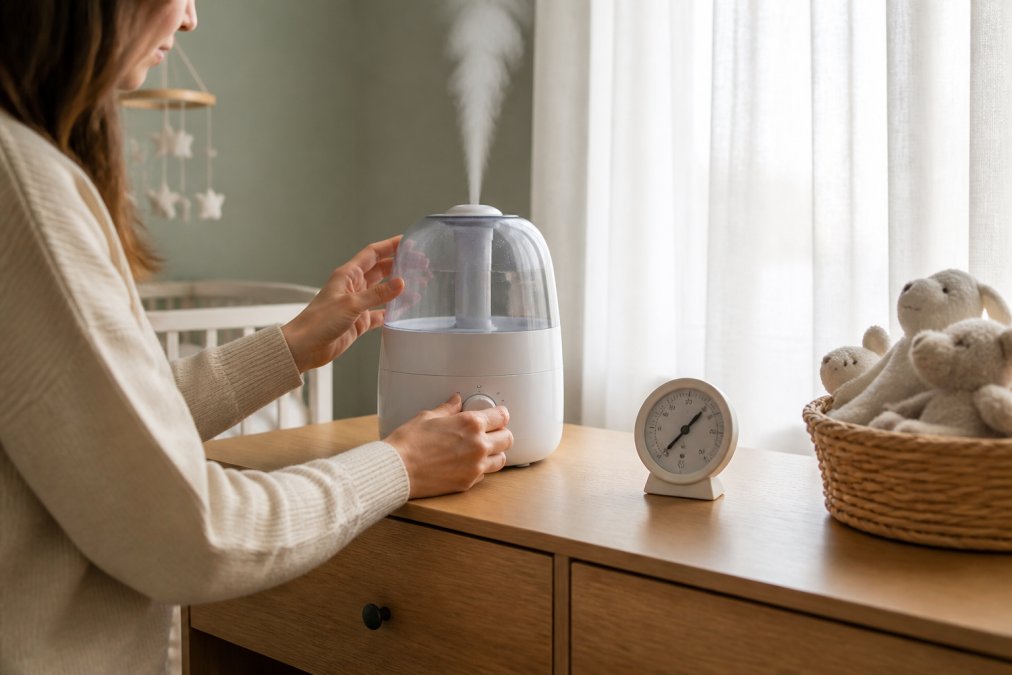
A common mistake is buying on tank size alone. A large tank in a small room means standing water sits for days, and that is where bacterial buildup starts. Coverage area, runtime and ease of cleaning matter more than litres.
Quick Comparison: Best Baby Humidifiers for Nursery Reviews 2026
Here is how the main options stack up before we dig into the detail.
| Type | Best For | Key Strength | Main Drawback |
|---|---|---|---|
| Cool mist (ultrasonic) | Most nurseries | Quiet operation, no burn risk | Needs distilled water |
| Warm mist | Congested babies in cold rooms | Slightly warmer output | Hot element, higher running cost |
| Evaporative | Hard-water areas | No white dust | Louder fan, needs a filter |
| Aroma diffuser | Small rooms, older toddlers | Doubles as a night light | Smaller tank capacity |
For most families, a cool mist ultrasonic unit with auto-shutoff and top-fill design is the sensible default: filterless, easy to rinse and quiet enough to sit a metre from the cot.

Cool Mist vs Warm Mist Humidifier for Baby: Which Is Safer?
Cool mist is generally the safer choice for a nursery because it has no heating element and no scald risk if a toddler reaches the unit. Warm mist humidifiers boil water to create steam, putting a hot surface in a child's room.
Why Cool Mist Is Usually Recommended for Nurseries
Cool mist works by vibrating water into a fine mist with an ultrasonic plate, or by blowing air through a wick. Neither heats the water, so the unit stays cool to the touch and uses less energy. The trade-off: ultrasonic models push minerals into the air as white dust if you use tap water in a hard-water area.
Warm mist has one genuine advantage: boiling kills many bacteria in the tank, and some parents find the warmer air soothing for congestion. If you go that route, place the unit well out of reach.
Nursery Humidity Levels for Baby: What to Aim For
Aim for around 40 to 60 per cent relative humidity in the nursery (A parents guide to the management of Atopic Eczema). Below that, dry air irritates little airways and worsens congestion; above it, condensation forms and mould growth becomes a real risk.
Use a hygrometer, not guesswork. A cheap digital one at cot height tells you more than any dial on the unit. Run the humidifier in bursts to hold the range rather than leaving it on all night.
How to Clean a Baby Humidifier (and Prevent Mould)
Clean a baby humidifier daily with a fresh-water rinse and descale weekly, because biofilm and mineral scale build up faster than most parents expect. Skip it and you are misting stale water into the air your baby breathes.
Daily and Weekly Cleaning Routine
- Empty the tank completely every morning, never top up over old water
- Rinse the tank and base with warm water and let them air-dry upside down
- Once a week, descale with a diluted white vinegar solution, then rinse thoroughly
- Wipe the ultrasonic plate gently with a soft cloth, never a scourer
- Check dishwasher-safe parts against the manufacturer's guidance before washing
Use distilled water in hard-water areas. It costs more per litre but stops mineral dust and slows scale, stretching time between deep cleans.
Water Quality and Mineral Buildup: What Parents Miss
Water quality is the most overlooked factor in humidifier choice, and it decides whether your unit is still pleasant to use in six months. Ultrasonic units aerosolise whatever is dissolved in the water, so hard tap water means fine mineral dust settling on furniture, cot sheets and surfaces your baby touches.
What hard water actually does inside a humidifier
Hard water carries dissolved calcium and magnesium (Water Hardness / Hard Water). In an ultrasonic unit, the vibrating plate throws those minerals into the air as fine white dust. The same minerals plate out as scale on the plate and base, reducing mist output and creating a rough surface where biofilm takes hold.
Evaporative units behave differently: the fan pulls air through a wicking filter that traps most minerals, so they produce little or no white dust, at the cost of a replaceable filter and an audible fan. Warm mist units boil the water, so minerals crust onto the heating element, making descaling even more important.
How to tell whether your water is a problem
You do not need a lab test to make a practical call.
Your practical options, ranked
| Approach | Effect on white dust | Ongoing cost and effort |
|---|---|---|
| Distilled or demineralised water | Eliminates it | Highest per-litre cost, heaviest to carry |
| Filtered water (jug or under-sink) | Reduces it, does not remove all minerals | Moderate cost, filter replacements |
| Evaporative unit with a wicking filter | Largely eliminates it | Filter replacements, louder fan |
| Tap water in an ultrasonic unit | Worst case | Cheapest water, most cleaning and dust |
The long-term consequences: scale, biofilm and mould
Matching water quality to your choice of unit
Noise Levels and Sleep Quality: What the Decibels Mean
Decibel reference points for a nursery
| Mode | Typical ultrasonic cool mist | Typical evaporative (fan-driven) |
|---|---|---|
| Sleep / low | Around 30-35 dB | Around 38-45 dB |
| Medium | Around 35-40 dB | Around 45-52 dB |
| High / boost | Around 40-48 dB | Around 50-58 dB |
Why the mechanism, not the brand, drives the noise
How to test a humidifier's real noise level at home
Placement, distance and the sleep-quality trade-off
Conclusion
Frequently Asked Questions
What is the best humidifier for a nursery?
A cool mist ultrasonic model with a top-fill tank, auto-shutoff, and a quiet motor under 30 decibels suits most nurseries. Look for a filterless design and dishwasher-safe parts to make cleaning easier. Tank capacity of 2 to 4 litres gives you roughly 12 to 24 hours of runtime, so you are not refilling overnight. A built-in hygrometer helps you keep the room at the right humidity rather than guessing.
Are cool mist humidifiers safer for babies than warm mist?
Cool mist is generally recommended for nurseries because there is no heating element, so there is no risk of burns if a curious toddler reaches the unit. Warm mist can feel soothing for congestion, but it uses a heating element and costs more to run. For a baby's room, cool mist is the safer default, especially once your child starts moving around. Both types need regular cleaning to prevent bacterial buildup.
How often should you clean a baby humidifier to prevent mould?
Empty and rinse the tank daily, then leave it to air dry. Do a deeper clean every three days using a diluted white vinegar solution to descale mineral deposits, and wipe all surfaces before refilling. Once a week, disinfect removable parts and check the base for standing water. Skipping this routine lets mould growth and bacterial buildup develop in as little as 48 hours, which then gets released into the air your baby breathes.
What humidity level should a nursery be kept at?
Aim for 40% to 60% relative humidity. Below 40%, dry air can irritate a baby's airways and worsen congestion. Above 60%, condensation forms on windows and surfaces, which encourages mould growth and dust mites. A cheap hygrometer placed across the room from the humidifier gives you an accurate reading. Run the unit in bursts to hold that range rather than leaving it on constantly.
Before you buy, weigh the three factors that actually change outcomes: a cool mist design with auto-shutoff, a hygrometer to hold relative humidity between 40 and 60 per cent, and a cleaning routine you will genuinely keep up with. Get those right and the brand on the box matters far less.


