

Table of Contents
- How to Choose the Best Baby Safety Gates for Stairs
- Pressure Fit vs Screw Fit Stair Gates: Which Is Right for You?
- Stair Gate Safety Standards BS EN 1930:2011 Explained
- Key Features to Look for in Baby Safety Gates
- Pet Gates vs Baby Gates for Stairs: What's the Difference?
- Troubleshooting Awkward Staircase Configurations
- Babyproofing Stairs Checklist: Beyond the Gate
- Conclusion
Last Updated: August 15, 2026
Choosing the best baby safety gates for stairs feels straightforward until you're measuring openings, wondering whether you need screws, and questioning whether that stylish wooden gate will hold up to a determined toddler. At The Nook and Nurture Company, we've put together this guide to help you make a confident, safe choice.
Staircase falls are among the most common causes of serious injury in young children. The right gate, correctly installed, is the single most effective preventive measure you can take. Below, we cover gate types, installation methods, safety standards, key features, and the tricky configurations most guides skip entirely.
Quick Picks:
- Best for top of stairs: Hardware-mounted swing gate with auto-close and double-locking mechanism
- Best for bottom of stairs: Pressure-fit gate with wide threshold opening and one-handed operation
- Best for awkward openings: Adjustable pressure-fit with multi-extension kit for non-standard widths
- Best for aesthetics: Wooden or Scandi-style gate with neutral finish
How to Choose the Best Baby Safety Gates for Stairs
Selecting baby safety gates starts with understanding where the gate goes and what your stairway demands. Not all gates are interchangeable, and the wrong choice at the top of the stairs can be dangerous.
Top of Stairs vs Bottom of Stairs: Different Requirements
The top of the stairs demands a hardware-mounted gate without exception. A gate at the top must withstand a child's full body weight if they push or fall against it, which means it must be fixed directly into wall studs or a solid banister post using installation hardware. Pressure-fit gates are not safe at the top of stairs because they rely on tension against wall surfaces, which can give way under sudden impact.
At the bottom of the stairs, a pressure-fit gate is generally acceptable since the risk is lower. The gate must open away from the stairs, never towards them, to avoid creating a trip hazard.
Measuring Your Stairway Width
Measure the opening at its narrowest point, accounting for skirting boards or architrave. Most standard gates fit openings between 75 cm and 82 cm. For wider openings, you'll need an extension kit, typically available in 7 cm, 9 cm, and 14 cm increments.
Measure at three heights (floor, mid-point, top of gate height) to catch wall irregularities. Note whether your walls are plasterboard, brick, or timber stud, as this affects fixings. For banister installations, check whether your post is round or square, as some kits require specific adaptor brackets. Most gates accommodate openings up to around 100 cm with extensions.
Pressure Fit vs Screw Fit Stair Gates: Which Is Right for You?
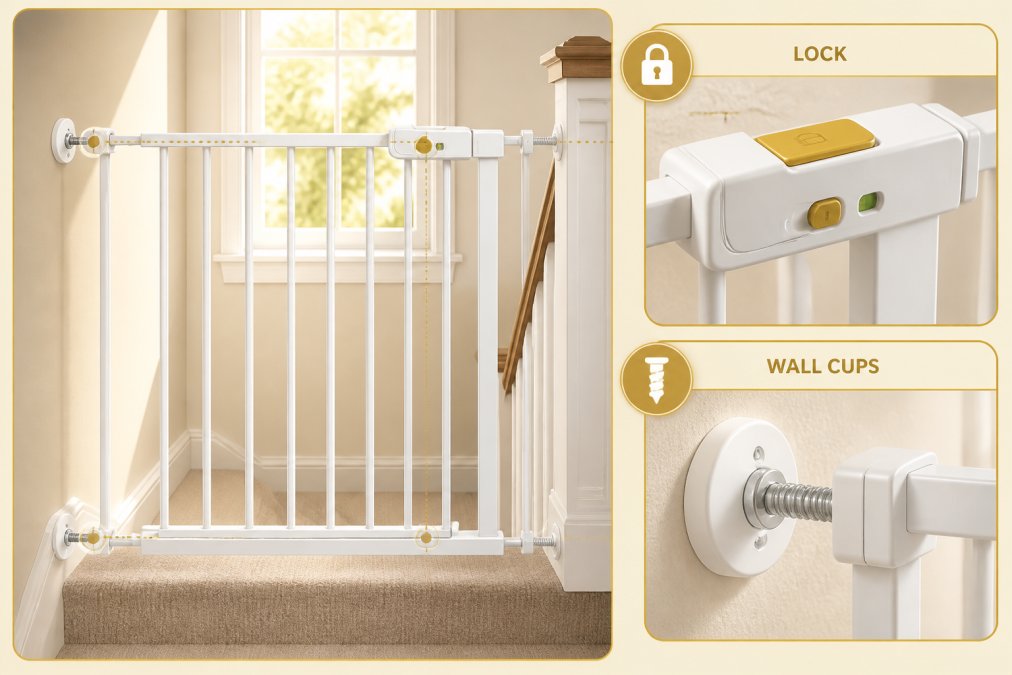
A pressure-fit gate uses a threaded tension system to wedge itself between two surfaces. No drilling required. Setup takes minutes, and the gate is fully removable without leaving marks. This makes it ideal for bottom-of-stair use, doorways, and room dividers where portability matters.
A hardware-mounted gate uses wall cups and installation hardware bolted into the wall or banister. It is fixed, permanent, and significantly more resistant to impact. This is the only acceptable choice for the top of any staircase.
When a Pressure-Fit Gate Is Enough
Pressure-fit gates work well at the bottom of stairs, in doorways between rooms, and as temporary barriers in rented accommodation. Look for models with a wide threshold bar that sits low to the ground to reduce trip hazards.
When You Must Use a Hardware-Mounted Gate
Any gate at the top of a staircase must be hardware-mounted. The Royal Society for the Prevention of Accidents guidance on home safety is clear that pressure-fit gates should never be used at the top of stairs because they cannot withstand the force of a falling child. Hardware-mounted gates are also better for wide openings where extensions are needed, since pressure-fit systems can lose tension over time with additional use.
Stair Gate Safety Standards BS EN 1930:2011 Explained
BS EN 1930:2011 is the British and European safety standard governing child safety barriers, including stair gates. It covers structural integrity, locking mechanism reliability, impact resistance, and the absence of entrapment hazards. Gates carrying the BS EN 1930:2011 mark have been independently tested against these criteria.
When buying, look for this certification explicitly on the packaging or product listing. A gate without clear safety certification is a gate to avoid, regardless of price or appearance. Correct installation is equally important, a certified gate installed incorrectly offers far less protection than the standard implies.
Key Features to Look for in Baby Safety Gates
Once you have established the gate type and confirmed safety certification, these features separate a genuinely useful gate from one that will frustrate you daily.
One-Handed Operation and Auto-Close Mechanisms
One-handed operation is a practical necessity when you are carrying a baby, laundry, or a cup of coffee. The best gates use a child-resistant latch that an adult can release with a single hand using a lift-and-push or squeeze-and-lift motion, while remaining tamper-proof for a toddler.
Auto-close is equally important at the top of the stairs. A gate that swings shut and latches automatically removes the risk of forgetting to close it. Look for a double-locking system that requires two distinct actions to open.
Materials, Durability, and Long-Term Maintenance
Most gates are made from steel, aluminium, or wood, each with different maintenance considerations.
| Material | Durability | Maintenance | Best For |
|---|---|---|---|
| Steel | High impact resistance | Wipe clean; check for rust at joints | High-traffic top-of-stair use |
| Aluminium | Lightweight, corrosion-resistant | Minimal; wipe with damp cloth | Doorways and bottom of stairs |
| Wood | Aesthetically warm | Polish periodically; check for splinters | Lounge and open-plan areas |
| Mesh/fabric | Flexible for wide spans | Machine washable (some models) | Retractable or wide openings |
Vertical bars are preferable to horizontal ones, which create a climbing frame for toddlers. Check the locking mechanism after six months of use, as the latch spring and pressure-fit tension can degrade over time.
Aesthetic Integration: Gates That Suit Your Home
A gate that clashes with your home is one you will be tempted to leave open. Wooden gates in oak, pine, or painted white finishes integrate naturally into period and contemporary interiors. Scandi-style gates with clean lines work well in open-plan spaces. Black powder-coated steel gates suit industrial or modern design schemes.
The Nook and Nurture Company curates gates chosen for both safety performance and suitability for real family homes, because a gate you actually want to use is a gate that keeps your child safer.
Pet Gates vs Baby Gates for Stairs: What's the Difference?
Pet gates and baby gates look similar, but they are not the same product, and using a pet gate as a stair gate is not a safe substitution.
Baby safety gates must comply with BS EN 1930:2011, which includes specific impact resistance testing and entrapment hazard requirements designed for children. Pet gates are typically tested to different standards focused on containing animals and may have larger bar spacing or weaker latches.
Always check that any gate used on a staircase carries explicit BS EN 1930:2011 certification and is specified by the manufacturer for stair use.
Troubleshooting Awkward Staircase Configurations
Standard gates assume a straight, parallel-walled opening with flat mounting surfaces. Many staircases do not cooperate.
Angled or sloped openings: Look for gates with adjustable wall cups that can be angled, or consider a retractable mesh barrier, which handles non-standard openings more flexibly.
Banister-to-wall installations: When one side of your opening is a banister post rather than a solid wall, you need a banister installation kit with adaptor brackets. Round posts require different adaptors than square ones.
Wide openings above 100 cm: Retractable mesh gates are often the best solution, spanning up to 140 cm or more while rolling back when not in use.
Open-plan staircases with no side wall: This configuration requires a gate with banister adaptors on both sides. If either banister post flexes significantly, the gate will not hold its tension reliably.
According to the Child Accident Prevention Trust's home safety guidance, awkward staircase configurations are one of the most common reasons parents delay fitting a gate. Do not let configuration complexity become a reason to leave the stairs unprotected.
Babyproofing Stairs Checklist: Beyond the Gate
A certified gate correctly installed is the foundation of stair safety. These additional measures complete the picture.
- Fit a gate at the top of the stairs (hardware-mounted, BS EN 1930:2011 certified)
- Fit a gate at the bottom of the stairs if your toddler is a climber or you have an open staircase
- Check stair banister spindle spacing: gaps should be no more than 10 cm to prevent head entrapment
- Ensure carpet or non-slip treads are fitted on all stair surfaces to reduce slip risk
- Remove any objects stored on stairs that could cause a trip
- Check that stair lighting is adequate, including a night light for late-night trips
- Secure any loose handrail fixings before relying on them for support
- Teach your toddler stair safety as early as developmentally appropriate
- Re-check gate latch and pressure-fit tension every three to six months
- Replace any gate showing signs of structural wear, cracked fixings, or a latch that no longer auto-closes reliably
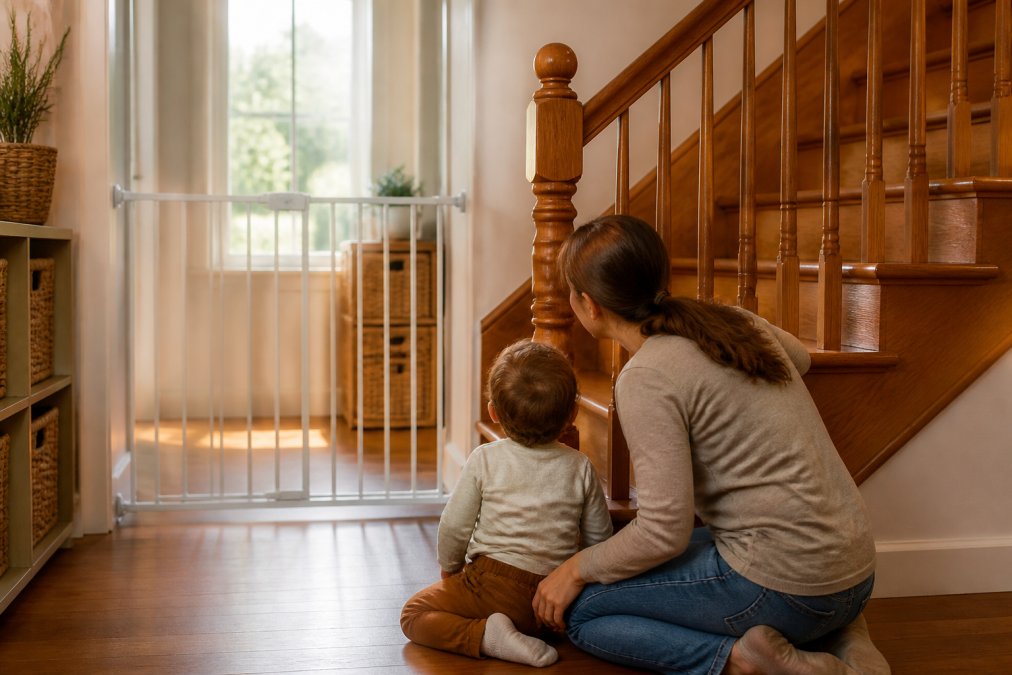
The NHS guidance on keeping babies and toddlers safe at home recommends a full home safety assessment at the point your child starts pulling to stand, which is typically when stair hazards become most acute.
| Staircase Area | Priority Action | Check Frequency |
|---|---|---|
| Top of stairs | Hardware-mounted gate, certified | Every 3 months |
| Bottom of stairs | Pressure-fit or hardware gate | Every 6 months |
| Stair treads | Non-slip carpet or grip strips | Annually |
| Banister spindles | Gap check (max 10 cm) | Once, on move-in |
| Stair lighting | Night light or motion sensor | Every 6 months |
| Gate latch | Auto-close and locking test | Every 3 months |
Staircase falls remain one of the most preventable home hazards for young children, and the right gate, fitted correctly to the right standard, makes an immediate, measurable difference. The Nook and Nurture Company offers a curated selection of baby safety gates chosen for both their certified safety performance and their suitability for real family homes, backed by next-day delivery and a 30-day risk-free trial. If a gate does not fit your staircase or your home, return it with no fuss. Browse the range and find the gate that works for your stairway configuration today.
Frequently Asked Questions
What type of baby gate is most suitable for the top of stairs?
A hardware-mounted (screw-fit) gate is the only safe choice at the top of stairs. Unlike pressure-fit gates, which can be pushed out of position under impact, a wall-mounted gate is bolted directly into the wall or banister posts. This makes it far more resistant to a child's weight or a sudden fall. Look for a gate that carries the BS EN 1930:2011 certification and opens away from the staircase, so it swings into the landing rather than over the steps.
Is there a baby gate that doesn't require drilling for stairs?
Pressure-fit gates require no drilling and use tension against the surrounding walls or door frame to stay in place. They are suitable at the bottom of stairs or in doorways, but building safety guidance strongly advises against using them at the top of a staircase. If drilling into walls is not possible, for example in a rented property, banister-to-banister installation kits allow a hardware-mounted gate to be fitted without touching the walls, using clamps that grip the newel posts instead.
At what age should you stop using stair gates?
Most child safety guidance suggests stair gates can be removed once a child is around two years old and can reliably climb and descend stairs safely with supervision. Every child develops at a different pace, so the decision should be based on your child's ability rather than a fixed age. Some families keep gates in place until age three, particularly in households with very steep staircases or where a younger sibling is also present. Remove the gate only when you are confident your child understands stair safety.
Do stair gates need to meet a specific safety standard?
Yes. In the UK, stair gates should conform to BS EN 1930:2011, the British and European standard for child safety barriers. This standard sets requirements for gate height (minimum 60 cm), bar spacing (no gap wider than 85 mm to prevent head entrapment), locking mechanism reliability, and impact resistance. Always check the product packaging or listing for explicit mention of BS EN 1930:2011 compliance before purchasing. Gates sold without this certification have not been independently tested to the same safety benchmarks.
Can I use a pet gate as a baby gate for stairs?
Pet gates and baby safety gates look similar but are built to different standards. Baby gates for stairs must meet BS EN 1930:2011, which covers impact resistance, locking mechanisms, and bar spacing designed to protect small children. Pet gates are not required to meet this standard and may have wider bar gaps, simpler latches, or lower height thresholds. Using a pet gate at a staircase in place of a certified baby safety gate is not recommended, as it may not withstand the forces or meet the child-resistant latch requirements the standard specifies.
This article was written using GrandRanker


