

Table of Contents
- Why Wooden Toys Are the Best Choice for Fine Motor Skills
- Quick Comparison: Best Wooden Toys for Fine Motor Skills
- Fine Motor Toys by Age: What to Buy and When
- Top Wooden Toys for Toddlers: Our 7 Picks Reviewed
- Fine Motor Activities for Toddlers: Play Prompts and Progression
- Toys for Hand-Eye Coordination: What to Look For
- Safety, Materials, and What to Check Before You Buy
- Frequently Asked Questions
Last Updated: October 8, 2026
Why Wooden Toys Are the Best Choice for Fine Motor Skills
The best wooden toys for fine motor skills start with what your child's hands need to practise: grasping, releasing, twisting, and placing.
At The Nook and Nurture Company, we choose pieces chunky enough to grip, smooth enough to be safe, and open-ended enough to be used a hundred ways.
Fine motor skills are the small, precise movements of the hands and fingers, controlled by the coordination between the brain, muscles, and eyes. They cover everything from a six-month-old's first grab to a three-year-old threading a lace.
What Fine Motor Skills Actually Are (and Why They Matter)
Fine motor development is the gradual build-up of hand strength, dexterity, and hand-eye coordination. It happens through repetition, not instruction.
The muscles used to grip a stacking ring are the same ones they will later use to hold a spoon, grip a pencil, and do up buttons, which is why the early years matter so much.
How Wooden Toys Build Hand Strength and Dexterity
Wooden toys build hand strength through weight and resistance: a block must be lifted, balanced, and placed with care, and a ring needs a firm grip to slide onto a post.
That effort is the point. Smooth edges and chunky pieces mean the challenge comes from coordination, not sharp corners or fiddly parts. Look for sustainably sourced wood and non-toxic paint.
Quick Comparison: Best Wooden Toys for Fine Motor Skills
The table below summarises our seven picks by price, age suitability, and the main skill each one develops.
| Toy | Price | Best Age | Main Skill |
|---|---|---|---|
| Chunky Wooden Toy Car | £3.99 | 6 months+ | Grasping and pushing |
| Baby's Colourful Stacking Rings | £9.99 | 6 months+ | Stacking and sequencing |
| Stacker Blocks Play Set | £8.99 | 6 months+ | Stacking and sorting |
| Speedy Monkey Snail Game | £15.99 | 18 months+ | Threading and counting |
| Six-Sided Activity Cube | £30.99 | 12 months+ | Shape sorting and dexterity |
| AIYAPLAY Coffee Machine Toy | £24.28 | 3 years+ | Role play and pincer grip |
| AIYAPLAY 79-Piece Train Set | £61.53 | 3 years+ | Crane control and planning |
Fine Motor Toys by Age: What to Buy and When
Age labels tell you when a toy is safe, not when your child is ready. Readiness is about what the hands can already do, so the bands below pair each stage with its hand skills and readiness cues.

A useful rule: buy for the skill your child is just attempting. A toy that is too hard gets abandoned within a minute; one that is too easy gets ignored.
6 to 12 Months: Grasping, Reaching, and Mouthing
Skills in play: whole-hand grasp (palmar grasp), reaching toward a target, releasing an object voluntarily, and transferring it from one hand to the other.
Readiness cues: sits unsupported or with light propping; brings objects to mouth deliberately; holds an object for several seconds without dropping it.
At this stage the mouth is a sensory tool, so everything is chewed. Choose chunky, single-piece toys with no detachable parts.
12 to 18 Months: Stacking, Posting, and Pincer Grasp
Skills in play: pincer grasp (thumb and forefinger working together), deliberate release into a target, and early bilateral coordination, one hand steadying while the other acts.
Readiness cues: picks up small items between thumb and finger rather than raking them; drops a shape into a hole rather than just banging it; can hold a toy in one hand and manipulate it with the other.
The pincer grasp is the headline skill here, and posting and stacking toys give it the most repetitions. The Baby's Colourful Stacking Rings (£9.99) teach size order through trial and error; the Stacker Blocks Play Set (£8.99) adds colour and number sorting.

18 Months to 3 Years: Threading, Sorting, and Pretend Play
Skills in play: refined pincer control, wrist rotation, bilateral coordination under load, and the beginnings of hand dominance.
Readiness cues: threads a large bead onto a stiff lace with help; sorts objects by one attribute (colour or size, not both at once); twists a knob or lid rather than just pushing it.
Threading and sorting become the main event. The Speedy Monkey Snail Educational Game (£15.99) uses a spiral base with nine rings, demanding more alignment control than a straight post.
3 Years and Over: Precision, Planning, and Construction
Skills in play: sustained grip strength, controlled tool use, and sequencing multiple steps to reach a goal.
Readiness cues: follows two- or three-step instructions; builds a structure and then plays with it; can operate a lever, crank, or clip without help.
The AIYAPLAY 79-Piece Wooden Train Set (£61.53) sits here.
Top Wooden Toys for Toddlers: Our 7 Picks Reviewed
Our seven picks cover every stage from first grab to three-year-old engineering projects, ordered roughly by age rather than price.
1. Chunky Wooden Toy Car (£3.99)
The best first wooden toy for a baby who has just learned to grab. It rolls, it is solid, and it survives being chewed and dropped.
What works: rounded edges, responsibly sourced wood, and a size that fits a small palm. Where it falls short: it does one thing. Some babies want more variety by ten months.
2. Baby's Colourful Stacking Rings (£9.99)
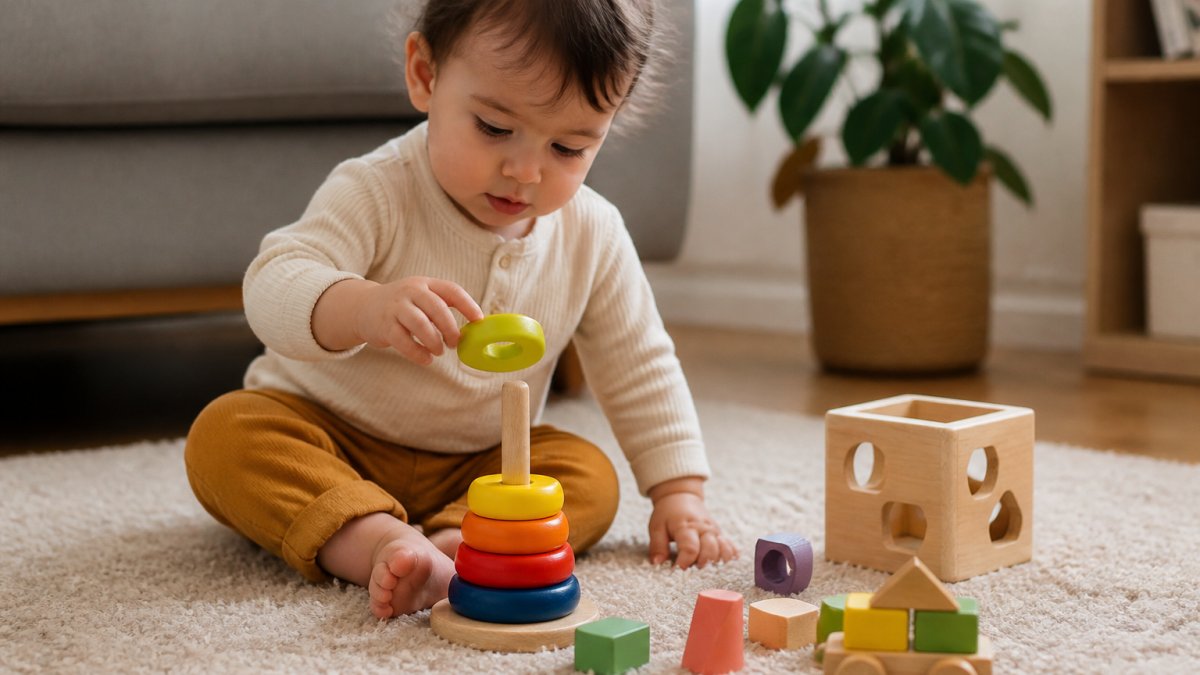
A classic for a reason: five rings, one wobbly base, and a lesson in size order children work out themselves. The wobbly base is the clever part, if the rings go on in the wrong order the tower tips, and your child tries again, building persistence alongside coordination.
3. Stacker Blocks Play Set (£8.99)
Ten numbered blocks that stack, nest, and sort, made from sturdy, BPA-free plastic with no sharp edges. They grow with your child: grabbing at six months, stacking two or three at twelve months, and sorting by colour at eighteen months.
4. Speedy Monkey Snail Educational Game (£15.99)
Nine rings on a spiral snail base. The spiral means each ring must be lined up just right, a genuine step up from a straight post. Made from FSC-certified wood with non-toxic paints, suitable from 18 months.
5. Six-Sided Activity Cube (£30.99)
Six sides, eight activities, one cube: a shape sorter, bead maze, spinning gears, car maze, clock face, flip butterfly, number tray, and graphic bead path. At 17 x 17 x 17cm it sits neatly on a shelf, the pick for families who want one toy that does the work of several.
6. AIYAPLAY Wooden Coffee Machine Toy (£24.28)
Eleven wooden pieces, pressable buttons, and a turning knob, role play with a fine motor purpose. The knob is the standout: turning it requires a firm grip and a twist, exactly the motion children need for later self-care skills. Recommended for ages 3 and over.
7. AIYAPLAY 79-Piece Wooden Train Set (£61.53)
Seventy-nine pieces, a four-level mine structure, and a manual crane and lift. The crane is the fine motor centrepiece: operating it takes control and patience.
Assembly takes about an hour. It is compatible with most major wooden train brands, so it can grow with an existing set.
Fine Motor Activities for Toddlers: Play Prompts and Progression
Fine motor activities for toddlers work best when you follow your child's lead and add one small challenge at a time. Here are prompts we suggest, grouped by what they build.
- Grasping: "Can you pass me the blue block?" Hand it back and repeat.
- Stacking: Build a tower together, then let your child knock it down and rebuild it.
- Threading: Slide rings onto a post in size order, biggest first.
Toys for Hand-Eye Coordination: What to Look For
Toys for hand-eye coordination share three features: a clear target, a piece that must be aimed, and a visible result. Posting a shape, sliding a ring, and driving a car along a track all qualify. The Six-Sided Activity Cube is the strongest single option, since its shape sorter and bead maze both demand aim and control; the Chunky Wooden Toy Car is the simplest, teaching tracking and reaching together.
Safety, Materials, and What to Check Before You Buy
Safety for wooden toys comes down to three things: age grading, materials, and supervision. The checklist below organises them by age band and toy type so you can run through it in the shop.
Age-by-Age Hazard Checklist
- Under 3 years: treat any part that fits inside a 35mm film canister as a choking risk. Avoid detachable pieces, small beads, and loose fixings. Check every joint by giving it a firm tug.
- 3 to 6 years: small parts are now less of a choking concern, but watch for long cords, laces, and strings, anything over roughly 220mm can pose a strangulation risk. Supervise threading and lacing play.
- All ages: check for splinters, rough edges, and any piece that has worked loose. Wooden toys can crack along the grain if dropped on a hard floor.
Materials and Finish Checks
- Paint and finish: look for water-based, child-safe paint and a non-toxic finish. Avoid anything with a strong solvent smell or a tacky surface.
- Wood sourcing: FSC-certified wood indicates responsibly sourced timber. If a brand cannot tell you where its wood comes from, treat that as a gap.
- Edges and surfaces: run a finger along every edge. It should feel smooth, with no raised grain or flaking coating.
Supervision by Toy Type
- Stacking and posting toys: low supervision once pieces are confirmed too large to swallow.
- Threading and lacing games: supervise closely, cords and laces are the main risk here.
- Activity cubes and busy boards: check hinges, doors, and moving parts for pinch points.
Standards to Look For
Toys sold in the UK must meet the Toy Safety Regulations and EN 71 standard, which covers mechanical safety and chemical limits. The CE or UKCA mark on the packaging indicates the toy has been assessed against these requirements.
A Quick Pre-Purchase Routine
Before you buy, do four things: confirm the age grading matches your child's stage, check the finish and edges by hand, tug every fixing, and confirm the wood sourcing claim. If a listing omits the age range or finish, ask.
Frequently Asked Questions
What are the best wooden toys for developing fine motor skills?
Stacking rings, shape sorters, lacing beads, and activity cubes are among the best wooden toys for fine motor skills. They target grasping, pincer grip, and hand-eye coordination through repetitive, hands-on play. The Baby's Colourful Stacking Rings (£9.99) and the Six-Sided Activity Cube (£30.99) both offer multiple skill-building activities in one toy. Look for chunky pieces, smooth edges, and non-toxic finishes suitable for your child's age.
Which wooden toys help toddlers develop fine motor skills?
For toddlers, stacking blocks, threading games, and pretend play sets work well. The Stacker Blocks Play Set (£8.99) builds grasping and balancing skills, while the AIYAPLAY Wooden Coffee Machine Toy (£24.28) develops dexterity through pressing buttons and turning knobs. The Speedy Monkey Snail Educational Game (£15.99) combines stacking, sorting, and counting for children from 18 months.
What fine motor skills should a toddler be developing?
Between 12 and 36 months, toddlers typically develop a pincer grasp (thumb and forefinger), the ability to stack two or more objects, hand-eye coordination for posting shapes into holes, and bilateral coordination (using both hands together). They also build hand strength for holding crayons and spoons. Wooden toys like stacking rings and shape sorters give them repeated practice with these exact movements.
How do stacking toys help fine motor development?
Stacking toys require children to grip individual pieces, line them up with a post or base, and release them carefully, which strengthens the small muscles in their hands and fingers. The wobbly base on stacking rings adds a problem-solving element: children must figure out size order through trial and error. This builds persistence alongside physical coordination.
How can I choose a safe wooden toy for a young child?
Check that the toy carries the EN71 safety standard, which covers mechanical and physical properties, flammability, and migration of certain elements. Look for smooth, rounded edges, non-toxic paint, and chunky pieces that cannot be swallowed. For children under 36 months, avoid small detachable parts. FSC-certified wood indicates responsibly sourced materials. Supervised play is recommended for all toys regardless of age rating.


