

Table of Contents
- Why Storage Systems Matter for Family Life
- How to Organise Toddler Toy Clutter: A Practical Framework
- Vertical Storage and Wall-Mounted Solutions
- Multi-Functional Furniture with Built-In Storage
- Family Entryway Organisation Hacks
- Minimalist Nursery Organisation Tips
- Labelling Systems and Containerisation
- Budget-Friendly DIY vs Professional Installation
Last Updated: August 29, 2026
Why Storage Systems Matter for Family Life
The difference between a chaotic family home and a manageable one often comes down to whether things have a place to live. When toys, clothes, and endless family accumulation scatter across every surface, the mental load skyrockets. You're constantly searching for things, stepping on Lego at 6am, and asking where that puzzle piece went.
Essential storage solutions for busy families aren't a luxury, they're a necessity. The right system gives everyone a framework for where things belong. Children learn organisation by doing it (peer-reviewed research). Parents reclaim mental space. The home becomes a space you can breathe in, rather than constantly battle against.
At The Nook and Nurture Company, we are dedicated to helping you nurture every corner of your home with products that combine quality, functionality, and care. The storage that sticks isn't what looks pretty in magazines. It's storage that fits your life, space, and family's actual habits. It's accessible enough that a three-year-old can put things back (the NIH). It's durable enough to survive being climbed on and dragged across the room.
The sections below cover practical frameworks for building storage that actually works, from toy organisation to entryway systems to labelling approaches that even pre-readers can understand.
How to Organise Toddler Toy Clutter: A Practical Framework
Toddler toy clutter is a specific problem. It's not just volume, it's that toddlers don't naturally organise. Without a system that makes organisation simple and intuitive, clutter spreads.
The key is breaking the mess into categories that make sense to a small child, then giving each category a visible, accessible home. Not one massive toy box where everything gets lost, but a framework that matches how toddlers actually think.
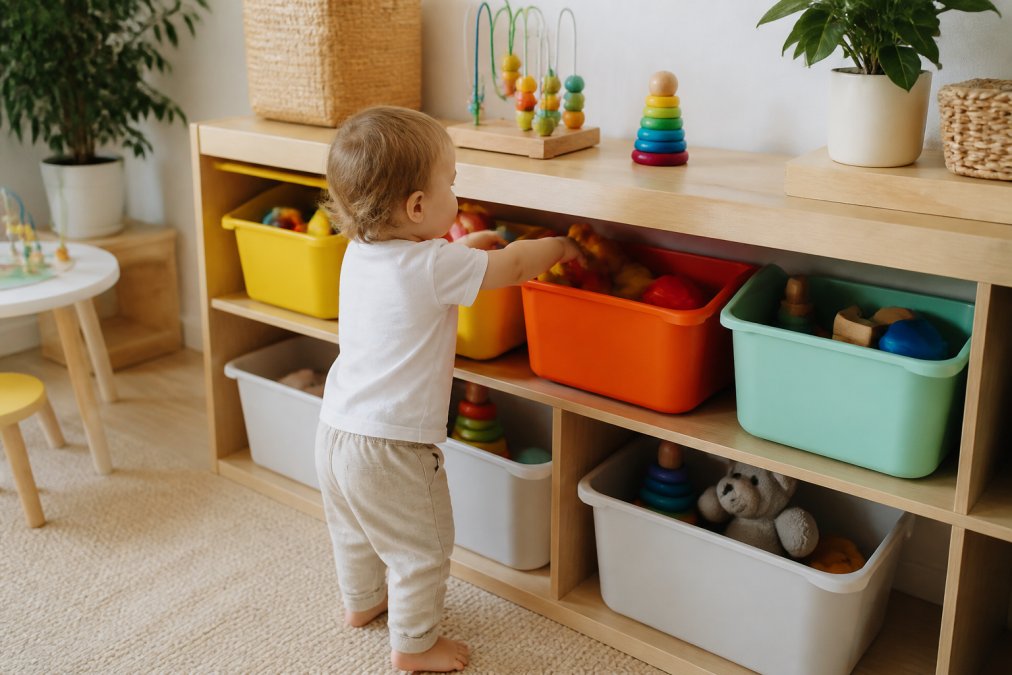
Categorise Before You Store
Before buying storage, sort what you actually have. Pull everything out, then sort into piles: building toys, dolls and soft toys, books, vehicles, dress-up clothes, puzzles, art supplies, and miscellaneous.
Be honest about what your child actually plays with. The toys that don't make the cut can go. A smaller collection of toys your child genuinely uses is infinitely better than a mountain of stuff they ignore. Now you know what categories you're storing and roughly how much of each, your storage blueprint.
Choose the Right Container for Each Category
Not every category needs the same storage. Small items like puzzle pieces need divided containers. Bulky items like soft toys need deeper, open storage. Books should be spine-out so children can see and choose them.
The Explorers Storage Units with 6 Boxes offer three different bin sizes, small for little bits, medium for books and blocks, large for bulky stuff. Seagrass baskets like the Natural Seagrass Storage Basket Set work for items you want visible and accessible. Match the container to the contents and how your child will access them.

Vertical Storage and Wall-Mounted Solutions
Floor space in a family home is precious. Wall hooks, floating shelves, and wall-mounted units transform unused wall space into functional storage without eating the room.
Wall hooks work for coats, bags, and lightweight items at child height, teaching independence. Floating shelves hold books or display favourite toys. Wall-mounted units like the ZONEKIZ 9-Basket Storage Unit take up minimal floor space while providing serious capacity. If it can go up, it should go up, this frees the floor for play and movement.

Multi-Functional Furniture with Built-In Storage
The best storage solutions do more than one job. A storage bench in the entryway holds shoes and coats while providing a place to sit. A toy box with a sturdy lid becomes a seat for story time.
The Kids Pink Heart Design Storage Box And Seat is a deep toy box that swallows clutter, but when the lid closes, it becomes a sturdy little seat. That dual function means it earns its place by doing more than just storing.
Family Entryway Organisation Hacks
The entryway is where family chaos collides with the outside world. Without a system, it becomes a bottleneck where clutter accumulates faster than anywhere else.
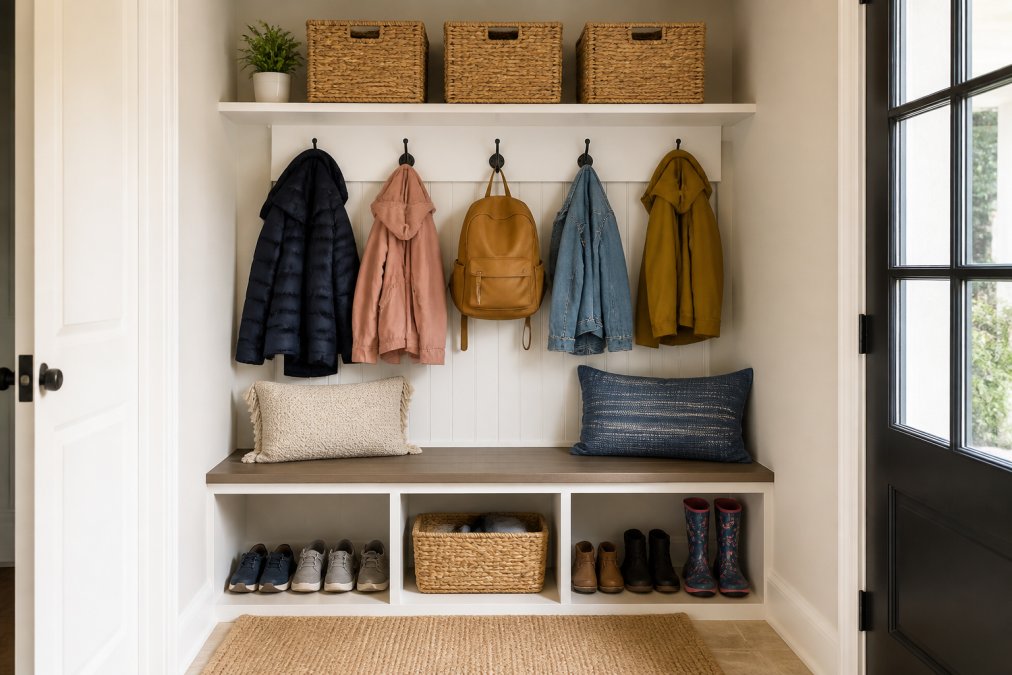
Create dedicated zones: one for coats and jackets with hooks at child and adult height, one for shoes in a rack or low basket, one for bags and school stuff on a shelf, and one basket for "things that need to go upstairs." Each family member knows exactly where to put their stuff. Wall hooks work better than expected, they're cheap, accessible to children, and create a visual system that doesn't require reading.
Minimalist Nursery Organisation Tips
A minimalist nursery isn't about having nothing, it's about having only what you actually use, organised so you can find it without chaos.
Decluttering Before You Organise
Start with brutal honesty about what you need. Newborns don't need twelve sleeping bags or twenty-five vests (the CDC). They need enough clean clothes to rotate through washing days, plus a few extras.
Keep nappies, wipes, and creams accessible in one place. The Nappy Caddy Organiser does this well. For clothes, keep only what fits the current season and size. For toys, newborns need just a few high-contrast cards, a rattle or two, a soft toy. Add deliberately, not passively.
Creating Dedicated Zones
A minimalist nursery has zones: a sleeping zone with the cot, a changing zone with the nappy caddy, a dressing zone with the wardrobe, a play zone with select toys. Each zone has a specific purpose, and items stay within their zone.
The Isla 4-Coloured Box Storage Unit works well because colour-coding creates instant zones. Each colour is a zone, and the system is intuitive enough that even a two-year-old can understand it.
Labelling Systems and Containerisation
Labelling transforms storage from "guess where it goes" to "I know exactly where it goes." Colour-coding is most intuitive for young children. The Isla 4-Coloured Box Storage Unit uses this approach, each colour represents a category. Children learn to sort by colour before they read.
Icon labels work next, a picture of blocks on the blocks bin. Text labels come last, once children can read. The Storage Unit with 6 Water Hyacinth Drawers works with all three approaches. Containerisation breaks large amounts of stuff into smaller, categorised containers, making tidying manageable. Instead of "tidy the playroom," the task becomes "put the blocks in the green basket."

| Storage Type | Best For | Accessibility | Cost |
|---|---|---|---|
| Wall hooks | Coats, bags, lightweight items | High (child-accessible) | Low |
| Colour-coded bins | Toys, mixed items | High (visual system) | Medium |
| Baskets with handles | Portable storage, soft items | Medium (requires lifting) | Medium |
| Seagrass storage | Display and storage combined | High (looks good left out) | Medium |
| Multi-functional furniture | Space-saving, dual purpose | Medium (depends on design) | High |
Budget-Friendly DIY vs Professional Installation
Storage doesn't have to be expensive. Wall hooks cost a few pounds and transform an entryway. Cardboard boxes wrapped in fabric become storage bins. Clear plastic containers create visible categorisation.
DIY approaches offer flexibility and gradual investment, but durability can be a concern. Cardboard can break, and cheap plastic may crack.
For more robust solutions, consider dedicated storage units. The Explorers Storage Units with 6 Boxes at £49.99 offers solid construction. The Storage Unit with 6 Water Hyacinth Drawers at £149.95 is a larger investment but designed for daily use.
Essential storage solutions for busy families aren't about perfection. They're about creating a framework where your home can function without constant chaos. The right system means children can put things back independently, you're not spending mental energy remembering where everything is, and the floor stays clear enough to move through a room.
The Nook and Nurture Company's range of storage solutions, from the practical ZONEKIZ 9-Basket Storage Unit to the multi-functional Pink Heart Storage Box And Seat, is designed with this reality in mind. Every piece handles family life as it actually happens. Start with one system that addresses your biggest clutter problem, establish the habit, then expand as your family's needs evolve. That's how storage becomes something that works for you, not against you.
Frequently Asked Questions
Q: What are the best storage solutions for busy families on a budget?
A: Start with affordable basics: storage baskets (from £13.95 for seagrass sets), multi-purpose toy boxes (£44.99-£62.95), and wall hooks for vertical space. The key is choosing containerisation that matches your actual clutter, not buying everything at once. A single well-chosen storage unit like the 6-Box Storage Unit (£49.99) often solves more than three smaller purchases. Focus on one room first, then expand as your system proves itself.
Q: How do I organise a busy family home when I have limited floor space?
A: Prioritise vertical storage and wall-mounted solutions to maximise your floor space. Use tall, narrow units rather than wide, shallow ones. The 9-Basket Storage Unit (£49.99) fits in a 30cm-deep footprint but holds nine categories of items. Add wall hooks for bags and coats, and use the space under stairs or beds for seasonal decor and items accessed less frequently. Vertical space-saving prevents clutter from spreading across the floor.
Q: What materials are best for sustainable family storage?
A: Seagrass and water hyacinth baskets are eco-friendly alternatives to plastic. The Natural Seagrass Basket Set (£13.95) and Maison & White Seagrass Basket Set (£15.99) are handwoven from fast-growing materials and are fully recyclable. They're durable, easy to clean, and look attractive left on display, so you're not hiding storage away, you're integrating it into your home's aesthetic. MDF storage units are also a consideration for durability.
Q: How can I help children maintain their own storage systems?
A: Use colour-coded or labelled bins so children can understand where things belong without reading complex instructions. The Isla 4-Colour Storage Unit (£110.95) uses colours as the system, purple for puzzles, pink for dolls, green for blocks. Keep storage at child height so they can reach and return items independently. Start with fewer categories (3-4) rather than many, as too many choices can overwhelm young children and storage systems may break down quickly.
Q: What's the difference between storage units and storage baskets for families?
A: Storage units (like the 6-Box or 9-Basket models, £49.99-£149.95) provide fixed, categorised storage with multiple compartments, ideal for toy organisation and creating dedicated zones. Baskets are portable, flexible, and better for items that move between rooms, nappies, cleaning supplies, or blankets. Most busy families benefit from both: a permanent unit for toys and a set of baskets (£13.95-£15.99) for items that shift around. Units create structure; baskets create flexibility.
This article was written using GrandRanker


