

Table of Contents
- Why Toddler Toy Clutter Feels Impossible to Beat
- Step 1: Declutter and Purge Before You Organise
- Step 2: Categorise Toys and Set Up Designated Storage Areas
- Toddler Toy Storage Hacks for Small Spaces and Tight Budgets
- How to Build a Toy Rotation System That Actually Works
- Teaching Toddlers to Tidy Up: Building the Habit Early
- Maintaining a Clutter-Free Home: Your Long-Term Routine
- Conclusion
Last Updated: August 14, 2026
Why Toddler Toy Clutter Feels Impossible to Beat
Toddler toy clutter defeats even organised households. You tidy on Sunday; by Monday the living room looks like a toy warehouse after an earthquake. The problem is not your habits, it is structural. Most families manage toy clutter reactively, picking up after each session rather than building a system that prevents chaos. Without a clear framework, toys multiply, migrate between rooms, and lose their pieces.
Research from the Anna Freud Centre on children's mental health shows that environmental disorder increases stress and reduces a child's ability to focus on play. A calmer, organised space genuinely supports better, more creative play.
This guide walks you through a complete system: from the initial purge to daily maintenance, with practical hacks for small spaces, tight budgets, and the relentless influx of birthday and Christmas presents.
Step 1: Declutter and Purge Before You Organise
The biggest mistake families make is buying storage solutions before decluttering. Bins cannot fix a volume problem. The first step is always reducing what you have.
A toy purge does not need to be brutal. The goal is identifying what your child actually plays with versus what simply occupies floor space. A practical rule: if a toy has not been touched in six to eight weeks, it is a candidate for removal.
Pull everything out, create a single pile, and sort from there. This forces you to confront the actual volume rather than tidying around it.
How to Decide What Stays and What Goes
Apply a simple three-category system:
- Keep: Toys your child uses regularly, open-ended play items, and anything with genuine developmental value
- Donate or pass on: Items in good condition that your child has outgrown or lost interest in
- Discard: Broken toys, items missing critical pieces, or anything with safety concerns
Open-ended play items like blocks, stacking cups, and simple figures support imaginative play at multiple developmental stages. Single-purpose electronic toys that have lost their novelty are the first candidates to go.
Managing Toy Influx from Birthdays and Holidays
The toy purge is not a one-time event. Birthdays and Christmas reliably undo months of organisation work. The most effective approach is a "one in, one out" rule: for every new toy that enters the home, one existing toy leaves.
Before gift-giving occasions, brief family members on what your child actually needs. A wish list focused on consumables, experiences, or specific items is far easier to manage than a free-for-all. After the event, rotate new items in gradually over the following weeks, which extends the novelty and prevents overwhelm.
Step 2: Categorise Toys and Set Up Designated Storage Areas
Categorisation is the foundation of any working storage system. Group toys by type: building and construction, soft toys and dolls, books, vehicles, art and craft supplies, puzzles and games, and outdoor play items. Each category gets its own designated storage area in a consistent location your child can learn and remember.
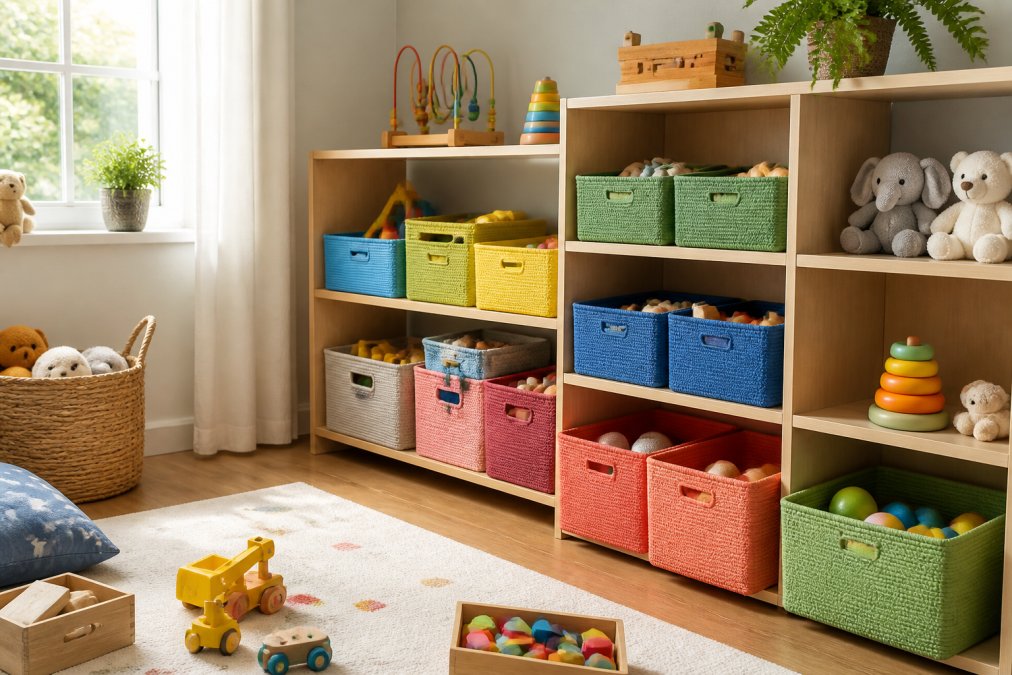
Designated areas create a visual organisation system your toddler can participate in. When a child knows that cars live in the red bin and soft toys live on the bottom shelf, clean-up becomes a matching game rather than a vague instruction.
Choosing the Right Bins, Baskets, and Shelving Units
For toddlers, low-level, open-front storage works far better than lidded boxes or high shelves, because children can see what is available and reach it independently.
The Explorers Storage Unit with 6 Boxes from The Nook and Nurture Company (£49.99) keeps categories separated at toddler height, and individual boxes can be pulled out and carried, making tidy-up genuinely manageable for small hands.

For more categories, the ZONEKIZ Storage Unit with 9 Removable Baskets (£49.99) offers nine separate compartments in grey. Bin labels are essential, use picture labels alongside words so pre-readers have clear visual cues during clean-up.

| Storage Type | Best For | Toddler Accessible | Approximate Cost |
|---|---|---|---|
| Open-front multi-bin unit | Categorised toy storage | Yes | £40-£60 |
| Toy box with lid | Bulky items, soft toys | With safety hinges | £40-£50 |
| Wicker baskets on shelves | Living room aesthetics | Yes (low shelf) | £5-£20 each |
| Zipper bags in a drawer | Small parts, craft items | With supervision | £1-£5 each |
| Laundry bags | Stuffed animals, soft toys | Yes | £3-£10 |
Taming Toys with Many Pieces: Puzzles, Lego, and Small Parts
Puzzles, Lego, and small-part toys destroy otherwise functional storage systems. Keep each puzzle in its own zipper bag or small box, clearly labelled with a photo of the completed image. For Lego and building sets, sort by size or colour rather than by set.

Small parts belonging to a specific toy should be stored with that toy, not in a general "bits and pieces" container. Zipper bags attached to the relevant toy box keep everything paired correctly.
Toddler Toy Storage Hacks for Small Spaces and Tight Budgets
Small space living means being intentional about vertical space, dual-purpose furniture, and what earns a place in the room.
Floating shelves installed at toddler height give books and a small selection of toys a permanent home without consuming floor space. A row of hooks near the door handles bags, dressing-up costumes, and backpacks efficiently.
Budget-friendly DIY storage hacks:
- Repurpose kitchen organisers. Cutlery trays and drawer dividers work well for small toys and art supplies.
- Use an over-door shoe organiser. The pockets hold small toys, colouring books, and craft supplies.
- Laundry bags for stuffed animals. A large laundry bag hung on a hook corrals stuffed animals without taking up shelf space.
- Magazine files for colouring books and activity pads. They stand upright and cost very little.
- Tension rods under a sink or in a cupboard. These create a second shelf for flat items like puzzle boards.
The AIYAPLAY Lion Toy Box (£44.99) is worth considering for families needing a single, contained solution. It has safety hinges on the lid and groove handles for easy opening.
How to Build a Toy Rotation System That Actually Works
A toy rotation system is the single most underused tool in managing toddler toy clutter. Rather than making every toy available all the time, you keep a curated selection out and store the rest. Every few weeks, you swap items in and out.
Toys that have been "away" for three weeks feel new again when they reappear. Children play with them more attentively and with more creativity. Fewer toys available at once also means less overwhelm, which genuinely affects how toddlers engage with play.
According to the National Literacy Trust on play and early development, children benefit from focused, uncluttered play environments that support sustained attention. A rotation system creates exactly that condition.
How Often to Rotate and What to Keep Out
Rotate every two to four weeks for most toddlers. Younger children, around 12 to 24 months, may benefit from more frequent rotation as their interests shift quickly.
A practical rotation framework:
- Divide your full toy inventory into three roughly equal groups
- Keep one group accessible at any given time
- Store the other two groups in lidded boxes in a cupboard or under a bed
- On rotation day, swap one stored group for the current group
- Before swapping, check stored toys for missing pieces and clean anything that needs it
Keep a few anchor items permanently available: a favourite soft toy, a current book selection, and any toy your child is actively working on.
Teaching Toddlers to Tidy Up: Building the Habit Early
Teaching toddlers to tidy up is about building a habit that becomes automatic over time. The earlier you start, the easier it gets, because toddlers between 18 months and three years are naturally in a sensitive period for order and routine.
The most effective approach is making clean-up time predictable, brief, and genuinely achievable. A child who succeeds at tidying up will do it again.
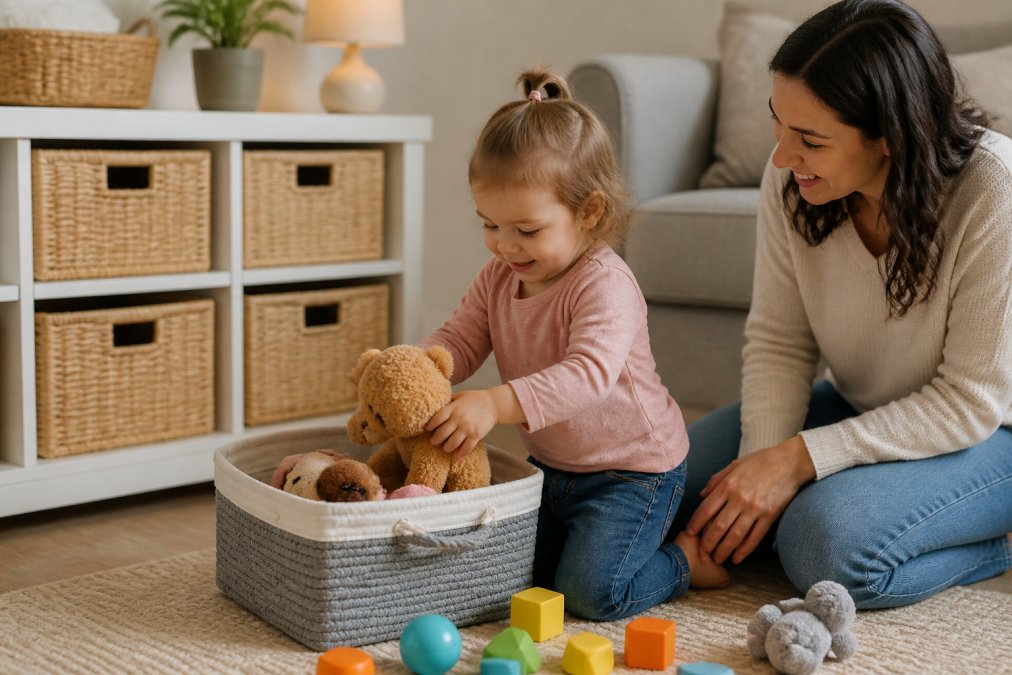
Practical strategies that work:
- Tidy up together. At this age, "tidy up" means tidy up alongside your child.
- Use a consistent signal. A song, a timer, or a specific phrase creates a predictable cue that clean-up is starting.
- Limit the scope. "Put the cars in the red bin" is achievable. "Tidy your room" is not.
- Match the storage to the child. If the bin is too high, too heavy, or too complicated, the habit will not form.
- Acknowledge the effort. A toddler who puts three toys away has done something real.
The goal is a child who understands that toys have homes and that putting them away is a normal part of playing with them.
Maintaining a Clutter-Free Home: Your Long-Term Routine
Getting the system in place is the hard part. Maintaining it is mostly about consistency and a few regular habits that prevent the slow drift back to chaos.
The most important maintenance habit is a weekly reset: a ten-minute check to return items to their designated areas, identify anything that has lost its home, and remove any broken or outgrown toys.
A monthly check of the toy inventory takes another fifteen minutes and catches gradual accumulation before it becomes a problem. Seasonal reviews, aligned with birthdays and Christmas, are when you do the fuller purge described in Step 1.
According to the Royal College of Occupational Therapists on home environments and wellbeing, consistent routines in the home environment support children's sense of security and predictability.
The long-term maintenance checklist:
- Daily: a five-minute tidy at the end of play sessions
- Weekly: return all items to designated areas, check for broken toys
- Monthly: review toy inventory, adjust storage if categories are overflowing
- Seasonally: full purge before birthdays and Christmas, apply one-in-one-out rule
Finite storage is the principle that holds all of this together. When the bin is full, something leaves before something new arrives. This single rule, applied consistently, prevents the gradual accumulation that defeats most organisation systems.
Managing toddler toy clutter is genuinely difficult without a system. The Nook and Nurture Company offers a curated range of storage solutions designed specifically for family homes, including the Explorers Storage Unit and the ZONEKIZ 9-basket unit, both chosen to make categorised, accessible storage practical at any budget. With next-day shipping and a 30-day risk-free trial, there is no reason to put off getting the system in place. Get started with The Nook and Nurture Company and turn the playroom from a daily frustration into a space that actually works.
Frequently Asked Questions
How do I declutter my toddler's toys without them noticing?
Work during nap time or after bedtime. Start with toys that have been ignored for several weeks, toddlers rarely miss what they haven't reached for. Place items in a box and store it out of sight for two to four weeks. If nothing is asked for, donate or pass on with confidence. This approach avoids meltdowns and gives you a chance to assess what genuinely holds their attention.
What is the 20 toy rule for kids?
The 20 toy rule is a minimalism-inspired guideline suggesting children benefit most from having around 20 accessible toys at any one time. The idea is that fewer choices reduce overwhelm, support longer periods of focused play, and make tidy-up time far more manageable. You don't have to follow the number rigidly, the principle is about keeping what's actively used and rotating or storing the rest so your toddler's play space stays calm and workable.
How often should I rotate my toddler's toys?
Most families find a two to four week rotation cycle works well. Swap out a portion of accessible toys when you notice your toddler losing interest or when the playroom starts feeling cluttered again. Store the resting toys in labelled boxes or bags out of reach. When you reintroduce them, toddlers often engage with them as though they're new, which supports open-ended play without the cost of constantly buying more.
Is it normal for 2-year-olds to want to organise their toys?
Yes, completely normal. Many toddlers around age two begin showing an interest in sorting and arranging objects, this is a natural part of cognitive development. You can support this by using clear bins with simple visual labels so they can see where things belong. A toddler-friendly storage setup with accessible, low shelving makes it easier for them to participate in tidying and reinforces the habit of putting things back in the right place.
This article was written using GrandRanker


