

Table of Contents
- What You Need Before You Start a Return
- How to Return Baby Products Online: Step-by-Step
- Consumer Contracts Regulations 2013 Returns: Your 14-Day Right
- Returning Faulty Baby Goods: What to Do When Something Is Wrong
- How to Package Baby Gear for Return
- Hygiene and Safety Restrictions: What You Cannot Return
- When a Return Is Refused: How to Troubleshoot
- Conclusion: Making Returns Work for Your Family
- Frequently Asked Questions
Last Updated: September 10, 2026
What You Need Before You Start a Return
Learning how to return baby products online should feel straightforward, not stressful. Before you open a return portal, gather four things: your order confirmation email, the digital invoice, proof of purchase if the item was a gift, and the original packaging where possible. Having these ready reduces the chance of a delayed or refused request.
Most retailers ask you to start the return within a set return window. Keep the shipping confirmation to hand, since it carries your tracking number and order reference. If you are returning faulty baby goods, photograph the fault before packing.
How to Return Baby Products Online: Step-by-Step
The process follows a predictable path: locate the order, start the return, choose how to send it back, then track your refund.
Step 1: Find Your Order and Check the Return Window
Log into your account and open your order history. Confirm the order number, delivery date, and the return window that applies. A return window is the period during which a retailer will accept a return, and it usually starts from the day your parcel arrives, not the day you ordered.
If you checked out as a guest, search your inbox for the order confirmation email instead. The digital invoice attached contains everything the returns team needs.
Step 2: Start the Return in the Retailer's Portal
Open the retailer's return portal and select the item you want to send back. You will be asked for a reason, such as "changed my mind", "wrong size", or "damaged or faulty items". Be honest: it determines whether you get a full or partial refund.
You should receive a return authorization and, in many cases, a prepaid return label by email. Print it or save the QR code to your phone.
Step 3: Choose Your Return Method
Most retailers offer two routes: a courier collection from your home, or a drop-off point such as a local shop or locker. Courier collection suits bulky items like a highchair or travel cot. A drop-off point is faster for smaller parcels and usually needs no booking.
Whichever you pick, keep the receipt or tracking number until your refund lands.
| Return Method | Best For | What You Need |
|---|---|---|
| Courier collection | Bulky gear, prams, furniture | Booked slot, printed label |
| Drop-off point | Small items, clothing, toys | QR code or printed label |
| In-store return | Items bought in person | Proof of purchase, card used |
Consumer Contracts Regulations 2013 Returns: Your 14-Day Right
When you buy online, the Consumer Contracts Regulations 2013 give you a 14-day right to cancel, starting the day you receive the goods (gov.uk). This is a legal right, separate from any goodwill policy a retailer offers, and it exists because you could not inspect the item in person before buying.
Under these rules, you must tell the retailer you are cancelling within 14 days, then send the goods back within a further 14 days. You are entitled to a refund of the item's cost and the standard outward delivery charge. The retailer may deduct if the goods' value has been reduced by handling beyond what you would do in a shop.
This is where many parents get caught out. You can open the box and inspect a baby monitor, but if you use it for a fortnight and return it scratched, expect a reduced refund. The official guidance on the Consumer Contracts Regulations sets out the full cancellation rights, and it is worth a quick read before you assume a return will be refused.
Returning Faulty Baby Goods: What to Do When Something Is Wrong
Faulty goods follow a different route to a change-of-mind return. If a product is damaged, unsafe, or not as described, you are entitled to a remedy under consumer law, and the retailer cannot simply point to the 14-day window and close the door.
Report the fault in writing through the customer support portal, attaching your photographs and order reference. State whether you want a repair, a replacement, or a refund. For a safety-critical item such as a car seat or cot, stop using it immediately and say so, because continuing to use faulty baby goods can put your child at risk.
A common mistake is accepting a store credit when you are legally entitled to your money back. If the fault appeared shortly after delivery, push for a refund rather than a voucher.
How to Package Baby Gear for Return
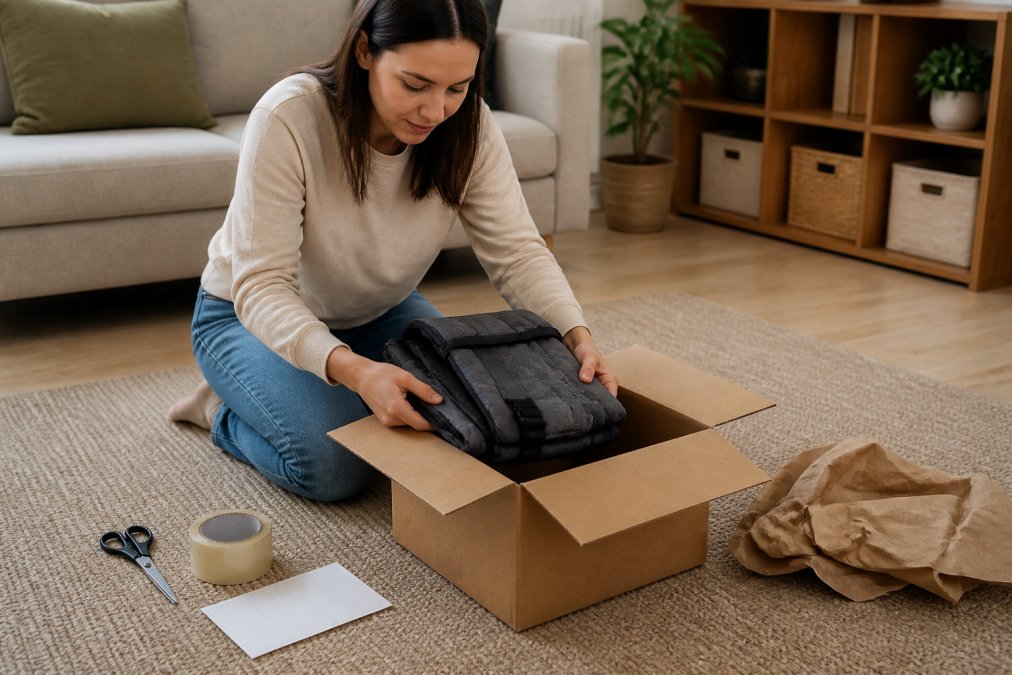
Pack the item so it arrives in saleable condition, because a battered box can turn a full refund into a partial one. Use the original packaging where you still have it, or a sturdy double-walled box of similar size, and cushion hard edges. Remove batteries from electronics and include every part, from the instruction booklet to the charging cable.
Match the Packaging to the Item
Different baby products fail differently in transit, so the packing method should change with the item:
- Prams, travel systems and highchairs. Fold them as they arrived, secure the frame with cable ties or tape so it cannot spring open, and wrap the wheels separately. These items are usually too large for a standard drop-off locker and need a courier collection.
- Car seats. Keep the harness buckled, remove the infant insert only if it was supplied separately, and box the seat upright rather than on its side. Never ship a car seat that has been involved in a collision without telling the retailer.
- Bottles, teats and breast pump parts. Re-seal any hygiene film you opened, bag small components together, and label the bag so nothing is lost in transit.
- Clothing and soft goods. Fold rather than roll, and use a weatherproof outer bag if you are dropping off at an outdoor collection point.
Weight, Size and Carrier Rules
Before you tape anything shut, weigh and measure the parcel. Most courier networks cap standard parcels at around 15kg to 20kg and set a maximum combined length and girth, typically 1.5m to 2m. A boxed travel cot or full travel system often exceeds one or both limits, which is why retailers route those items through a booked collection rather than a counter drop-off.
If your parcel is over the limit, do not force it through a drop-off point. Book a home collection through the retailer's portal or the carrier's booking page, choose a slot when someone will be in, and print the label at the size the carrier specifies. Oversized parcels are frequently refused at the counter, which resets your return clock.
Labels, Barcodes and Tracking
Tape the box securely along all open seams, then attach the prepaid return label over any old barcodes, including the original delivery label and any carrier stickers. If the label is a QR code, save it to your phone and email before you leave the house, because a dead phone battery at the counter is a common reason returns get abandoned.
Note the tracking number before the parcel leaves your hands and keep the drop-off receipt. If the retailer later claims the item never arrived, that receipt and tracking reference move the claim forward.
What You Cannot Put in a Return Parcel
Carrier terms prohibit certain items in the standard returns network, and baby gear runs into this more often than most categories. Lithium-ion batteries, including those in some monitors and portable sound machines, are restricted or banned from certain air and courier routes. Aerosols, flammable liquids and pressurised containers are prohibited outright. If your item contains any of these, remove the battery where the design allows, or ask the retailer for a specialist collection label.
Hygiene and Safety Restrictions: What You Cannot Return
Some baby products cannot be returned once opened, and this catches out more parents than any other rule. The reason is not retailer stinginess: once a hygiene seal is broken or a safety-critical item has left controlled storage, the product can no longer be guaranteed safe or resaleable, and in some cases cannot legally be sold again.
Products With Hygiene Seals
Anything that comes into contact with milk, food or a baby's mouth is normally non-returnable once the seal is broken. That covers:
- Bottles, teats and soothers
- Breast pumps and pump kits, including collection cups and tubing
- Sterilisers once the internal packaging is opened
- Potty-training seats, potties and step stools
- Nipple creams, barrier creams and any opened toiletries
- Teething gels, dummies and oral syringes
The test is usually the seal, not the box. If the outer carton is opened but the inner hygiene film is intact, many retailers will still accept the return. If the film is broken, expect a refusal even if the item looks unused.
Mattresses and Bedding
Mattresses, mattress protectors, pillow inserts and fitted sheets are treated as non-returnable once the protective wrapping is removed, because they cannot be re-sanitised to a standard that would let them be sold as new. Some retailers allow a return if the mattress is still fully sealed in its original vacuum wrap, so check before you cut the plastic.
Safety-Certified and Personalised Items
Where a product carries a safety certification, a returned item may need inspection before it can be resold, and some categories are excluded from resale entirely:
- Car seats. Once used, a seat's history is unknown, so most retailers will not accept a return unless it is faulty. If you have fitted it in a car, treat it as non-returnable for change of mind.
- Cots, bedside cribs and travel cots. These are usually returnable if unassembled and in original packaging, but once built they may be refused on safety grounds.
- Personalised or made-to-order items. Names, embroidered blankets and custom-printed items fall outside the standard cancellation right because they cannot be resold to anyone else.
The Legal Basis
The Consumer Contracts Regulations 2013, which give you a 14-day right to cancel an online purchase, specifically exclude goods made to the consumer's specification, and allow retailers to refuse returns where hygiene or health protection rules apply to sealed goods that have been unsealed. That is the legal hook behind most "non-returnable once opened" policies, and why a change-of-mind return on an opened breast pump will usually fail while a faulty-goods claim on the same pump will usually succeed.
What to Do If You Are Unsure
Check the product page before you unseal anything. Look for a hygiene notice, a returns exclusion or a safety statement, and if it is not clear, ask the retailer in writing before opening the packaging. A quick message now saves a refused request later, and a written answer is useful evidence if the policy is applied inconsistently.
When a Return Is Refused: How to Troubleshoot
A refused return is rarely the end of the story, and a calm, methodical approach resolves most of them. Work through these steps in order:
- Check the reason given. Retailers must tell you why a return was declined. If the reason is a missed window, confirm the exact delivery date.
- Re-submit with evidence. Attach your photographs, proof of purchase, and a clear description of the fault.
- Ask for the policy in writing. Request the specific clause being applied, quoting your order number.
- Escalate politely. Ask for the complaint to be reviewed by a supervisor or the returns team.
- Know your fallback. If the retailer will not resolve a faulty-goods dispute, you can raise it with a consumer advice service or, where eligible, an alternative dispute resolution scheme.
The consumer rights guidance from the Citizens Advice service explains how to escalate a dispute and when you can take it further. Keep every message: a written trail is what moves a stuck return forward.
Conclusion: Making Returns Work for Your Family
Returns are a normal part of shopping for a growing family, and knowing your rights turns a frustrating chore into a five-minute task. Whether you are sending back an unopened gift, a faulty monitor, or a cot that did not fit your space, the same principles apply: act inside the window, keep your proof of purchase, and package carefully.
Every order comes with a 30-day risk-free trial and a full refund if you are not satisfied, so you can try a product at home with your baby before committing. Our products are chosen with parents and babies in mind, backed by 100% secure payments and guaranteed next-day shipping.
Shop with the confidence that a return, if you ever need one, will be simple.
Frequently Asked Questions
How long do I have to return baby items under the Consumer Contracts Regulations?
You have 14 days from the day you receive the goods to tell the retailer you want to cancel, and a further 14 days to send the items back. This applies to most online orders. The retailer must refund you within 14 days of receiving the returned goods or proof of postage, whichever comes first. Some retailers offer longer windows as a goodwill gesture, so check the returns policy on their site before you start the process.
Do I have to pay for return postage for online baby orders?
For change-of-mind returns, the retailer can deduct the cost of return shipping from your refund if this was made clear in their terms before you bought. For faulty or damaged goods, the retailer must cover the cost of return. Many retailers provide a prepaid return label or a free courier collection for faulty items. If you are unsure, check your order confirmation email or the returns section of the retailer's customer support portal.
Can I return baby products if I have opened the packaging?
Under the Consumer Contracts Regulations 2013, you can open packaging to inspect items as you would in a shop. However, hygiene-sealed products such as bottles, teats, breast pumps and mattresses cannot be returned once the seal is broken, for safety reasons. For other items, keep original packaging and tags where possible. If you have assembled or used an item beyond a simple inspection, the retailer may offer a partial refund or refuse the return.
What should I do if my return is refused?
Ask the retailer for the specific reason in writing, quoting your order number and return authorisation. If you believe the refusal is unfair, cite your rights under the Consumer Rights Act 2015 for faulty goods or the Consumer Contracts Regulations 2013 for change-of-mind cancellations. Escalate to a manager via the customer support portal and keep records of all communication. If the issue remains unresolved, you can contact Citizens Advice or raise a complaint with the retailer's trade association.


