

Table of Contents
- What Makes a Montessori Nursery Different (And Why Budget Matters)
- The Prepared Environment: What You Actually Need
- How to Organise Toddler Toy Clutter the Montessori Way
- DIY Montessori Nursery Furniture on a Tight Budget
- Non-Toxic Nursery Decor Ideas That Won't Break the Bank
- Budget-Friendly Shopping: Second-Hand, Upcycled, and Smart Sourcing
- Safety Standards and Compliance for Your Budget Montessori Nursery
- Scaling Your Nursery as Your Child Grows
- Frequently Asked Questions
Last Updated: September 19, 2026
What Makes a Montessori Nursery Different (And Why Budget Matters)
Learning how to set up a Montessori nursery on a budget starts with one core idea: let children lead their own learning. Instead of toys scattered everywhere and furniture sized for adults, you create spaces where toddlers can move freely, choose what interests them, and develop independence. This approach to early childhood development emphasises the prepared environment, a carefully arranged space that invites exploration without overwhelming choices.
The budget question isn't about spending less on junk. It's about spending smart on what actually matters. Many parents assume Montessori means expensive wooden toys and designer furniture. The truth is simpler: a prepared environment works because it's intentional, not because it's costly.
Understanding how to set up a Montessori nursery on a budget means knowing what a prepared environment actually needs so you can create one for far less than you'd expect. The difference between a chaotic nursery and a calm, functional space often comes down to organisation and intentional choices, not a bigger budget.
The Prepared Environment: What You Actually Need
The prepared environment is the heart of Montessori parenting. It's a space designed for your child's independence, not your convenience. This doesn't mean bare walls and minimalism for its own sake. It means every item serves a purpose, is accessible to your child, and supports their development.
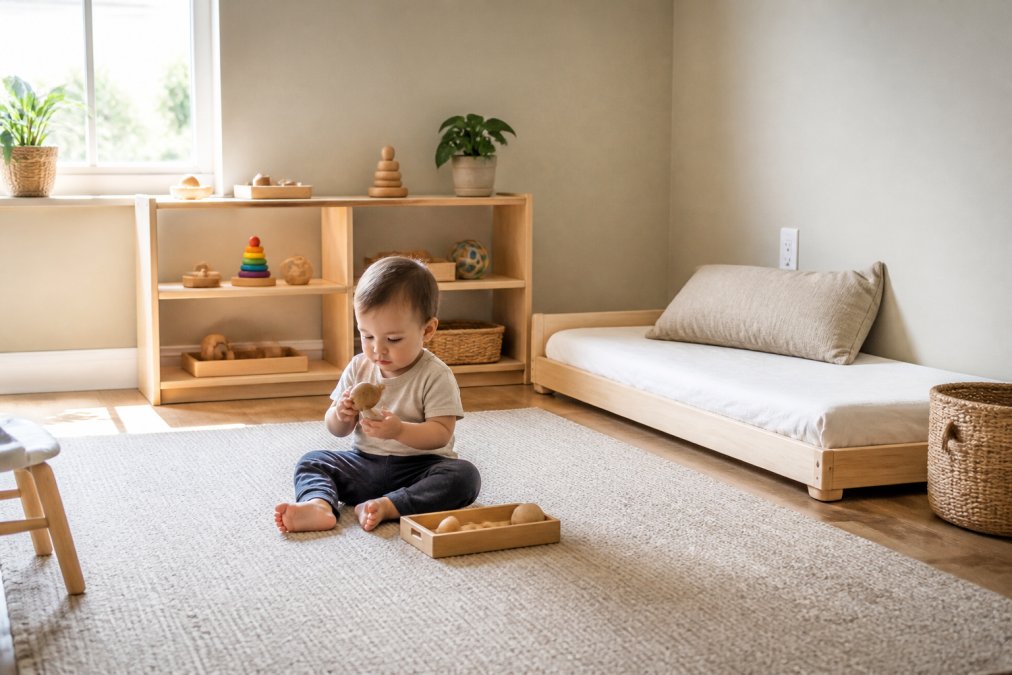
A prepared environment has three main areas: sleeping, movement, and care.
Sleeping Area
Your child's sleeping space should be low to the ground and accessible without help. A floor bed, a mattress on the floor or a very low platform, lets toddlers get in and out independently. This builds confidence and teaches them to manage their own rest time.
You don't need a special Montessori floor bed. A standard cot mattress on a wooden pallet, a low platform bed, or even a mattress directly on the floor works perfectly. Add soft, natural bedding in neutral colours. Keep the space calm with minimal decoration.
Safety matters here. Use a bed guard or position the bed against a wall so your child can't roll out. Keep the area clear of hazards. Check that any DIY platform is stable and won't wobble or collapse.
Movement Area
This is where your child plays, explores, and builds physical skills. It needs floor space, bare or with a soft rug, where your child can move freely without tripping over toys or furniture.
Keep toys low and visible on open shelving. Avoid closed toy boxes where everything piles on top of each other. Use baskets or low bins so your child can see what's available and choose independently.
The movement area should be uncluttered. A few quality toys that encourage open-ended play beat a room full of plastic gadgets. Natural light helps. A low mirror lets your child see themselves moving, it supports body awareness and development.
Care Area
This is where your child learns daily living skills: dressing, washing, brushing teeth. Set up a low sink or washing station. A step stool lets them reach a bathroom sink independently. A low rail or hooks hold clothes at their height.
Keep care items in baskets or small containers. Label them with pictures so your child knows what goes where. Natural materials like wood and fabric feel better than plastic.
How to Organise Toddler Toy Clutter the Montessori Way
Toy clutter is the enemy of a prepared environment. Too many toys overwhelm children and make tidying impossible. The Montessori approach to toy organisation is ruthless: fewer, better toys, rotated regularly.
Start by decluttering. Keep only toys that:
- Encourage open-ended play (building blocks, vehicles, natural objects)
- Support development (stacking rings, shape sorters, puzzles)
- Spark joy and genuine interest
- Are in good condition with no missing pieces
Remove toys that flash, beep, or require batteries. Remove broken toys. Remove toys your child has outgrown. This alone cuts clutter by half.
Organise what's left into categories. Use the Isla 4-Coloured Box Storage Unit from The Nook and Nurture Company, four colour-coded baskets that let your child understand where things belong without reading labels. Purple for puzzles, pink for dolls, green for blocks, yellow for art supplies. Simplicity itself.

Rotate toys every few weeks. Keep some toys out, store others away. When you bring stored toys back, they feel new again. Your child stays engaged with fewer items taking up space.
Use open shelving so toys are visible. Closed toy boxes create chaos, everything gets jumbled and lost. Open shelves let your child see choices and put things back easily.
DIY Montessori Nursery Furniture on a Tight Budget
You don't need to buy Montessori-branded furniture at premium prices. Standard furniture works fine if it's the right size and serves the right purpose.
Low shelving: A standard bookshelf works if it's under 1 metre tall. Paint it white or natural wood for a calm look. Or build simple shelves from timber and brackets, much cheaper than buying a unit. The key is low height so your child can reach everything.
Floor bed: Skip expensive platform beds. Use a wooden pallet, a standard bed frame with the legs removed, or just a mattress on the floor. Add a bed guard from a hardware store if needed. Natural wood or white paint keeps it looking intentional.
Isla 4-Coloured Box Storage Unit →
Clothes rail: A child-sized clothes rail costs very little. Or use a low tension rod mounted between two pieces of timber. Your child learns to dress independently when clothes are at their height.
Washing station: A small table with a basin and jug. Add a step stool so your child can reach a sink. A towel rack at their height completes it.
Storage baskets: Natural seagrass baskets from The Nook and Nurture Company (£13.95 for a set of three) are affordable and beautiful. They work for any room and last for years. Woven baskets feel warm and look intentional, far better than plastic storage boxes.

Safety compliance matters when you DIY. Any furniture your child climbs on or uses must be stable and secure. Shelves must be anchored to walls so they can't tip. Beds must have guardrails. Test everything before your child uses it.
Non-Toxic Nursery Decor Ideas That Won't Break the Bank
A prepared environment doesn't need lots of decoration. What you choose should be natural, calming, and safe.
Paint walls in neutral colours: soft white, warm beige, pale grey. These create calm without visual clutter. Avoid bright primary colours, they overstimulate. If you want colour, use it in small amounts: a few cushions, a rug, artwork.
Choose natural materials where possible. Wood, cotton, wool, linen, seagrass. These materials feel better, look intentional, and are safer than synthetic options. They also age beautifully, they don't look cheap after a few months.
Keep artwork minimal. One or two pieces at your child's eye level work better than a gallery wall. Photographs of family, nature scenes, or simple art in natural frames feel calm and personal.
Use natural light whenever possible. Open curtains during the day. Soft lighting in the evening, a dimmer switch or warm bulbs, helps wind down before sleep.
Add a few natural objects: smooth stones, shells, branches, plants in sturdy pots. These invite exploration and connect your child to nature. They're free or nearly free if you gather them yourself.
Avoid plastic decorations, character posters, and bright synthetic fabrics. These create visual noise that works against the calm, intentional space you're building.
Budget-Friendly Shopping: Second-Hand, Upcycled, and Smart Sourcing
Your biggest budget wins come from smart shopping, not DIY shortcuts.
Second-hand furniture: Charity shops, online marketplaces, and local buy-and-sell groups have solid wooden furniture at a fraction of retail price. Look for solid wood pieces that can be sanded and repainted. Avoid anything with deep stains or damage.
Upcycling: An old dresser becomes low shelving if you remove drawers and add baskets. A wooden ladder becomes a clothes rail. A vintage trunk becomes toy storage. Pinterest has endless upcycling ideas. The key is starting with solid pieces and transforming them with paint or simple modifications.
Thrifted toys: Wooden toys from charity shops are often better quality and cheaper than new plastic ones.
Safety Standards and Compliance for Your Budget Montessori Nursery
Budget doesn't mean unsafe. Safety compliance is non-negotiable, whether you buy new or DIY.
Scaling Your Nursery as Your Child Grows
A budget nursery doesn't end when your child turns two. The space needs to evolve as your child develops.
Frequently Asked Questions
What are the essential elements of a Montessori nursery?
A Montessori nursery needs a prepared environment with three core areas: a sleeping area (ideally a low floor bed or mattress on the ground), a movement area with space to crawl and play, and a care area for nappy changing and dressing. Include low shelves with a rotation of toys, natural materials, non-toxic decor, and child-sized furniture. The key is accessibility, everything must be within your child's reach so they can develop independence and make choices. You don't need expensive equipment; simple, quality items work best.
How much does it cost to set up a Montessori nursery on a budget?
You can set up a functional Montessori nursery by shopping second-hand, upcycling household items, and prioritising essentials. A floor bed, low shelving unit like the Isla 4-Colour Storage Unit (£110.95), natural baskets (from £13.95), and a few quality toys form the foundation. Avoid expensive branded items; focus on safe, non-toxic materials and open-ended toys. Many families overspend on decoration and unnecessary furniture, Montessori spaces thrive on simplicity.
Can I apply Montessori principles in a small nursery space?
Yes. Montessori works brilliantly in small spaces because the philosophy emphasises quality over quantity. Use vertical storage to maximise wall space, rotate toys to reduce clutter, and keep the colour palette neutral so the room feels larger. A compact storage unit with baskets, one low shelf, and a floor bed take up minimal space while meeting all Montessori principles. Small rooms actually encourage the minimalist, focused environment Montessori requires.
What are the safety standards for a Montessori nursery in the UK?
Key requirements for a safe nursery include secure furniture (no tip-over risks), non-toxic materials, appropriate flooring for safety, and regular safety checks. When choosing or building furniture, ensure it meets relevant British Standards for stability and child safety. Avoid small parts that pose choking hazards, use only child-safe finishes, and keep the environment free from sharp edges or unstable items.


