

Table of Contents
- Why Testing Nursery Furniture for Toxins Matters
- Understanding Formaldehyde in Furniture
- VOCs from New Furniture: What Parents Should Know
- Step-by-Step: How to Test Nursery Furniture for Toxins at Home
- How to Reduce Furniture Fumes and Improve Indoor Air Quality
- Cot Safety Standards and Certification: What to Look For
- When to Retest or Take Action
- Conclusion: Creating a Healthier Nursery
- Frequently Asked Questions
Last Updated: October 15, 2026
Why Testing Nursery Furniture for Toxins Matters
Your baby spends more time in their nursery than anywhere else. Learning how to test nursery furniture for toxins is one of the most practical steps you can take as a parent, and it doesn't require a science background.
Most nursery furniture meets basic safety rules, but safety rules and low chemical emissions are not the same thing.
Here's the gap most guides skip: a cot can pass every structural safety test and still release formaldehyde and other volatile organic compounds for weeks after unboxing.
New furniture odour is the clue most parents notice first. That sharp, glue-like smell is off-gassing.
Below, we'll walk through how to test nursery furniture for toxins at home, what the results mean, and when to call in a laboratory.
Understanding Formaldehyde in Furniture
Formaldehyde is a colourless gas used in adhesives and resins that bind composite wood, and it can irritate the eyes, nose and throat at higher concentrations.
- Composite wood: plywood, particleboard and MDF used in cot bases and drawer fronts
- Adhesives and glues: the binder holding pressed wood together
- Finishes and sealants: some paints and lacquers release it as they cure
Solid wood pieces joined with mechanical fixings typically emit far less.
The Health and Safety Executive guidance on formaldehyde sets workplace exposure limits, which gives a useful sense of how regulators treat this chemical.
VOCs from New Furniture: What Parents Should Know
Off-gassing is strongest in the first days and weeks after a piece is unpacked.
What affects how much you'll breathe in:
- Room size and ventilation: a small nursery with the window shut traps emissions
- Temperature: warmer rooms speed up off-gassing
- Age of the furniture: new pieces emit more than settled ones
This is why a single cot may be fine while a complete room of new flat-pack furniture feels overwhelming. It's cumulative.
A common mistake is assuming "natural" or "wooden" on a label means zero emissions. Look at what the piece is made of and how it's finished, not how it's marketed.
Step-by-Step: How to Test Nursery Furniture for Toxins at Home
You can run a useful assessment yourself before paying for lab work. Here's a process to consider.
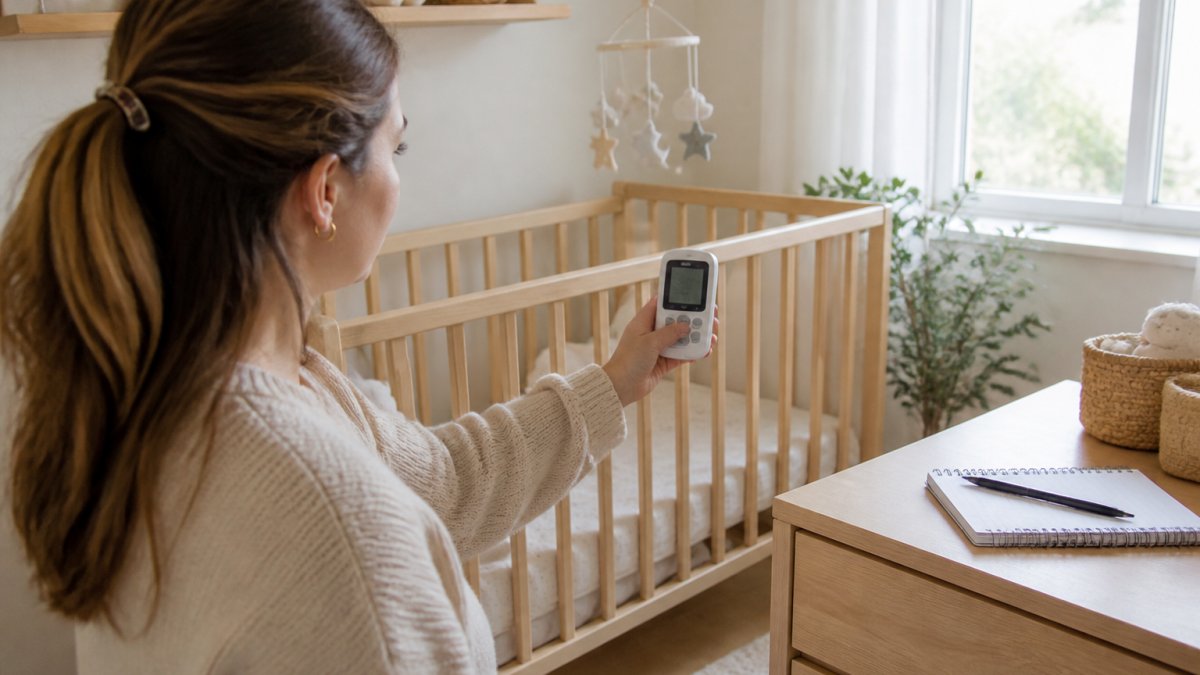
Total time: 2 to 4 weeks for a full assessment Difficulty: Beginner
What You'll Need
- A notebook or phone for records
- A handheld VOC or formaldehyde meter (optional)
- Airtight sample bags or jars (for lab testing)
Step 1: Visual Inspection and Odour Check
Start with your nose and eyes. This costs nothing and tells you a lot.
- Smell the piece up close on the day it's unboxed. A strong chemical odour is a signal.
- Check for a "new car" smell that lingers past a week.
- Look at the edges and drilled holes where raw composite wood is exposed.
- Note the finish. Is it sealed, or does the surface feel bare and chalky?
- Write down the date you opened it, so you can track how long the smell lasts.
Expected result: You'll know which pieces are the likely culprits before testing anything.
Step 2: Understand What Your Meter Can and Cannot Do
Handheld meters fall into two broad families, and the difference matters more than price.
- Metal-oxide (MOS) sensors respond to a wide range of VOCs. They are cheap, fast and good at spotting a trend, but they cannot tell you which compound they detected, and they cross-react with alcohol, cleaning sprays, perfumes and humidity.
- Electrochemical formaldehyde sensors are tuned to formaldehyde specifically. They are more selective but still drift, and need regular calibration against a known reference.
- Photoionisation detectors (PIDs) give a broad total-VOC reading in parts per billion. They are the closest thing to a serious instrument a parent can buy, but they report a sum, not a fingerprint, and need a lamp suited to the compounds you care about.
What this means in practice:
- A meter cannot separate formaldehyde from the perfume of a new mattress.
- Readings drift with temperature and humidity, so log both alongside the number.
- Cooking, cleaning sprays, air fresheners and scented candles skew readings taken in the same room.
Use a meter to compare rooms or track a trend over days, not to decide whether a specific cot is safe.
Step 3: DIY Air Sampling and Professional Laboratory Testing
For a real answer, you need a laboratory, the step most parents don't know exists.
- Choose an accredited lab that tests indoor air or product emissions. In the UK, look for UKAS accreditation, which confirms the lab meets recognised technical competence standards.
- Ask what they need. Some test room air, others a material sample, and some offer both. The method determines what the result can tell you.
- Collect the sample properly. Air samples usually need a sealed canister or a pump with a sorbent tube; material samples go in an airtight bag or jar, sealed within minutes of cutting.
- Label everything with the room, item, date and time.
- Send it off using the lab's specified courier, and keep the tracking number.
- Read the report carefully. Look at which compounds were tested, the method, the detection limit and the reported figure.
Expected result: A measured figure you can compare against recognised emission limits.
Step 4: Interpret the Result Against a Limit, Not a Feeling
A number on its own means nothing. You need a reference point.
- Air tests are usually reported in micrograms per cubic metre (µg/m³) or parts per billion (ppb). Compare the figure against a recognised indoor air guideline, not zero.
- Material or chamber tests are often reported as an emission rate, such as milligrams per square metre per hour. These are the figures certification schemes use, and they are not directly comparable to a room-air reading.
- Detection limits matter. If a compound was not detected, check the limit of detection. "Not detected" below a very low limit is stronger than below a loose one.
A common pattern is a low but non-zero formaldehyde result well under a recognised guideline. That's not a reason to panic, it's a reason to ventilate and retest in a few weeks.
Step 5: Test by Component, Not by Piece
Treating a cot as one material hides where emissions come from. Break it down:
- Composite wood panels (plywood, particleboard, MDF) in cot bases, drawer fronts and shelf backs are the usual formaldehyde source.
- Adhesives and edge banding seal the cut faces. A well-banded panel emits far less than a raw one.
- Foam in mattresses and padded bumpers can release its own VOCs, separate from the frame.
If you're sampling, sample the component you suspect. If you're ventilating, ventilate the whole room, because emissions from one component still end up in the air your baby breathes.
How to Reduce Furniture Fumes and Improve Indoor Air Quality
You don't always need a test to act. Reducing furniture fumes is often the fastest fix, whether or not you've measured anything.
- Air the room daily. Open windows for 10 to 15 minutes, even in cooler months.
- Unpack early. Let new pieces off-gas in a garage or spare room before the baby arrives.
- Keep the room cool. Lower temperatures slow emissions.
Small, consistent steps beat one big effort. A window opened daily does more than a single deep clean.
Cot Safety Standards and Certification: What to Look For
Cot safety standards set the rules on structure, gaps and stability, while emissions certifications cover what the furniture releases into the air. They are two different things, and you need to check both.
In the UK, cots and nursery furniture should meet the relevant British Standard, which covers things like bar spacing, mattress fit and entrapment risks. Look for a label or paperwork confirming compliance.
For emissions, certification schemes matter more than marketing claims.
| What to Check | What It Covers | Why It Matters |
|---|---|---|
| British Standard compliance | Structure, gaps, stability | Stops physical injury risks |
| GREENGUARD Gold | Low chemical emissions | Tests for VOCs including formaldehyde |
| Material list | Wood type, adhesives | Shows what off-gasses |
| Finish type | Paint, oil, sealant | Affects release over time |
GREENGUARD Gold is one of the stricter emissions certifications, and it tests for many compounds. The UL Solutions GREENGUARD certification programme explains what the standard measures.
What a Certificate Actually Covers
A certificate is not a statement about the whole item. It covers the specific components submitted for testing, against a specific method, at a specific time.
- Scope is component-level. A cot may have its finish tested while its composite wood panels are not, or vice versa. The certificate should name the components.
- Scope is material-specific. A fabric tested for one colourway does not automatically cover a different dye lot.
- Scope is time-limited. Certificates are issued against a production run or a model. A design change can invalidate the original test.
How to Read a Test Report
If you request a test report from a retailer, four things tell you whether it is meaningful:
- The method. Look for a recognised chamber or emission test method rather than an in-house screen.
- The compounds tested. A report that lists formaldehyde only is narrower than one that covers a panel of VOCs.
- The limit applied. A result is only meaningful against a stated limit. Ask which limit the lab compared against.
- The detection limit. A "pass" below a loose detection limit is weaker than a "pass" below a tight one.
Emissions Limits Are Not a Zero-Chemical Guarantee
This is the point most marketing copy skips: an emissions limit is a threshold, not an absence. A product can pass a strict certification and still release small, measurable amounts of formaldehyde and other VOCs, the certification only tells you those amounts sit below a defined ceiling under defined conditions. That is still useful, but it does not mean the nursery air is chemical-free, and it does not replace ventilation.
What Certifications Cannot Tell You
- They cannot tell you how the furniture will behave in your specific room, at your temperature and humidity.
- They cannot account for the cumulative effect of a full nursery set, new flooring, a repainted wall and a new mattress in the same small space.
- They cannot tell you whether a piece will bother a particularly sensitive child.
Use certification as a filter when buying, and use testing and ventilation as the tools that tell you what is actually happening in your home.
When to Retest or Take Action
Not every smell needs a laboratory. Use these triggers to decide your next move.
- Retest if the odour lingers past four weeks despite daily ventilation.
- Retest after adding new furniture, flooring or a repainted wall.
- Take action if anyone in the home has persistent headaches, coughing or eye irritation in that room.
If symptoms appear and don't settle, speak to your GP. We can help you understand your furniture and your air, but we can't give medical advice.
Conclusion: Creating a Healthier Nursery
Getting a nursery ready is stressful enough without worrying about invisible chemicals. The good news: the process is manageable.
At The Nook and Nurture Company, we choose products with parents and babies in mind, and we back every order with a 30-day risk-free trial, guaranteed next day shipping, and a full refund if you're not satisfied.
Browse our nursery collection and build a healthier space with products chosen with care.
Frequently Asked Questions
Is formaldehyde present in furniture?
Yes, formaldehyde is commonly found in composite wood products like plywood and MDF, which are often used in nursery furniture. It is also present in some glues and adhesives. Over time, these materials can release formaldehyde into the air, a process known as off-gassing. The amount released depends on the product and its age. Choosing furniture with low-emission certifications, such as GREENGUARD Gold, can help reduce exposure. Testing your nursery furniture for toxins is a practical step to identify potential sources.
How can I check nursery furniture for VOCs?
To check for VOCs, start by smelling the furniture; a strong chemical odour may indicate high emissions. You can use a consumer VOC meter, but these have limitations and may not detect all harmful compounds. For more accurate results, consider professional laboratory testing where air samples are collected and analysed. Additionally, look for certifications like GREENGUARD Gold that verify low VOC emissions. Ensuring good ventilation and allowing furniture to air out can also reduce VOC levels.
How do I know if a cot meets UK safety standards?
In the UK, cots must comply with British Standard BS EN 716, which covers safety requirements for domestic and non-domestic cots. Look for a label or documentation confirming compliance. Key checks include bar spacing (to prevent entrapment), mattress fit, and stability. Also ensure there are no sharp edges or protrusions. If you are unsure, contact the manufacturer or retailer for verification. Always follow assembly instructions and avoid using outdated or modified cots.
How long should new furniture air out before a baby uses the room?
There is no fixed time, as off-gassing varies by material and ventilation. As a general guide, allow at least two to four weeks of airing out in a well-ventilated room before your baby sleeps there. Open windows daily, use fans to circulate air, and consider an air purifier with a HEPA and activated carbon filter. If you can still smell chemical odours after this period, continue airing out and consider testing. Always prioritise your baby's health and consult a professional if concerned.


