

Table of Contents
- Why Secondhand Nursery Furniture Deserves a Second Look
- How Much You Actually Save on Secondhand Nursery Furniture
- Secondhand Nursery Furniture Safety Checks You Cannot Skip
- Buying a Secondhand Cot: What to Inspect Before You Pay
- Your Used Nursery Furniture Checklist
- How to Clean Secondhand Nursery Furniture Before It Comes Inside
- Where Secondhand Makes Sense and Where It Does Not
- Frequently Asked Questions
Last Updated: October 17, 2026
Why Secondhand Nursery Furniture Deserves a Second Look
Secondhand nursery furniture is pre-owned cots, changing units, chests of drawers and storage pieces bought from another family rather than new from a retailer. It is one of the few categories where buying used delivers a genuine win: you save money, you keep usable furniture out of landfill, and you often get better-made pieces than the flat-pack equivalents at the same price.
Here at The Nook and Nurture Company, we sell new furniture, so we have no obvious reason to recommend the secondhand route. We still do, with conditions. A well-chosen used cot or changing unit can serve a family for years. A badly chosen one can be a genuine hazard.

Below, we break down what you actually save, which safety checks you cannot skip, and where secondhand stops being sensible.
How Much You Actually Save on Secondhand Nursery Furniture
Savings on secondhand nursery furniture are substantial, though they vary enormously by item and condition. A cot bought new and resold after two years typically changes hands for a fraction of its original price, and the same pattern holds for changing units, wardrobes and chests of drawers. The bigger items save the most, because they are expensive new and awkward to move, so sellers price them to shift.
Where the money really adds up is across a full nursery. Most families buy a cot, a mattress, a changing unit, a wardrobe or chest, and some form of storage. Buying even half of that secondhand can free up a meaningful chunk of budget for the things that matter more: a new mattress, a car seat, and the safety essentials you should never buy used.
There are hidden costs to weigh, though. Collection and transport on a bulky item can eat into the saving, and you may need to replace fixings, touch up paint or buy a new mattress. Factor those in before you decide a bargain is a bargain.
Secondhand Nursery Furniture Safety Checks You Cannot Skip
Secondhand nursery furniture safety checks come down to four things: stability, fixings, condition and history. Any piece that fails on any of these is not a bargain, whatever the price.
Start with the standard. Furniture sold new in the UK must meet the relevant British and European safety standards, and cots in particular are covered by specific requirements for bar spacing, mattress fit and side height. Check whether the seller can confirm the piece met those standards when it was bought. If they cannot, walk away.
Then look at condition. Wood that has cracked, swelled or splintered is a no. So is any piece with peeling paint or veneer, because a baby will chew it. Check every joint and fixing point for wobble, and check that all the original bolts and brackets are present and tight.
Finally, ask about history. Has it been stored in a damp garage or a smoky home? Has it been reassembled more than once? Both affect how sound it really is.
Stability, Fixings and Anti-Tip Fittings
Stability is the check most buyers skip, and it is the one that matters most once a baby becomes a toddler who pulls up on everything.
Push the piece gently from the top. It should not rock, flex or shift. Check that every anti-tip strap or wall bracket is included, and fit it properly when you get the piece home. Any tall unit that cannot be anchored to a wall is a risk, not a saving.
Inspect the fixings closely. Cam locks, dowels and bolts should all be present and seated. Loose or missing fixings are cheap to replace in theory, but only if you can identify the exact part.
Buying a Secondhand Cot: What to Inspect Before You Pay
Buying a secondhand cot is the highest-stakes purchase in the whole nursery, so inspect it in person and be prepared to walk away.
Bring a tape measure. Check the internal dimensions against the mattress you plan to use. A mattress that leaves a gap at the sides is a suffocation risk, and gaps are one of the most common problems with older cots. Measure the distance between the bars too, and check that the top rail sits high enough that a baby cannot climb out.
Look at the base. It should adjust to at least two heights, and the mechanism should lock firmly in every position. Test it several times. Check every bar for cracks and every joint for movement.
Shefa Kids 880 Baby Changing Unit - Grey/White →
Ask directly whether the cot has been in a home with smokers, pets or damp. If the answer is vague, treat it as a no.
Your Used Nursery Furniture Checklist
Here is the checklist we would use ourselves, in the order we would run it.
- Confirm the piece met UK safety standards when new
- Measure all internal dimensions and bar spacings
- Push and rock the piece to test stability
- Check every joint, bolt and cam lock for tightness
- Confirm all anti-tip straps or wall brackets are included
- Inspect all surfaces for cracks, splinters and peeling finish
- Test any moving parts, drawers and hinges repeatedly
- Ask about storage conditions, smoking and pets
- Confirm the original instructions and spare fixings are included
- Agree a collection plan and transport before paying
Print it, screenshot it, or keep it open on your phone while you are standing in someone's hallway. It takes five minutes and it will save you from a bad purchase.
| Item | What to check | Walk away if |
|---|---|---|
| Cot | Bar spacing, mattress fit, base locking | Any side has been repaired |
| Changing unit | Stability, drawer runners, surface finish | It rocks or a drawer jams |
| Wardrobe or chest | Anti-tip bracket, door hinges | No bracket and no way to fit one |
| Storage units | Fixings, shelf supports, edges | Missing fixings you cannot source |
| Mattress | Firmness, fit, staining | It is soft, sagging or stained |
How to Clean Secondhand Nursery Furniture Before It Comes Inside
Cleaning secondhand nursery furniture properly means dealing with three things: surface grime, odours and any pests that travelled with it. Do this before the piece enters the nursery, ideally in a garage or outside.
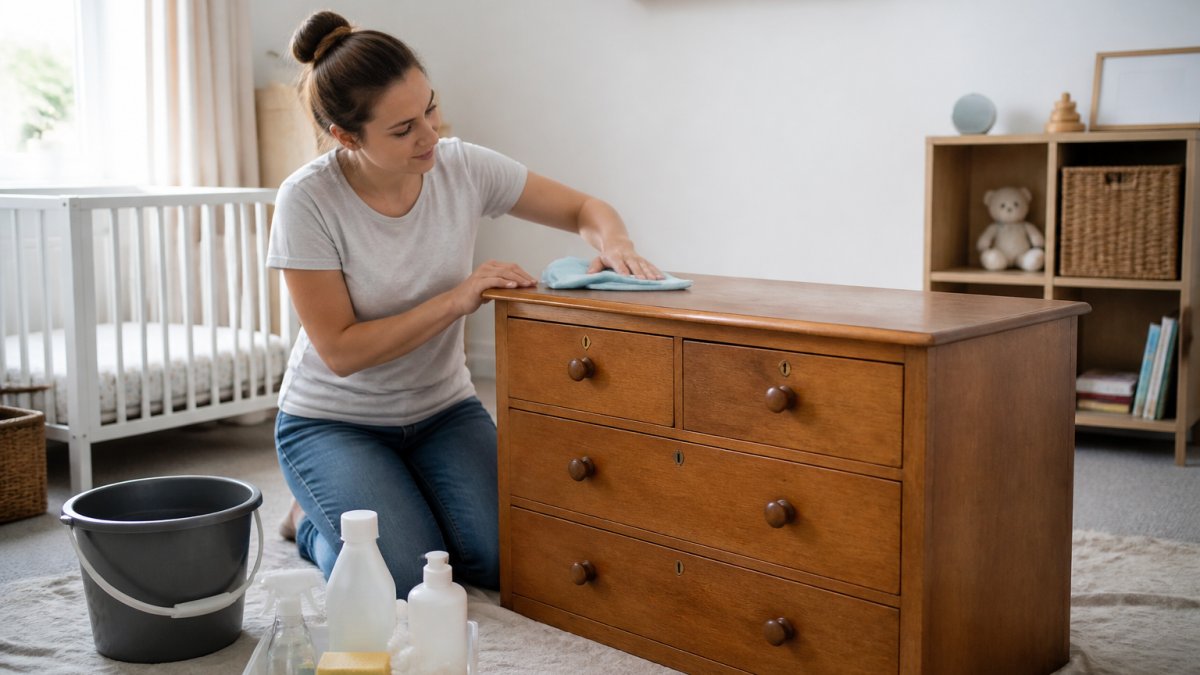
Wipe every surface with a damp cloth and a mild detergent solution, then wipe again with clean water. Pay attention to drawer interiors, undersides and the backs of panels, which are the parts nobody cleans. Dry thoroughly, because damp wood swells.
For odours, leave the piece in a well-ventilated space for several days. Do not mask smells with air freshener. If a smoke or damp smell persists after a week, the piece is not worth keeping.
Check for pests as you clean. Look along seams, in drawer runners and underneath for frass, casings or live insects. If you find any, treat the piece outside and do not bring it in until it is clear.
Where Secondhand Makes Sense and Where It Does Not
Secondhand makes sense for hard furniture: cots, changing units, wardrobes, chests of drawers, bookshelves and storage. These are durable, easy to inspect and easy to clean.
It does not make sense for mattresses, car seats or anything with a soft, absorbent surface. A used mattress has an unknown history and cannot be properly cleaned. A used car seat may have been in an impact you cannot see.
If you want the reassurance of new for the pieces that carry the most risk, our Shefa Kids 880 Baby Changing Unit is a good example of what to look for in any changing unit, new or used: a 90cm working height, three deep drawers, rounded edges and an anti-tip wall bracket. Compare any secondhand unit against those features before you buy.
For storage, our AIYAPLAY Bear Bookcase and 9-Basket Storage Unit show the anti-tipping and rounded-edge details worth insisting on.


The challenge with secondhand nursery furniture is that the savings are real but the risks are invisible until you know what to look for. If you would rather skip the inspection and buy new, The Nook and Nurture Company stocks furniture built with the safety details that matter: anti-tip brackets, rounded edges and proper fixings, backed by guaranteed next-day shipping, secure SSL payment and a 30-day risk-free trial with a full refund if you are not satisfied. Get started with The Nook and Nurture Company and furnish the nursery with pieces you do not have to second-guess.
Frequently Asked Questions
Is it safe to buy a secondhand cot?
It can be, provided you inspect it properly first. Check that the mattress base is firm and fits with no gaps wider than a finger, that all fixings and bolts are present and tight, and that there are no cracks, splinters or loose joints. Avoid any cot with missing parts, a drop-side mechanism, or a mattress that sags. If the cot has been stored in a damp garage or has been painted with an unknown finish, leave it. A cot that passes a careful inspection is a sound buy; one that raises doubts is not worth the saving.
What should I check before buying used nursery furniture?
Work through four things: stability, fixings, surfaces and smell. Push and rock the piece to see whether it wobbles, then check every bolt, bracket and cam fitting is present and tight. Run your hand along edges for splinters and check for cracks in the frame. Smell the furniture too, because a strong musty or chemical odour can mean damp storage or a recent finish that has not cured. Ask whether anti-tip straps or wall brackets come with it, and confirm the dimensions fit your room before you commit.
How do I clean secondhand nursery furniture before use?
Start with a vacuum and a damp cloth using warm water and a little mild washing-up liquid, then wipe again with clean water and dry thoroughly. Pay attention to drawer runners, hinges and the underside of shelves where dust collects. For wooden pieces, avoid soaking the surface and never use bleach on anything a baby might mouth. Fabric baskets and mattresses should be washed or replaced rather than spot-cleaned. Leave the furniture to air in a well-ventilated room for a few days before you put anything in the drawers.
Which nursery items should I avoid buying secondhand?
Skip mattresses, car seats and anything with a soft or padded sleep surface, because you cannot verify their history or wear. Avoid painted furniture of unknown age where the finish may be flaking, and anything with missing fixings, cracks or a wobble you cannot correct. Cots with drop sides and older furniture without anti-tip fittings are best left alone. For everything else, a careful check plus a proper clean usually makes secondhand a sensible choice, and it keeps more furniture out of landfill.


