

Table of Contents
- What Makes the Best Eco-Friendly Baby Changing Tables Worth Buying
- How to Spot Non-Toxic Changing Tables
- Changing Table Safety Features That Actually Matter
- Choosing Non-Toxic Changing Table Pads
- Changing Table Alternatives When Space Is Tight
- A Practical Pick: The Shefa Kids 880 Baby Changing Unit
- Mistakes to Avoid When Buying Eco-Friendly Changing Tables
- Frequently Asked Questions
Last Updated: October 18, 2026
What Makes the Best Eco-Friendly Baby Changing Tables Worth Buying
The best eco-friendly baby changing tables are the ones that protect your baby from hidden chemicals, last beyond the nappy years, and feel solid under your hands during a wriggly change. At The Nook and Nurture Company, we look at three things first: materials, construction, and how long the piece will actually stay in your home.

A changing table is one of the most-used items in a nursery. You will lift your baby onto it several times a day for months, sometimes years. That makes the surface finish, the frame, and the joinery worth studying before you buy.
Most parents focus on the mat and forget the frame. That is backwards. The frame is what holds your baby at height, and it is the part you cannot replace later.
What separates a good buy from a bad one comes down to four checks:
- Material honesty. Solid wood, formaldehyde-free board, or water-based finishes, stated plainly.
- Height and posture. A unit that lets you stand upright saves your back during night changes.
- Second life. A removable top that becomes a dresser keeps the furniture useful after nappies.
- Storage built in. Drawers within arm's reach mean you are not reaching across the room mid-change.
Below, we break down how to spot non-toxic options, which safety features matter, and where to spend your money.
How to Spot Non-Toxic Changing Tables
Look for a changing table that names its materials and finish openly, rather than hiding behind vague words like "eco" or "green". If the listing will not tell you what the wood or board is, and what the surface is sealed with, treat that as a warning sign.
The most common concern is formaldehyde, which appears in some glues and composite boards. Low-emission and formaldehyde-free boards exist, and reputable makers say so on the label. Ask directly if it is not listed.
Three practical checks before you buy:
- Ask for the finish. Water-based paints and low-VOC sealants are the safer choice for a nursery.
- Check for certifications. Genuine eco-claims usually come with a recognised certification or a materials declaration.
- Sniff test on arrival. A strong chemical smell that lingers for days is a reason to air the room and query the finish.
Changing Table Safety Features That Actually Matter
Stability and a secure restraint matter far more than decorative extras. A changing table should have a raised lip on all four sides of the changing area, a safety strap, and a frame that does not rock or wobble when you lean on it.
Safety straps are only useful if you use them. Most nappy-change injuries happen in the seconds a parent turns away, so the strap plus a hand kept on your baby is the real protection.
Features worth prioritising:
- Raised edges on all sides of the changing surface.
- A safety strap with a secure buckle, not a flimsy clip.
- Lockable castors if the unit has wheels, so it cannot roll mid-change.
- A weight limit stated clearly by the maker, so you know when to stop using the top.
- Smooth, splinter-free edges at hand height, since you will lean on them constantly.
Check the unit against current safety guidance before you buy. The Royal Society for the Prevention of Accidents safety advice is a sensible starting point for home safety around babies.
Choosing Non-Toxic Changing Table Pads
A non-toxic changing table pad is one made without phthalates, PVC, or flame-retardant chemicals you did not ask for, and with a wipe-clean cover you can actually remove and wash. The pad is what your baby's skin touches directly, so it deserves more scrutiny than the frame.
Foam quality matters. Cheap foam flattens within months and loses the cushioning that keeps your baby comfortable. Look for a firm pad with a removable, washable cover.
What to check:
- Cover material. Cotton or a breathable fabric over the foam, with a waterproof layer underneath.
- Removable and washable. You will wash it often; make sure it comes off easily.
- Correct fit. The pad should sit snugly inside the raised edges, with no gaps a small hand could slip into.
- No strong smell. A new pad should not reek of chemicals out of the packaging.
Buy at least two covers. One on the pad, one in the wash, and you are never caught out at 3am.
Changing Table Alternatives When Space Is Tight
A changing table alternative is any safe, stable surface you set up for nappy changes when a dedicated unit will not fit, such as a changing mat on a dresser, a wall-mounted unit, or a mat used on the floor. Each has trade-offs worth knowing before you commit.
Shefa Kids 880 Baby Changing Unit - Grey/White →
The floor mat is the cheapest and safest option in one respect: your baby cannot fall off it. The cost is your back, since you are kneeling or bending for every change. A dresser-top mat saves space but only works if the dresser is stable and the mat cannot slide.
Quick comparison:
| Option | Space Needed | Back Comfort | Best For |
|---|---|---|---|
| Floor mat | None | Low | Tight flats, travel, early weeks |
| Dresser-top mat | Dresser surface | Medium | Small nurseries with a sturdy dresser |
| Wall-mounted unit | Wall space only | High | Narrow rooms, upstairs landings |
| Freestanding changing unit | Floor footprint | High | Dedicated nurseries with room |
Whichever you choose, keep one hand on your baby at all times and never leave them unattended at height.
A Practical Pick: The Shefa Kids 880 Baby Changing Unit
If you want one piece of furniture that handles the nappy years and then keeps earning its place, the Shefa Kids 880 Baby Changing Unit at £144.49 is our pick. It sits at 90cm, which is the height that lets you change your baby standing comfortably rather than bent double.
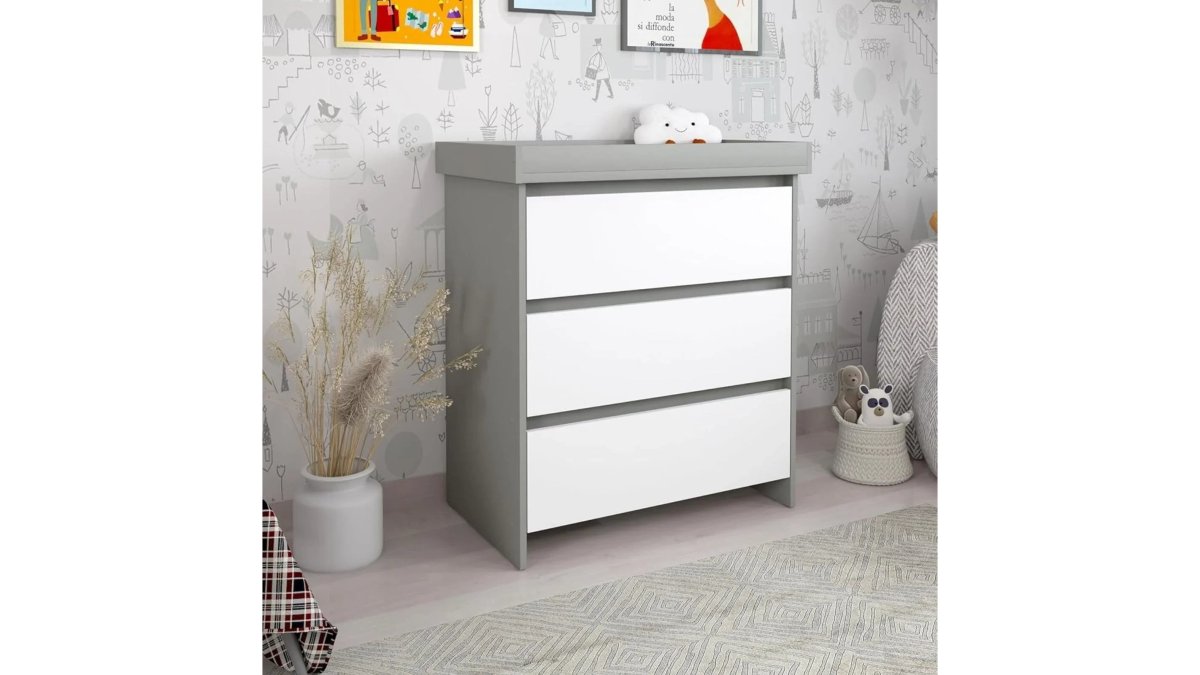
The removable changing top is the detail most guides miss. When nappy days end, the top comes off and the unit becomes a three-drawer dresser. That means it moves from the nursery to a toddler's room without being replaced.
Three deep drawers keep everything within reach: nappies on top, wipes and creams beside them, vests and sleepsuits in the middle, blankets in the bottom. No more reaching across the room mid-change.
What most reviews miss is the posture point. Eight to twelve changes a day for months adds up, and a 90cm working height is the difference between comfortable and a sore back.
Ordering through The Nook and Nurture Company comes with next-day shipping and a 30-day risk-free trial, so you can check the height and finish in your own nursery before committing.
Mistakes to Avoid When Buying Eco-Friendly Changing Tables
The biggest mistake is buying on the word "eco" alone. Without named materials or a certification, you have no way to verify the claim, and you may pay a premium for a label rather than a difference.
Second is ignoring the height. A low unit feels fine in the shop and ruins your back at home. Measure your own standing height and check the unit against it.
Other common errors:
- Skipping the second-life question. A unit that becomes useless after nappies is a poor buy, however green the materials.
- Buying one pad cover. You will be washing it constantly; buy two.
- Forgetting the weight limit. Check when the changing top is no longer suitable and plan the switch.
- Not checking stability. Give any unit a firm nudge before use. If it rocks, it is not safe at height.
- Ignoring the finish smell. A lingering chemical odour is a reason to air the room and query the seller.
For broader guidance on keeping your home safe for a baby, the NHS advice on child safety is a useful reference.
Buying a changing table that is genuinely eco-friendly, safe, and built to last takes a little homework, but the payoff is a piece of furniture that serves your family for years rather than months. At The Nook and Nurture Company, we choose items with parents and babies in mind, back them with a 30-day risk-free trial, and ship next day so you can set up without the wait. Explore our changing tables and see how the Shefa Kids 880 fits your nursery, with secure SSL checkout and a full refund if it is not right for your space.
Frequently Asked Questions
What makes a baby changing table eco-friendly?
The biggest factors are the materials, the finish and how long the furniture lasts. Solid wood from responsibly managed sources, or board made with low-emission binders, is a better starting point than heavily glued composite panels. Look for water-based finishes rather than solvent-heavy lacquers, and check whether the unit converts to a dresser once nappy days end. Longevity is the most overlooked eco-friendly changing table feature: a unit that serves for years avoids the waste of a short-lived purchase.
Which materials are best for non-toxic changing tables?
Solid wood such as pine, beech or rubberwood is the simplest choice, because it needs less adhesive than composite boards. If you are buying a painted or varnished unit, ask what the finish contains and let it air before use. For non-toxic changing tables made from board, look for low-formaldehyde panels and edge sealing on every cut side. Avoid anything with a strong chemical smell on arrival, and check the pad separately, since the foam and cover sit closest to your baby.
Can a dresser be used as a baby changing table?
Yes, and it is one of the most practical changing table alternatives. The key requirement is a secure, raised changing surface with a lip or barrier on all four sides, plus a pad that does not slide. A standard dresser top is usually too low for comfortable changes, so measure the height before committing. A unit that already includes a removable changing top, like a dedicated changing unit, gives you the dresser later without buying twice.
How long do babies use a changing table?
Most families use a changing table for around 12 to 18 months, until their baby is too wriggly or too heavy for a raised surface. That short window is why convertible designs make sense: a unit with a removable top keeps working as a dresser for years afterwards. If you plan to use a changing table safety rail and strap, check the weight limit in the instructions and stop using the raised surface once your child reaches it.


