

Table of Contents
- Step 1: Measure Your Space and Plan Your Layout
- Step 2: Install Hooks, Shelving, and Built-In Cabinets
- Family Mudroom Storage Ideas That Work
- Small Mudroom Organisation Ideas for Tight Spaces
- Mudroom Organisation for Kids: Creating Accessible Zones
- Mudroom Organisation Checklist: What Every Family Needs
- Maintenance and Keeping Your Mudroom Tidy
- Frequently Asked Questions
Last Updated: October 16, 2026
Step 1: Measure Your Space and Plan Your Layout
Creating a functional family mudroom starts with measuring your entryway: width, depth, and ceiling height. Note where doors swing open, where windows sit, and how much wall space you have.
A common mistake is overestimating how much storage a small space can hold.
Sketch a simple layout. Mark where family members will naturally drop coats, bags, and shoes. This is your drop zone.
Consider traffic flow. If your mudroom connects the front door to the kitchen, keep the path clear and place bulkier items like benches against walls, not in the middle of the space.
Think about zones for each family member. A child's zone should be lower and more accessible. Adult zones can go higher.
| Planning Step | What to Measure | Why It Matters |
|---|---|---|
| Space dimensions | Width, depth, ceiling height | Determines what fits and how to arrange it |
| Wall space | Available wall length and obstacles | Guides hook and shelf placement |
| Traffic patterns | Door swings, natural pathways | Keeps storage out of the way |
| Family size | Number of people using the space | Determines how many zones you need |
| Seasonal needs | Winter coats, summer shoes | Affects storage capacity planning |
Step 2: Install Hooks, Shelving, and Built-In Cabinets
Hooks are the foundation of a functional family mudroom: fast, affordable, and work at any height.
Space hooks 30 centimetres apart so multiple coats don't bunch together. Staggered heights prevent one hook from blocking access to another.
Shelving gives you flexibility. Open shelves suit daily items like school bags and keys, while closed cabinets hide clutter.
Built-in cabinets contain mess and make the space feel finished. If you're renting or can't commit to permanent fixtures, freestanding cabinets work just as well.
Install shelving at varying heights. Lower shelves hold shoes and bags. Middle shelves store everyday items. Upper shelves keep seasonal gear out of the way until you need it.
Family Mudroom Storage Ideas That Work
The best family mudroom storage matches how your household actually lives. Generic solutions fail because they don't account for your specific clutter: school bags, sports equipment, wet shoes, and the mysterious items that accumulate by the door.
Benches and Seating for Drop Zones
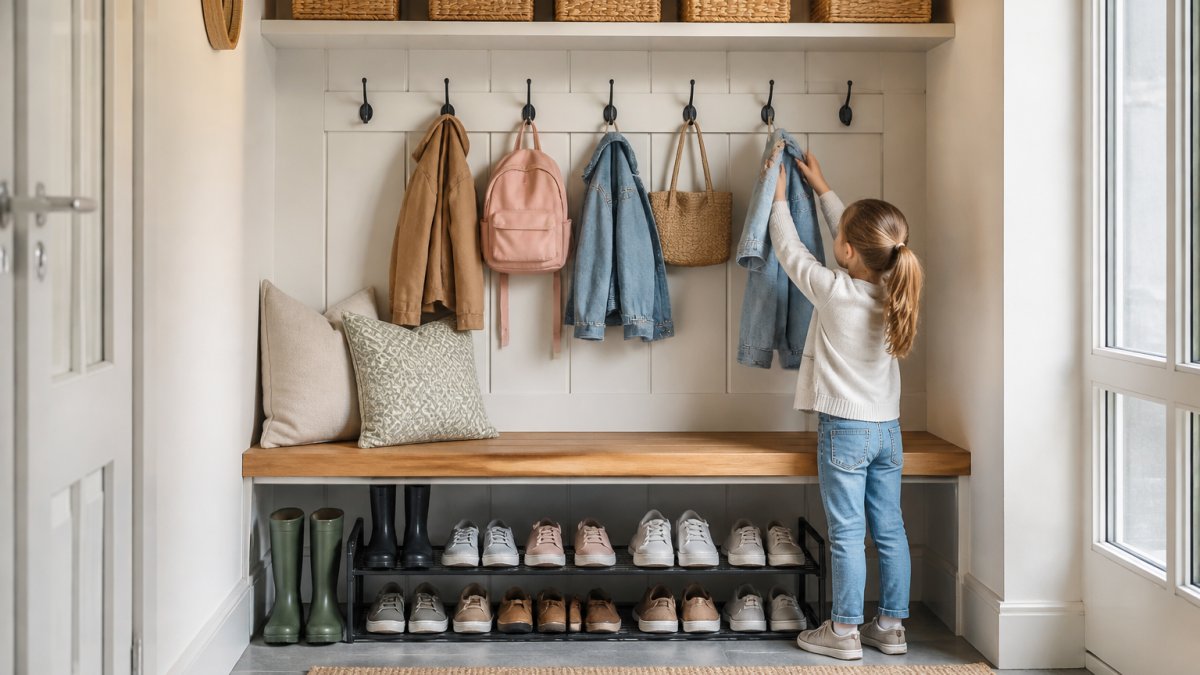
A simple wooden bench with storage underneath is ideal. You get seating and hidden storage in one piece. Look for benches with lift-up seats that reveal a storage compartment.
If space is tight, a narrow bench against one wall works fine. The key is a dedicated spot where items land instead of spreading across the floor.
Cushions make benches more inviting. A simple seat cushion signals this is a place to sit, not just a storage ledge, and kids are more likely to cooperate when the space feels intentional.
Shoe Storage and Cubbies
Shoes are the mudroom's biggest challenge. Wet trainers, boots, school shoes, and outdoor sandals accumulate fast. A dedicated shoe zone prevents them from spreading across the entryway.
A low shelf works well for everyday shoes. Arrange them in pairs, heel to toe, so they don't topple. Cubbies or individual slots keep pairs together and make it obvious when someone's left a shoe behind.
For families with many children, a cubby system gives each child their own labelled slot, making it clear whose shoes go where and teaching accountability.
Seagrass or woven baskets sit beautifully on shoe shelves and contain the visual clutter. The Nook and Nurture Company's Natural Seagrass Storage Basket Set offers three sizes that work perfectly for this, the largest basket holds several pairs of shoes, while smaller baskets keep accessories like socks or shoe polish organised.

A boot tray at the entrance catches drips before shoes reach the shelf. This simple step prevents water damage and keeps the rest of your home drier.
Concealed Storage for Everyday Clutter
Every family accumulates items that don't fit anywhere else: spare keys, permission slips, phone chargers, hair clips, lost buttons. These need a home, or they pile up on every surface.
Closed cabinets or drawers hide this clutter while keeping it accessible. A small drawer under a bench holds keys and chargers. A cabinet above shoe storage holds hats and gloves.
Labelled bins inside cabinets keep similar items together: one for keys and post, one for pet supplies, one for seasonal items. Labels make it easy to find things and put them back.
The Set Of Three Woven Palm Leaf Baskets by Lidi at £16.95 provides attractive, natural storage that works inside cabinets or on open shelves.

Small Mudroom Organisation Ideas for Tight Spaces
A small mudroom doesn't mean you can't be organised. It means you prioritise ruthlessly: keep only what you use regularly and store everything else elsewhere.
Vertical storage is your friend in tight spaces. Use walls instead of floor space. Hooks go higher, shelves go narrower, and every centimetre counts.
A slim bench that's only 30 centimetres deep fits into tight corners. A narrow shelf above it doubles your storage without taking up more floor space. Hooks on both sides of the door frame maximise wall coverage.
Remove anything that doesn't belong in a mudroom. Winter coats go on hooks, school bags on a shelf, and everything else lives in a bedroom closet or storage cupboard elsewhere.
Natural Seagrass Storage Basket Set →
Rental-Friendly and No-Built-In Solutions
Renting means you can't install permanent shelving or cabinets, but you can still create an organised mudroom with a different approach.
Over-the-door organisers hang on the inside or outside of your mudroom door. They hold shoes, small items, and accessories without taking up wall or floor space.
Lean-to shelving units stand against walls without bolting down. They're stable enough for everyday use and move with you when you leave.
The Maison & White Seagrass Storage Basket Set at £15.99 works beautifully in rental homes.
Hooks are your secret weapon in rentals. Adhesive hooks hold surprisingly heavy loads. A row of hooks on one wall creates a coat rack without a drill.
Mudroom Organisation for Kids: Creating Accessible Zones
Children use a mudroom differently than adults. They need things at their height, systems simple enough to follow without reminders, and visual cues about where things go.
Create a dedicated zone for each child: a low shelf, a set of hooks, a cubby with their name on it. This ownership makes them more likely to put things away.
Child-Height Hooks and Low Shelving
Install hooks at child height, around 100 centimetres for younger children, 120 centimetres for older ones. Hooks that are too high mean coats end up on the floor because kids can't reach them.
Low shelves should hold items children use independently: their school bag, shoes, and coat. If they have to ask an adult for help, they won't use the system.
Use pictures alongside labels for younger children who can't read yet. A picture of a coat above the coat hook. A picture of shoes above the shoe shelf. Visual cues work faster than written labels.
Lightweight baskets work better than heavy bins for children. The Lidi Oval Straw Basket Set at £28.95 offers three sizes that work across different zones, the smallest sits at child height for small items, while larger baskets go on higher shelves.

Pet Stations and Seasonal Storage
If you have pets, your mudroom needs a pet zone. Dog leads hang on a dedicated hook. Pet bowls sit in a basket. Towels for muddy paws stay within reach.
A low basket holds pet supplies: treats, toys, grooming tools. Keep it near the door so you don't forget the lead on a morning walk.
Seasonal storage takes up valuable mudroom space. Winter coats, summer sandals, and holiday decorations don't belong in a small mudroom year-round. Store them in a cupboard upstairs or in a garage instead.
A single high shelf in your mudroom can hold off-season items in clearly labelled boxes. When summer arrives, swap out winter coats for lighter jackets. This keeps your mudroom functional all year.
Mudroom Organisation Checklist: What Every Family Needs
A functional family mudroom includes these essential elements. Not all at once, prioritise based on your space and budget. Start with what your family needs most.
- Hooks for coats and bags at adult and child height
- Shoe storage or a dedicated shoe zone
- A bench or seating for putting on shoes
- Shelving for school bags, keys, and daily items
- Baskets or bins to contain small clutter
- A boot tray or mat to catch wet shoes
- Labels so family members know where things go
- Closed storage to hide everyday mess
- A charging station or drawer for phone cables
- Seasonal storage for off-season items
- A mirror so kids can check their appearance before leaving
- A designated pet zone if you have animals
Maintenance and Keeping Your Mudroom Tidy
An organised mudroom only stays organised with maintenance. A few simple habits keep clutter from building back up.
Weekly, clear items that don't belong. Shoes that have moved to other rooms go back to the mudroom. Post that's been read goes to recycling. School permission slips go to a designated folder.
Wipe down surfaces regularly. Muddy shoes leave marks. Wet coats drip. A quick wipe keeps your mudroom from looking grimy.
Check seasonally. As seasons change, swap out coats and shoes. Donate items no one uses. Tidy shelves and reorganise if something isn't working.
Involve the whole family.
A functional family mudroom transforms your entryway from cluttered chaos into an organised drop zone.
Frequently Asked Questions
What should every functional family mudroom include?
A functional family mudroom needs hooks for coats and bags, dedicated shoe storage, a bench or seating area, shelving or cubbies for each family member, and bins or baskets for everyday clutter. Include a drop zone near the door where items land when people arrive. If space allows, add a charging drawer for devices and a command centre for keys and post. The key is assigning a specific spot for each item so nothing gets lost.
How can you organise a mudroom for a busy family?
Create a mudroom organisation system by assigning each family member a dedicated zone with their own cubby, hooks, and shelf space. Label everything clearly so children know where their items belong. Use woven baskets like the Seagrass Basket Set or Lidi Oval Straw Baskets to contain small items and keep surfaces clear. Place frequently used items at eye level and within reach. Set a rule that coats hang, shoes go in the designated area, and bags go in their cubby before anyone moves deeper into the house.
What storage solutions work best for small mudroom spaces?
In small mudrooms, use vertical storage by installing tall shelving and hooks on walls. Choose oval-shaped baskets that tuck flush against walls rather than round ones that waste space. Wall-mounted benches save floor space while providing seating. Magnetic strips on doors hold keys. Over-the-door organisers add storage without taking up room. For rentals, freestanding storage units and command hooks avoid permanent damage. Prioritise multi-purpose furniture, such as a bench with storage underneath, to maximise every centimetre.
How do you keep a family mudroom tidy and organised?
Establish a daily routine where family members place items in their designated spots immediately upon arrival. Wipe down surfaces weekly to prevent moisture and dirt buildup. Empty bins and baskets regularly so they don't overflow. Use easy-to-clean materials like laminate and sealed wood that resist moisture from wet coats and shoes. Schedule a monthly sort to remove outgrown shoes and seasonal items. Make it easy for children by using low hooks and baskets at their height, so they're more likely to tidy up without help.


