

Table of Contents
- Why Montessori Toys Are Different: Hands-On Learning That Sticks
- Montessori Toys vs Traditional Toys: What Actually Changes for Your Toddler
- Montessori Toys for Fine Motor Skills: Building Dexterity Through Play
-
Montessori Toys by Age: What to Give a 1, 2, and 3-Year-Old
- 12 to 18 Months: Cause, Effect, and Chunky Grips
- 18 Months to 2.5 Years: Sorting, Stacking, and Simple Problem-Solving
- 2.5 to 3.5 Years: Sequencing, Patterns, and Pretend Play
- Adapting Toys for Different Abilities and Sensory Needs
- How to Introduce a Toy and Step Back
- Rotation, Quantity, and Avoiding Overbuying
- How to Choose Montessori Toys: A Practical Checklist for Parents
- Realistic Expectations: What Montessori Toys Can and Cannot Do
- Frequently Asked Questions
Last Updated: October 6, 2026
Why Montessori Toys Are Different: Hands-On Learning That Sticks
The benefits of montessori toys for toddlers come down to one idea: children learn best when they lead. Montessori toys are deliberately simple, hands-on objects that invite a toddler to explore, repeat, and solve problems without a screen or a voice telling them what to do.
The design logic is easy to miss if you have only ever bought toys from a supermarket aisle. Conventional toys tend to entertain the child. Montessori toys ask the child to do the work.
The Core Principles Behind the Design
Four principles separate a Montessori toy from an ordinary one:
- Child-led play. The toddler decides what the toy becomes, not the manufacturer.
- One skill at a time. A good toy isolates a single challenge, such as stacking or posting.
- Real materials and real weight. Wood and natural finishes give honest feedback in the hand.
That last point matters more than most parents realise. A ring that will not slide onto a spiral teaches patience and problem-solving at the same time.
Montessori Toys vs Traditional Toys: What Actually Changes for Your Toddler
The practical difference is attention. A flashing, beeping toy performs for the child; a wooden car waits to be pushed. Montessori toys vs traditional toys is really a question of who is in charge of the play, and the research on early development consistently favours the child.
The Problem With Flashing, Beeping, and Doing Everything for Them
A toy that sings, lights up, and counts for your toddler has already solved the problem. There is nothing left to figure out. A plain chunky wooden car offers no instructions at all, so the toddler invents the game: rolling it, lining it up, racing it.

That invented game is where concentration and curiosity grow.
Montessori Toys for Fine Motor Skills: Building Dexterity Through Play
Fine motor skills develop through repetition, not instruction.
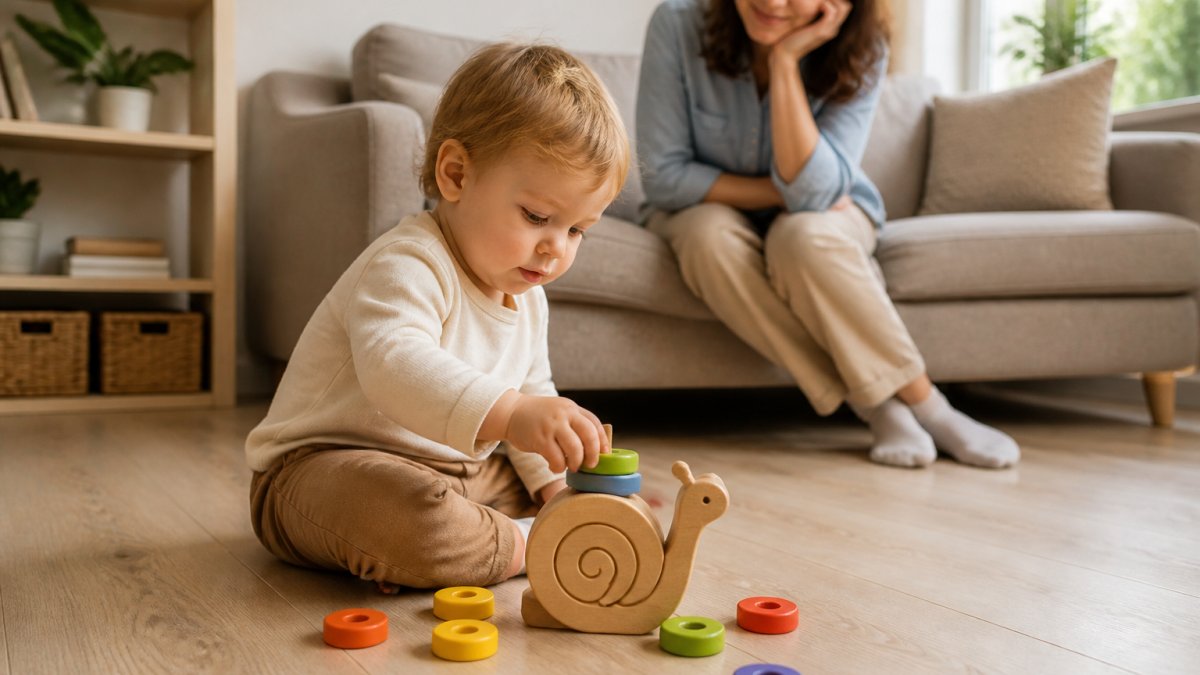
What most benefit lists skip is the sequence. Toddler hand development tends to move through recognisable stages, and the right toy at the right stage does more than a harder toy introduced too early:
- Palmar grasp (roughly 12-18 months). The whole hand wraps around an object. Chunky, lightweight pieces that fit a closed fist are the right challenge here.
- Pincer grasp (roughly 15-24 months). Thumb and forefinger start working together. Small knobs, pegs, and posting slots invite this grip without demanding precision the child does not yet have.
- Tripod and controlled release (roughly 2-3 years). The child can hold a piece between thumb and two fingers and place it deliberately. Stacking, threading, and simple lacing become possible.
A toy that isolates one of these grips, rather than combining five, lets a toddler practise the same movement dozens of times in a single sitting.
The Speedy Monkey Snail Educational Game is a good example.

Our Stacker Blocks Play Set does something similar with ten numbered blocks. Grasping, balancing, and rebuilding a tower works the same muscles, and the numbers add early counting without turning play into a lesson.
How to Tell It Is Working
Progress in fine motor control is quiet. A few signs worth watching for:
- The child reaches for a piece with thumb and forefinger rather than a whole-hand scoop.
- They place a ring or block rather than dropping it from height.
- They repeat the same action several times in a row without prompting.
If none of these appear after several weeks with the same toy, the challenge is probably too hard or too easy. Swap it for something one step up or down rather than adding a new toy on top.
Montessori Toys by Age: What to Give a 1, 2, and 3-Year-Old
Age is a rough guide, not a rule. A toddler who is walking early may be ready for sorting months before a peer, so match the toy to what your child can already do, then stretch it slightly. The bands below describe what most toddlers are working on, not what they must be doing.
12 to 18 Months: Cause, Effect, and Chunky Grips
At this stage, the goal is grip strength and cause and effect. Chunky shapes that are easy to hold and impossible to swallow work best.
What to watch for: does the child push the car and then look to see where it went? That look-back is the beginning of intentional play. If they only mouth the toy, keep it in rotation and try again in a few weeks.
18 Months to 2.5 Years: Sorting, Stacking, and Simple Problem-Solving
Sorting and stacking arrive here. The Six-Sided Activity Cube (£30.99) covers a lot of ground in one object: a shape sorter, a bead maze, spinning gears, a car maze, and a number tray, each on its own face.

A common pattern at this age is the child who can post a shape but not yet rotate it to fit. That is normal. The toy is doing its job by showing the mismatch.
2.5 to 3.5 Years: Sequencing, Patterns, and Pretend Play
Older toddlers want order and story. Numbered blocks, colour sequences, and simple pretend scenarios keep them engaged. This is where a stacker set earns its place, because the child starts sorting by number, colour, and size rather than just building.
At this stage you can introduce a second layer of difficulty without buying anything new: ask the child to build a tower with only the red blocks, or to line the blocks up from smallest to largest.
| Age | What They Are Working On | Good Fit |
|---|---|---|
| 12-18 months | Grip, cause and effect | Chunky wooden car |
| 18 months-2.5 years | Sorting, stacking, posting | Activity cube, snail game |
| 2.5-3.5 years | Sequencing, patterns, pretend play | Numbered stacker blocks |
Adapting Toys for Different Abilities and Sensory Needs
Not every toddler follows the same path, and the toy shelf should reflect that. A few adjustments that work well:
- For children with limited hand strength or motor delay, choose larger knobs, magnetic pieces, or velcro-backed shapes that need less precision to succeed.
- For children who seek sensory input, wooden toys with varied textures, weights, and finishes often hold attention better than uniform plastic.
- For children who are sensitive to noise or visual clutter, avoid battery toys with lights and sounds, and present one toy at a time on a plain surface.
If your child has an identified developmental need, an occupational therapist or health visitor can suggest specific adaptations. The principle stays the same: match the challenge to the child, not the child to the toy.
How to Introduce a Toy and Step Back
A new toy rarely needs a demonstration. Try this sequence:
- Place the toy on a low surface within reach and sit nearby without speaking.
- Let the child explore it however they like for a few minutes, even if they use it "wrongly".
- If they lose interest, model one action slowly, once, and then stop.
- Watch what they repeat. That repetition is the skill they are building.
- Only intervene if they become frustrated enough to give up. A little struggle is productive; distress is not.
Rotation, Quantity, and Avoiding Overbuying
More toys do not mean more play. A toddler faced with a crowded shelf tends to flit between objects and settle on none. A workable approach:
- Keep six to eight toys accessible at any one time.
- Store the rest out of sight and swap a few every week or two.
- Bring back a rotated toy as if it were new; toddlers often rediscover it with fresh attention.
This approach also keeps cost down. A small, well-chosen collection that gets rotated will see more use than a large one that sits in a heap.
How to Choose Montessori Toys: A Practical Checklist for Parents
Choosing well is mostly about subtraction. Fewer toys, better made, rotated regularly, will hold a toddler's attention far longer than a full toy box.
- Does the toy do one thing well, or does it try to do everything?
- Can my child use it without me demonstrating first?
- Is it made from wood or another natural material with a smooth finish?
Safety, Materials, and What the Labels Actually Mean
In the UK, toys sold for children under 14 must carry the UKCA or CE marking and meet the Toy (Safety) Regulations 2011, which cover choking hazards, materials, and chemical limits. Look for that marking, check the age warning, and inspect seams and small parts yourself. Second-hand wooden toys are fine if the paint is intact and there are no loose pieces.
Realistic Expectations: What Montessori Toys Can and Cannot Do
Montessori toys support development; they do not accelerate it beyond a child's own timeline. A stacking toy will not make a toddler read earlier, and no single purchase will transform behaviour.
Where conventional toys still win: a push-along walker with wheels and a handle can be genuinely useful for a toddler learning to walk, and some electronic toys are helpful for children who respond well to sound and music.
Frequently Asked Questions
Why are Montessori toys good for toddlers?
Montessori toys are designed to match what a toddler's brain and body are ready to do. Instead of flashing lights or loud sounds, they rely on simple, hands-on exploration: stacking, sorting, threading, and pushing. This builds fine motor skills, hand-eye coordination, and concentration because your child is actively doing something rather than watching a toy perform. The open-ended design also encourages problem-solving and independence, as there is no single 'right' way to play, so toddlers learn to test ideas and try again.
What makes a toy a Montessori toy?
A Montessori toy is usually made from natural materials like wood, has a simple, uncluttered design, and is self-correcting so your child can see for themselves if something does not work. It is open-ended, meaning it can be used in multiple ways, and it is sized for a toddler's hands. A chunky wooden car or a set of numbered stacking blocks fits this description: no batteries, no screens, and no instructions needed. The toy invites your child to lead the play.
Are wooden toys better for toddlers than plastic ones?
Wooden toys are often favoured in Montessori settings because they are durable, feel warm and solid in the hand, and do not rely on batteries or sounds. That said, plastic toys can also be valuable if they are open-ended and safe. The key is not the material itself but how the toy is used. A BPA-free plastic stacking set can support the same skills as a wooden one. What matters more is whether the toy lets your toddler explore, build, and solve problems independently.
How do I choose the right Montessori toys by age for my toddler?
Match the toy to what your toddler can physically and mentally do. At 12 to 18 months, choose chunky objects for grasping and cause-and-effect, like a wooden car or a simple activity cube. From 18 months to 2.5 years, look for sorting, stacking, and nesting toys that build problem-solving. Between 2.5 and 3.5 years, introduce sequencing, counting, and pretend play. Always check for small parts that could be a choking hazard and look for non-toxic finishes.
Every toddler develops at their own pace, and the right toy is the one that meets your child where they are. The Nook and Nurture Company curates wooden and educational toys with parents in mind, backed by guaranteed next day shipping, 100% secure payments with SSL encryption, and a 30-day risk-free trial with a full refund if something is not right. Get started with The Nook and Nurture Company and build a toy shelf your toddler will actually use.


