

Table of Contents
- Why Back Support Matters When Choosing a Baby Carrier
- Ergonomic Baby Carrier Benefits for Parent and Baby
- Hip-Healthy Baby Carrier Standards Explained
- How to Adjust a Baby Carrier for Back Pain
- Best Baby Carriers for Back Support UK: Top Picks Compared
- Front-Inward vs Back Carry: Which Position Suits Your Back?
- Choosing the Best Baby Carrier for Back Support: Key Features
- Frequently Asked Questions
Last Updated: September 13, 2026
Why Back Support Matters When Choosing a Baby Carrier
A baby carrier is only as good as the support it gives the adult wearing it. Most parents focus on the baby's comfort, then discover weeks later that their own shoulders, mid-back and hips are paying the price, after wearing it for hours a day, for a year or more. At The Nook and Nurture Company, we hear the same story constantly, and it almost always starts with a carrier bought for looks rather than load distribution.
The fix is rarely a stronger back, but a better-designed carrier worn correctly. This guide covers what genuine back support looks like in the best baby carriers for back support UK parents can buy, how to adjust one, and which features reduce strain.
Ergonomic Baby Carrier Benefits for Parent and Baby
The main ergonomic baby carrier benefits are even weight distribution for the wearer and a hip-healthy seated position for the baby. A well-designed carrier spreads your child's weight across your hips and torso rather than your neck and upper back, and holds the baby's legs in an "M" position, knees higher than bottom.
How Ergonomic Design Protects Your Spine and Pelvic Floor
Ergonomic design protects your spine by keeping the load close to your centre of gravity. Holding your baby high and tight against your chest shortens the lever arm between the weight and your spine, and a wide, structured waist belt transfers much of that load to your pelvis.
That pelvic transfer matters even more during postpartum recovery. Pregnancy and birth place significant demand on the pelvic floor and core, and many parents find their trunk stability reduced for months afterwards. A carrier that relies on shoulder straps alone forces your core to compensate for every movement; one that spreads weight to the hips lets your core stabilise.
Hip-Healthy Baby Carrier Standards Explained
Hip-healthy baby carrier standards describe how a carrier should position a baby's hips to support healthy joint development. The recognised benchmark is the "M" position: thighs supported to the knee, knees level with or slightly above the hips, and the spine supported in a natural curve (hipdysplasia.org). Carriers that let the legs dangle straight down, or hold the baby by the crotch, do not meet this standard.
The International Hip Dysplasia Institute is the body most often referenced for this guidance, and its hip-healthy carrier guidance is worth reading before you buy. The practical takeaway is simple: look for a carrier with a wide, adjustable seat panel that supports the thighs, not a narrow strip between the legs. A newborn insert is often needed to achieve the correct position for very small babies.
| Feature | What It Does | Why It Matters |
|---|---|---|
| Wide seat panel | Supports thighs to the knee | Keeps hips in the "M" position |
| Adjustable seat width | Grows with your baby | Correct fit from newborn to toddler |
| Structured waist belt | Transfers load to pelvis | Reduces shoulder and upper back strain |
| Padded shoulder straps | Spreads pressure | Prevents pressure points and numbness |
| Breathable mesh | Improves airflow | Keeps both wearer and baby cooler |
How to Adjust a Baby Carrier for Back Pain
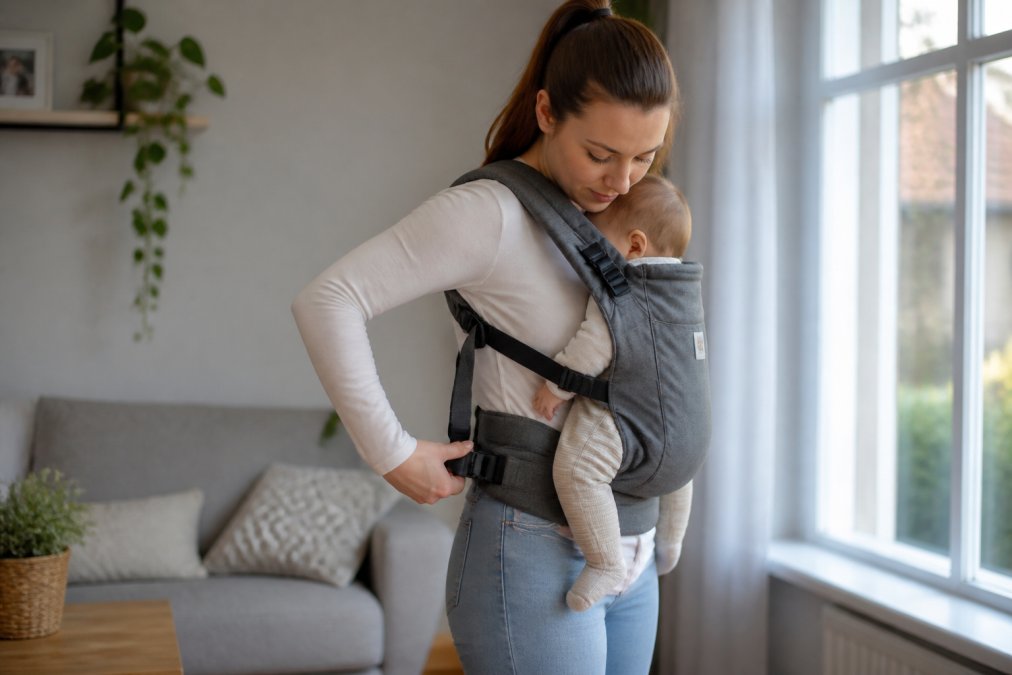
Knowing how to adjust a baby carrier for back pain is mostly about sequence and height. Get the order right and the carrier does the work; get it wrong and no amount of strap-tightening will help. The goal: a carrier that sits high on your back, holds your baby tight, and takes its weight through your hips.
Step-by-Step: Setting Up Your Carrier Correctly
- Fasten the waist belt first, sitting it on your hip bones, not your waist. Tighten until it feels firm but you can still breathe deeply.
- Lift your baby into the carrier and settle them high on your chest, close enough to kiss the top of their head.
- Bring the back panel up and fasten the shoulder straps, keeping them snug but not tight.
- Adjust the seat panel width so it supports from knee to knee.
- Tighten the shoulder straps last, just enough to remove slack.
- Check the position in a mirror: baby upright, chin clear of their chest, face visible at all times.
A common mistake is letting the waist belt ride up onto the soft part of the waist: comfortable for ten minutes, painful after an hour. Another is wearing the carrier too low, which pushes your baby's weight forward and forces your lower back to arch.
Best Baby Carriers for Back Support UK: Top Picks Compared
The best baby carriers for back support UK parents can rely on share four things: a structured waist belt, padded shoulder straps, an adjustable seat panel and breathable materials. Beyond that, the right choice depends on your body type, your baby's age and how you plan to use it.
At The Nook and Nurture Company, every carrier we stock is chosen with the wearer's back in mind as much as the baby's hips. Our 30-day risk-free trial lets you wear a carrier properly, with your baby in it, before you commit, if it does not suit your back or your baby, you get a full refund.
What to Look For, Category by Category
Rather than name a single winner, understand what each carrier category does well for back support, so you can match it to your body and routine.
Soft-structured carriers (SSCs) are the workhorse for most parents, suiting babies from around 3.5 kg (with a newborn insert where required) up to roughly 15-20 kg. The back-support features that matter most are a wide, padded waist belt that sits on the hip bones and a seat panel that adjusts from narrow (newborn) to wide (toddler), supporting knee-to-knee.
Convertible carriers offer both front-inward and back carry in one product, with a similar weight range to SSCs. The trade-off is more straps and buckles to adjust. For back support, the waist belt must remain structured in both positions, not just the front.
Hiking backpack carriers use a rigid frame and load lifters to move weight onto your hips and off your shoulders. They suit older babies and toddlers who can sit unsupported, often from around 7-9 kg upwards, and have a higher weight ceiling than soft carriers. Excellent for long walks on uneven ground, but bulky in shops and on public transport.
Wraps and stretchy carriers distribute pressure evenly across the torso and are popular for the first few weeks, but offer less structured back support as your baby grows heavier. Most parents transition to an SSC or convertible carrier once their baby passes roughly 7-9 kg.
| Carrier Type | Typical Weight Range | Best For | Key Back-Support Feature | Watch Out For |
|---|---|---|---|---|
| Everyday soft-structured | ~3.5-20 kg | Daily use, newborn to toddler | Wide padded waist belt | Narrow seat panels |
| Convertible carrier | ~3.5-20 kg | Front-inward and back carry | Adjustable seat width | Fiddly strap changes |
| Hiking backpack carrier | ~7-20 kg+ | Long walks, older babies | Rigid frame, load lifters | Bulk in tight spaces |
| Wrap or stretchy carrier | ~3.5-9 kg | Newborns, first weeks | Even pressure across torso | Less structure as baby grows |
The Parent-Health Test Most Reviews Skip
Most buying guides test a carrier for ten minutes in a shop. That tells you almost nothing about how it will feel after two hours on a Saturday walk with a sleeping toddler. When you try a carrier, do these three things:
- Wear it for at least 20 minutes with your baby in it. Back strain often appears after the first ten minutes, not immediately.
- Walk up and down stairs. This is where a poorly fitted waist belt reveals itself, because the load shifts with each step.
- Check the pressure points. Red marks on your shoulders or under your arms after a short wear usually mean the straps are too narrow or the waist belt is not carrying enough of the load.
If you are buying online, look for a retailer that allows a proper trial period with your baby, not just a returns window for an unused item.
Front-Inward vs Back Carry: Which Position Suits Your Back?
Front-inward carry suits most parents for the first year, while back carry becomes more comfortable as your baby grows heavier. Front-inward keeps the load centred and lets you monitor your baby's breathing and positioning easily. Once your child can sit up unaided and has good head control, a back carry moves the weight behind you and off your chest, which many parents find easier on the lower back during longer carries.
The Four Positions and What Each Does to Your Back
Front-inward (parent-facing). The default for newborns and most of the first year. The load sits close to your centre of gravity, the easiest position for your spine. Keep your baby high on your chest, close enough to kiss the top of their head, with their chin clear of their chest.
Front-outward (world-facing). Popular once babies become curious, but it shifts the load forward and away from your centre of gravity, increasing strain on your lower back and shoulders. Most babywearing guidance suggests limiting outward-facing sessions to short periods, and only once your baby has good head and neck control, typically from around four to six months (the NHS). Check that the seat panel still supports the thighs and that your baby's hips remain in the "M" position.
Back carry. Once your baby can sit up unaided, usually from around six months, a back carry moves the weight behind you and off your chest. Many parents find this the most comfortable position for longer walks and heavier toddlers, because the load sits over the hips and the spine stays upright. The trade-off: you cannot see your baby's face, so check positioning regularly.
Hip carry. A useful middle option for short periods, particularly for babies who want to see the world but are not yet ready for a back carry. It puts the load on one hip, so it is best used in short bursts rather than for long walks.
When to Switch Positions
There is no fixed date for moving from front to back carry, the trigger is your baby's development, not their age. Wait until your baby can sit up unaided and has good head and neck control. If unsure, keep them front-inward a little longer; front-inward remains safe and supportive well into the second year for many families.
Safety Checks for Every Position
Whichever position you use, run through the same checks each time:
- Airway: your baby's chin should never drop toward their chest. You should be able to fit two fingers under their chin.
- Face: your baby's face should be visible to you at all times, or at least easy to check.
- Position: baby upright, not slumped, with their back supported in a natural curve.
- Hips: thighs supported to the knee, knees level with or slightly above the hips.
- Fit: the carrier should feel snug, with no gaps that let your baby slump or shift.
If you use an outward-facing setting, keep sessions short and check that your baby's hips and spine are still well supported. Parent-facing remains the more comfortable option for extended wear.
Choosing the Best Baby Carrier for Back Support: Key Features
Choosing the best baby carrier for back support comes down to matching the carrier's structure to your body and routine. Prioritise a waist belt that sits on your hips, shoulder straps wide enough to avoid digging in, and a seat panel that adjusts as your baby grows. Try before you commit, with your baby in it, not just on a hanger.
Sizing for Different Body Types
Sizing is where most buying guides fall short, and it decides whether a carrier actually works for you. Carriers are not one-size-fits-all, and the same model can feel supportive on one parent and painful on another.
- Petite frames: look for a carrier with a shorter back panel and a waist belt that tightens down far enough without bunching.
- Tall frames: check the torso length. A panel that sits too low will pull your baby away from your chest.
- Broader shoulders: padded straps that cross at the back can dig in; a carrier with straight straps often fits better.
- Larger bodies: confirm the waist belt extends far enough and that any extension straps are included, not sold separately.
Durability matters too. A carrier is washed repeatedly, tugged on daily and exposed to sun, rain and snack spills. Look for reinforced stitching at the strap anchors, one-handed buckles and machine-washable fabrics. A carrier that holds its shape after a year of daily use is worth far more than one that sags after a month.
Frequently Asked Questions
What is the best baby carrier for someone with back pain?
Look for a carrier with a wide, padded waist belt that transfers weight to your hips rather than your shoulders. Structured carriers with lumbar support and adjustable shoulder straps tend to work best for parents with existing back pain. A waist belt that sits snugly on your hips, combined with a supportive panel that holds your baby in an upright position, reduces strain on your lower back significantly. Always adjust the carrier so your baby sits high enough to kiss their head comfortably.
Are structured carriers better for back support than wraps?
Structured carriers generally offer more back support because they distribute weight through a firm waist belt and padded shoulder straps. Wraps can work well for newborns and short periods, but they rely more on your shoulders and upper back to carry the load. For longer wear times or heavier babies, a structured carrier with lumbar support and an adjustable harness gives your spine better alignment and reduces pressure points across your shoulders and lower back.
What features should I look for in a baby carrier for lumbar support?
Prioritise a wide waist belt that sits on your hips, padded shoulder straps that adjust easily, and a supportive panel that keeps your baby in the hip-healthy M-position. Breathable mesh fabric helps with airflow during longer wears. Look for a carrier that has been tried and tested for weight capacity. An adjustable harness lets you fine-tune the fit as your body changes during postpartum recovery, which matters for maintaining good spinal alignment.
Is it safe to use a baby carrier if I have a history of back issues?
Many parents with back issues use baby carriers successfully, but the key is choosing one with proper weight distribution and adjusting it correctly. A carrier with a firm waist belt and lumbar support shifts weight to your hips, reducing load on your spine. Start with shorter wearing sessions and build up gradually. If you have a diagnosed spinal condition or are in postpartum recovery, speak to your GP or a physiotherapist before wearing your baby for extended periods.
Back strain from babywearing is common, but it is rarely unavoidable. It usually traces back to a carrier that spreads weight poorly or a fit that was never adjusted properly. The Nook and Nurture Company stocks carriers chosen for genuine ergonomic support, backed by a 30-day risk-free trial, guaranteed next-day shipping and 100% secure payments. Get started with The Nook and Nurture Company and find a carrier that supports your back as well as it supports your baby.


