

Table of Contents
- Step 1: Match Toys to Developmental Milestones for Babies 0-12 Months
- Step 2: Check UKCA Safety Standards for Baby Toys Before You Buy
- Step 3: Prioritise Open-Ended Play Over Structured Toys
- Step 4: Choose Safe Materials and Check for Choking Hazards
- Step 5: Learn How to Rotate Baby Toys to Encourage Focus
- Step 6: Spot the Signs of Toy-Related Overstimulation
- Step 7: Build a Toy Collection That Grows With Your Baby
- Frequently Asked Questions
Last Updated: September 23, 2026
Step 1: Match Toys to Developmental Milestones for Babies 0-12 Months
Choosing age-appropriate developmental toys starts with one question: what can your baby actually do this month? Toys that match current abilities get played with. Toys that run ahead of them sit in a basket.
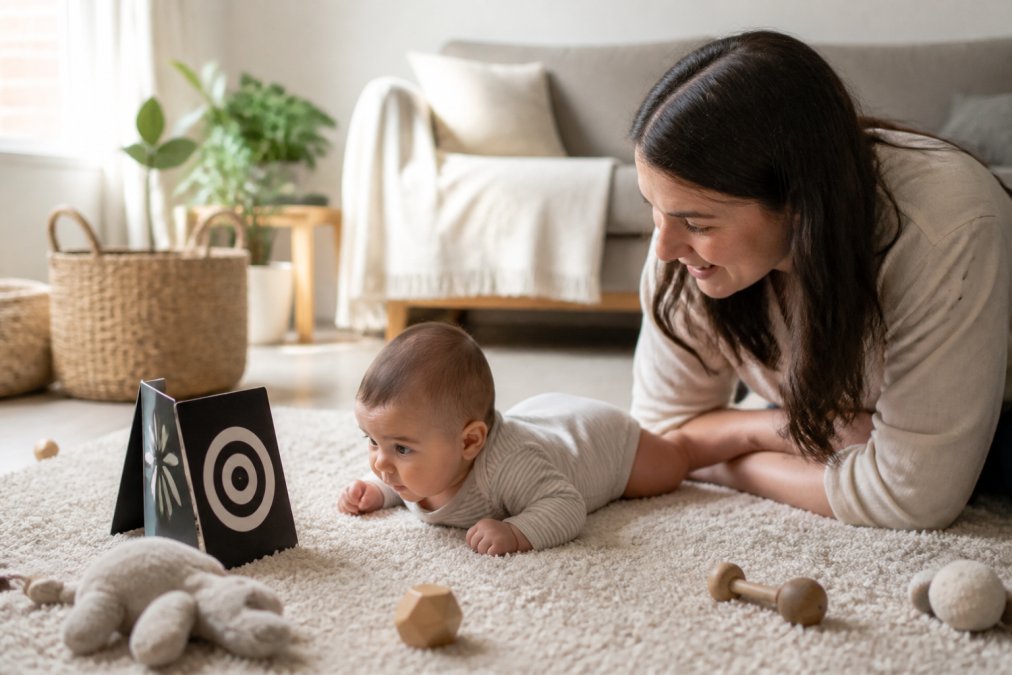
Developmental toys are objects designed to build specific skills, like grasping, tracking, or problem-solving, at the stage your baby is ready for them. At The Nook and Nurture Company, we group the first year into three broad windows, because a newborn and a nine-month-old need very different things.
The table below shows what to look for at each stage.
| Age | Key Skills Emerging | What to Look For |
|---|---|---|
| 0-3 months | Visual tracking, head lifting | High-contrast cards, soft sounds |
| 3-6 months | Reaching, grasping, rolling | Light rattles, textured fabrics |
| 6-12 months | Sitting, stacking, posting | Stacking rings, shape sorters |
0-3 Months: High-Contrast Visuals and Gentle Sounds
Newborn eyes see bold shapes and strong contrast long before they see colour. High-contrast visual cards are the single most useful toy in this window. They support visual tracking and give you something to prop up during tummy time.
3-6 Months: Grasping, Reaching, and Tummy Time Play
Grasping becomes deliberate around this stage. Your baby starts reaching for what they see, which is where hand-eye coordination begins.
6-12 Months: Cause-and-Effect, Stacking, and Problem-Solving
Sitting up changes everything. Once your baby has a free hand and a stable base, stacking, posting, and sorting become possible.
Step 2: Check UKCA Safety Standards for Baby Toys Before You Buy
Every toy sold for children under 14 in Great Britain must carry the UKCA mark. That mark is your first filter, and it is not optional.
What to check on the label:
- The UKCA mark, clearly visible
- A minimum age warning where relevant
- The manufacturer or importer's name and address
- Safety warnings in English
Step 3: Prioritise Open-Ended Play Over Structured Toys
Open-ended play beats structured toys for the simple reason that it grows with your child. A toy with one button does one thing. A toy with no fixed outcome does a hundred.
Step 4: Choose Safe Materials and Check for Choking Hazards
Material choice and choking risk are the two safety checks that matter most once a toy is in your home. Most guides stop at "avoid small parts". The useful version is knowing what to look for on the label and how to test a toy yourself in under a minute.
Reading the material, not the marketing
What you can rely on is the material itself:
- Untreated or naturally finished wood (beech, maple, rubberwood) has no coating to chip or wear through. Look for finishes described as linseed, beeswax, or water-based rather than "lacquered".
- Food-grade silicone is stable, chew-safe, and does not leach the way some soft plastics can when mouthed repeatedly.
- ABS plastic is the common hard plastic in stacking rings and shape sorters. It is durable, but check that any paint or print is described as EN 71-3 compliant, which covers migration of certain elements.
- Soft PVC (often found in cheap bath toys and squeeze toys) is the one to be cautious with, particularly if it has a strong plasticky smell out of the box.
A quick sniff test is genuinely useful: a strong chemical odour usually means plasticisers or solvents you would rather your baby did not mouth.

The choking check, done properly
The small-parts cylinder is a standard test. Anything that fits entirely inside it is a hazard for a child under three. But the cylinder only catches whole objects. The failures parents actually report are usually detachable parts:
The Newborn Sensory Box (0-6+ Months) →
- Squeeze the toy. If an eye, bead, or squeaker shifts or feels loose, it will come off.
- Tug any fabric attachment. Crinkle tags and ribbon loops should be stitched through, not glued.
- Check seams on soft toys. A gap you can see is a gap that will open.
- Measure cords and strings. Anything over 220mm is a strangulation risk and should be cut or the toy retired.
The checks that are easy to forget
- Batteries. If a toy takes button cells, the compartment must be screwed shut, not clipped. Button batteries are a serious ingestion hazard and the reason many battery toys carry a minimum age of three.
- Magnets. Small high-strength magnets are dangerous if swallowed in pairs. Avoid any toy where magnets are accessible.
- Paint wear. Check painted wooden toys monthly. If you can see bare wood through the paint, the coating is failing and the toy should go.
A note on wood versus plastic
Wooden toys tend to last longer, hold their finish better, and are easier to pass on. Plastic toys are often cheaper, lighter, and easier to clean. Neither is automatically safer. A well-made ABS shape sorter with EN 71-3 compliant paint is a better choice than a cheap wooden toy with a flaking lacquer finish. Judge the specific toy, not the material category.
Step 5: Learn How to Rotate Baby Toys to Encourage Focus
Knowing how to rotate baby toys is the difference between a playroom that works and one that overwhelms. Most guides tell you to rotate. Almost none tell you what to keep out, how to decide, or what to do with the rest. That is the part that actually matters.
Why rotation works
Most babies play longer with three toys than with thirty. Too much choice scatters attention, and a toy that is always available stops being interesting. Rotation solves both problems at once: it keeps the number of options low and the novelty high, without buying anything new.
What to keep out at each stage
Aim for four to six toys on the floor at any one time, chosen to cover different skills rather than different themes:
- 0-3 months: one high-contrast card set, one soft rattle, one textured fabric piece. That is genuinely enough.
- 3-6 months: one grasping toy, one crinkle or textured item, one soft rattle, one tummy-time prop.
- 6-12 months: one stacking or posting toy, one cause-and-effect toy, one open-ended piece, one comfort item.
The rotation system, step by step
- Pick four to six toys for the current week, covering different skills.
- Store the rest out of sight, not just in a corner. A lidded basket or a high shelf works; a clear box on the floor does not.
- Swap the set every one to two weeks. Weekly suits younger babies; fortnightly suits older ones who are still working something out.
- Watch which toys get ignored two rotations running. Those are the ones to retire, donate, or store for a younger sibling.
- Keep one or two "anchor" toys out permanently, usually a comfort object or a favourite open-ended piece.
Handling the clutter problem
The rotation system only works if the out-of-sight toys have a proper home. A single deep basket becomes a jumble within a month. Two or three shallow baskets, sorted by stage, make the swap take two minutes instead of twenty.
When to stop rotating
Rotation is a tool, not a rule. Once your baby is mobile and starts seeking out specific toys from the basket themselves, you can loosen the system. The goal was never a perfect schedule. It was a floor with enough space for your baby to focus.
Step 6: Spot the Signs of Toy-Related Overstimulation
Toy-related overstimulation looks like a meltdown but is really a nervous system hitting its limit. More toys and more noise do not equal more learning.
Watch for these signs:
- Turning away from a toy or arching the back
- Crying that starts suddenly during play
- Rubbing eyes, yawning, or going limp
- Fussiness that stops the moment the room goes quiet
Step 7: Build a Toy Collection That Grows With Your Baby
A good toy collection is not the biggest one. It is the one that still works in six months.
Build in layers:
- Sensory basics for the first months, like the Newborn Sensory Box
- Fine motor tools for grasping and posting
- Problem-solving toys for the sitting and crawling stage
- One or two open-ended pieces that survive every stage
Frequently Asked Questions
What are some age-appropriate toys for babies?
For newborns up to 3 months, high-contrast cards, soft rattles, and tactile fabrics support visual tracking and early sensory development. From 3 to 6 months, grasping toys and stacking rings build fine motor skills and hand-eye coordination. Between 6 and 12 months, shape sorters, activity cubes, and rollable toys encourage problem-solving, cause-and-effect learning, and spatial awareness. The key is matching the toy to what your baby can currently do, not what they will do months from now.
How do I know if a toy is safe for my baby?
Look for the UKCA mark, which confirms the toy meets UK safety requirements for children's products. Check for small parts that could become choking hazards, especially for babies under 36 months. Avoid toys with loose strings longer than 220mm, sharp edges, or toxic finishes. For teething babies, choose BPA-free and non-toxic materials.
How many toys should a baby have for optimal development?
Fewer than you think. Many parents find that 8 to 12 well-chosen toys, rotated regularly, keep a baby more engaged than a room full of options. Too many choices can lead to overstimulation, shorter attention spans, and less deep play. Store the rest and swap them every one to two weeks so each rotation feels fresh and encourages focused exploration.
Are expensive educational toys better for baby development?
Price does not determine developmental value. A £9.99 set of stacking rings teaches size sequencing, colour recognition, and fine motor skills just as effectively as a £50 electronic toy. What matters is whether the toy matches your baby's current developmental stage and invites open-ended play. Simple, well-made toys that let babies explore through touch, movement, and trial-and-error often support development better than battery-operated alternatives that do the playing for them.


