

Table of Contents
- What You'll Need Before Shopping
- Understanding Choking Hazards for Babies
- Check for UKCA Marking on Toys
- Selecting Non-Toxic Baby Toys
- Inspect Physical Safety Features
- Match Toys to Developmental Milestones
- Common Mistakes to Avoid
- Conclusion
Last Updated: August 16, 2026
What You'll Need Before Shopping
Gather a magnifying glass to spot small detachable parts, keep your phone handy for recall checks, and use a ruler to verify components meet the 5cm safety threshold, anything smaller than a toilet paper roll poses a choking risk for babies under three. Most importantly, bookmark the Office for Product Safety and Standards product recall database before you shop, and familiarise yourself with UKCA marking requirements, which indicate that a product meets UK safety standards.
Note your baby's age and developmental stage, as what's safe for a six-month-old can be dangerous for a one-year-old. Write down whether your little one is teething, learning to grasp, or starting to explore independently.
Understanding Choking Hazards for Babies
Choking hazards represent the single greatest risk when selecting toys for young children. A choking hazard is any object small enough to fit entirely inside a child's mouth without being able to breathe around it. The standard test uses a cylinder measuring 31.75mm in diameter, roughly the size of a toilet paper roll. If something fits entirely through that cylinder, it's too small for children under three years old.
Small parts come in many forms: beads, buttons, small magnets, unsecured battery compartments, crumbling foam, and detachable eyes on stuffed animals. Babies explore the world through their mouths, especially between six and eighteen months, and don't understand that swallowing something is dangerous.
The danger extends beyond obvious small objects. Foam that breaks apart, loose stitching that unravels, and paint or coating materials that flake off all pose potential hazards. When you inspect a toy, consider not just what's obviously loose but what could become loose with normal use.
Age matters tremendously. Toys marked for babies under 12 months have different safety requirements than toys for toddlers aged 12-36 months. Always check the age range on the packaging, small toys without proper safety certification are among the most dangerous items in a nursery.
Check for UKCA Marking on Toys
The UKCA marking is your most important safety signal when shopping for baby toys. UKCA stands for UK Conformity Assessed, and it indicates that a toy meets the essential safety requirements set out in the Toy Safety Regulations 2011. Any toy sold in the UK market should display this marking clearly on the packaging or the toy itself.
The UKCA marking looks like the letters "UKCA" inside a distinctive shape and is usually printed near other product information. If a toy doesn't have this marking, it hasn't been assessed for UK safety standards and you should avoid it.
The presence of UKCA marking means the manufacturer has tested the toy against specific safety standards covering choking hazards, chemical safety, flammability, mechanical hazards, and electrical safety. Some manufacturers also seek CE marking or third-party certifications from organisations that verify non-toxic materials and finishes, adding further assurance.
Selecting Non-Toxic Baby Toys
Non-toxic materials matter because babies put everything in their mouths, and their bodies absorb substances differently than adults do. Look for toys made from organic cotton, sustainably harvested wood, or natural rubber. When examining wooden toys, check that they're finished with water-based, non-toxic paints or natural oils rather than chemical coatings.
Soft toys should use organic cotton or natural fibres certified free from harmful dyes. Check labels for certifications like GOTS (Global Organic Textile Standard). Avoid toys with strong chemical smells, which indicate off-gassing of volatile organic compounds.
Plastic toys require scrutiny around BPA and phthalates. While UK regulations prohibit the most harmful chemicals, prioritise toys explicitly labelled as BPA-free and phthalate-free. Rigid plastics are generally safer than soft plastics, which are more likely to degrade and release chemicals.
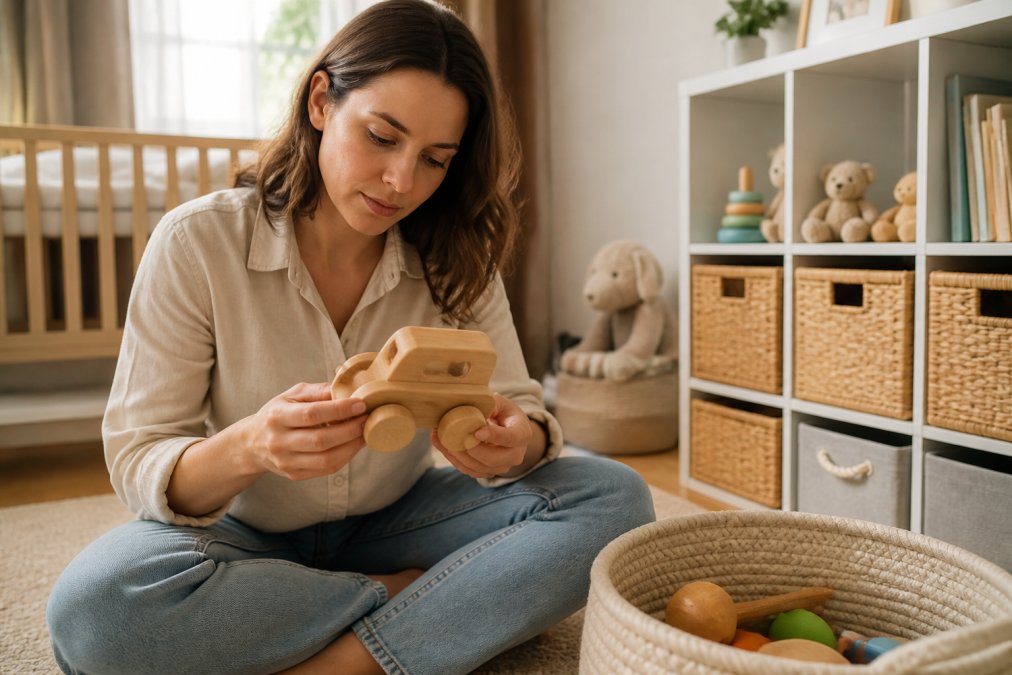
At The Nook and Nurture Company, we carefully select toys that meet strict non-toxic standards. Our Newborn Sensory Box includes toys designed with natural materials and safe finishes, giving new parents confidence that their baby is exploring safely.

Inspect Physical Safety Features
Physical safety features determine whether a toy will hold up to normal baby use without becoming dangerous. Your inspection should cover durability, construction quality, and the absence of mechanical hazards.
Sharp edges and detachable components
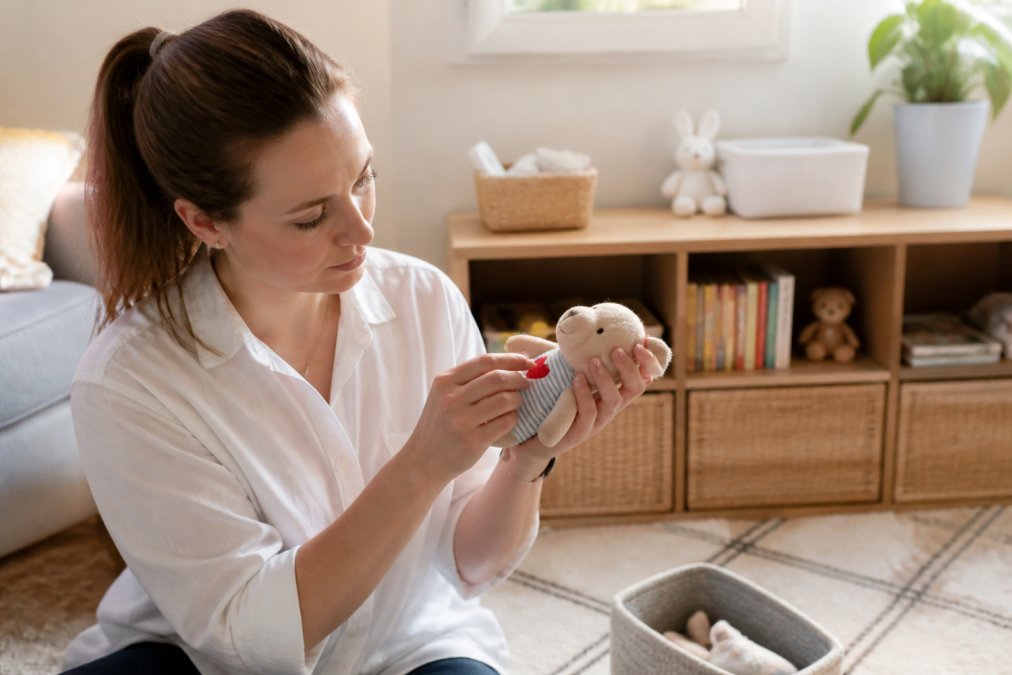
Run your fingers along every edge and point on the toy. Sharp edges are immediately disqualifying and can cut soft baby skin. Edges should be smooth and rounded. Pay special attention to where different materials join together. Seams on stuffed animals should be reinforced and stitched securely.
Detachable components are a major concern. Eyes on stuffed animals should be embroidered rather than glued or sewn on with a single stitch. Test this yourself, if you can work something loose by hand, your baby will be able to remove it. Check for small magnets that might be embedded in the toy; swallowing multiple magnets can cause serious internal injuries.
Cords, strings and strangulation risks
Long cords and strings present strangulation and entanglement risks. Cords longer than 7.5cm can wrap around a baby's neck or limbs. Examine how strings are attached to the toy, they should be sewn securely, not glued or tied with a knot that could come loose. Drawstrings on clothing-style toys should be removed or secured so they can't become entanglement hazards.
Battery compartments and electrical safety
Toys with batteries require special attention. Battery compartments should be secured with screws, not snaps or simple latches. Button batteries are particularly dangerous and can cause severe internal burns if swallowed. A toy with button batteries should have a compartment that requires a tool to open.
Check that batteries are properly installed and the compartment is completely closed. For toys with cords or plugs, verify that all wiring is intact with no exposed wires or damaged insulation.
Match Toys to Developmental Milestones
Developmental appropriateness is as important as physical safety. Matching toys to your baby's current abilities prevents both boredom and safety risks.
Newborns and babies under three months need toys that develop visual tracking and hearing. High-contrast black-and-white images, gentle rattles, and soft textures are appropriate. Avoid anything that could become loose.
Babies aged three to six months are learning to grasp and bring objects to their mouths. Teething toys, soft rattles, and textured toys designed for mouthing are ideal. Choose toys that can be easily cleaned and sanitised. Our Rattles and Teethers Gift Set offers safe options designed specifically for this stage.

Babies aged six to twelve months are developing more sophisticated motor skills and understanding cause and effect. Stacking toys, balls, and toys that make sounds become interesting. Choking hazards become a more serious concern, as babies can deliberately grasp and manipulate small objects. Ensure all toys meet the 5cm safety threshold with no small detachable parts.
Toddlers aged twelve to thirty-six months can play with toys that have smaller components, but only if they're securely attached. Building blocks, shape-sorting toys, and simple puzzles become appropriate. Choking hazards remain a concern until age three. Our Baby's Colourful Stacking Rings Early Development Sensory Toy provides safe stacking play designed for developing fine motor skills.

Don't rush developmental stages. A toy marketed for older children won't be safer or more beneficial for a younger baby.
Common Mistakes to Avoid
Many parents make predictable mistakes when selecting toys. Understanding these pitfalls helps you avoid them.
Trusting brand reputation without checking individual products is the first mistake. A well-known toy manufacturer might have excellent safety standards overall, but a specific toy could still pose risks. Always inspect the individual toy you're buying and check UKCA marking on that specific product.
Assuming second-hand toys are safe is another common error. Used toys may have been damaged, repaired unsafely, or altered since manufacture. Always inspect second-hand toys as thoroughly as new ones and verify that UKCA marking is still present and legible.
Ignoring age recommendations is surprisingly common. Age recommendations are based on safety testing, not developmental readiness. A toy marked for ages three and up poses real choking hazards for younger children, regardless of how mature your child seems.
Overlooking the importance of supervision is a serious mistake. Even the safest toy can become dangerous if a baby is left alone with it. Never leave a baby unattended with toys, regardless of how safe they seem.
Buying too many toys at once affects safety. More toys means more items to inspect, track, and supervise. A smaller collection of well-chosen, thoroughly inspected toys is safer and more developmentally beneficial.
Choosing safe baby toys is fundamentally about diligence and knowledge. You now understand what to look for: UKCA marking, non-toxic materials, secure construction, and age-appropriate design. When you're ready to build your toy collection with confidence, explore options that have been vetted for both safety and developmental value. Your baby deserves toys that are genuinely safe, and you deserve peace of mind.
Frequently Asked Questions
How do I know if a baby toy is safe?
Look for the UKCA marking, which shows the toy meets safety standards. Check the label for age recommendations and warnings about choking hazards. Inspect the toy for sharp edges, loose parts, small detachable components, and cords longer than 30 centimetres. Smell the toy for chemical odours and verify it's made from non-toxic materials. Ensure battery compartments are secure and any paint or finish is lead-free.
What is the UK toy safety standard I should look for?
The UKCA marking indicates compliance with the Toy Safety Regulations 2011, which aligns with the EN 71 European standard. This marking confirms the toy has been tested for hazards including choking risks, toxic substances, and physical safety. Always check that the UKCA mark is present on the packaging or the toy itself, along with the manufacturer's details and age-appropriate labelling.
What are the safest baby toys for newborns and young infants?
The safest options for newborns are toys without small parts, detachable components, or cords. High-contrast sensory toys, soft rattles, and teethers designed for their age group work well. Look for natural materials like organic cotton and wood with water-based finishes. Avoid toys with loose buttons, bells, or stuffing that could come loose. Products like The Newborn Sensory Box and Rattles and Teethers Gift Set are specifically designed with infant safety in mind.
Should I worry about second-hand baby toys?
Second-hand toys carry additional risks: recalls may not be obvious, safety features may have degraded, and you cannot verify the toy's full history or whether it's been properly cleaned. If buying second-hand, check the recalled toy database, inspect thoroughly for damage, wash with hot soapy water, and verify the UKCA marking is still visible. New toys from trusted retailers offer greater assurance of safety compliance and traceability.
This article was written using GrandRanker


