

Table of Contents
- Why Rotating Toys Works (and What It Isn't
- Step 1: Gather Every Toy and Take a Full Inventory
- Step 2: Decluttering Toys with Kids Without the Meltdowns
- Step 3: Sort Toys into Categories and Rotation Groups
- How Many Toys to Keep Out at Once
- How Often to Rotate Toys: Finding Your Schedule
- Building a Toy Rotation Schedule That Sticks
- Setting Up Storage in Small Spaces
- When Rotation Does Not Work: Troubleshooting
- Frequently Asked Questions
Last Updated: October 6, 2026
Why Rotating Toys Works (and What It Isn't
Toy rotation is the practice of keeping only a small selection of toys accessible while the rest are stored away, then swapping them periodically. It works because most children play longer and more deeply with fewer options at once.
What toy rotation is not: a punishment, a permanent declutter, or a one-off tidy-up. You are not taking toys away. You are rotating them, like a shop window. The toys come back, and when they do, they feel new again.
The system in this guide has three moving parts:
- A full toy inventory you build once
- A rotation schedule you can actually keep
- Storage that makes swapping quick
Get those right and toy clutter stops being a daily battle. It becomes a ten-minute job once a week or once a month.
Step 1: Gather Every Toy and Take a Full Inventory
Start by gathering every toy in the house into one room. Yes, every one: the car boot, the grandparents' spare room, the bottom of the pushchair, the bath toys.
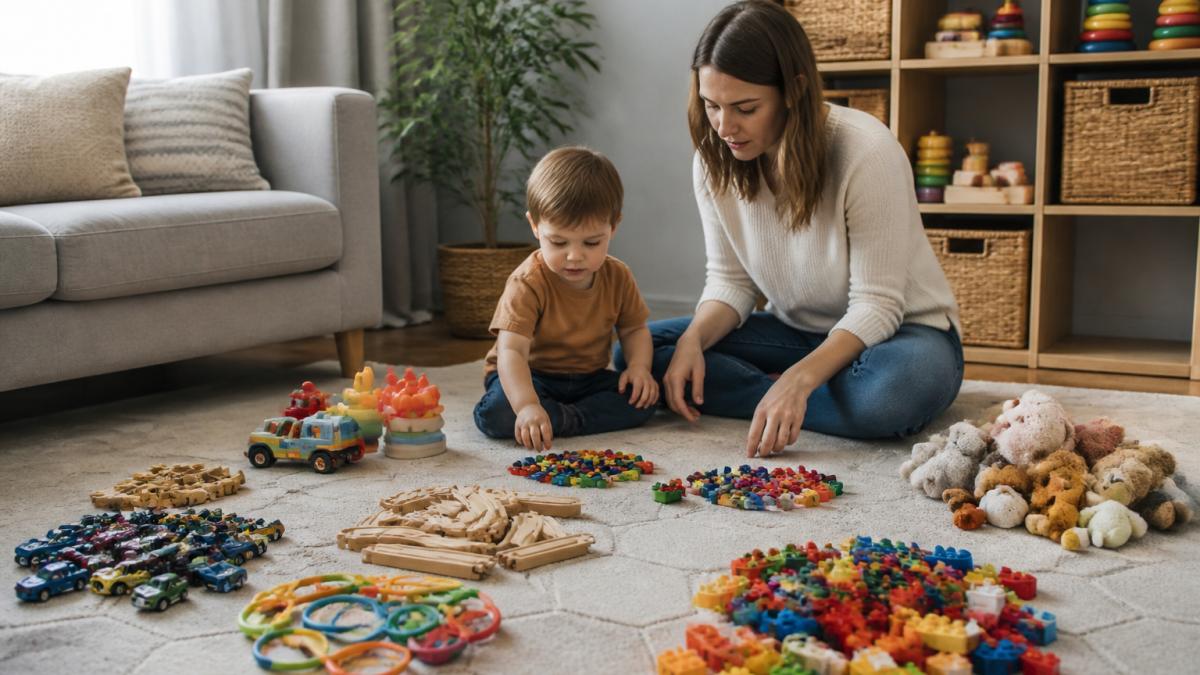
Work through the house in this order:
- Playroom and bedroom floors
- Under beds, sofas, and cot bases
- Cupboards, wardrobes, and hallway baskets
- Anywhere you have a "I'll deal with that later" pile
As you gather, sort into rough piles rather than neat categories. You are not organising yet. You are finding out what you own.
Then write it down. A simple toy inventory is the single most useful thing you will make.
The inventory does two jobs. It stops you buying duplicates you already own, and it makes rotation fast because you know exactly what is in storage. Most parents find the gathering stage takes an afternoon.
Step 2: Decluttering Toys with Kids Without the Meltdowns
Decluttering toys with kids is easier when the child is involved but not in charge. Children resist when they feel things are being taken from them without warning. Give them a role instead: they are the quality checker, not the defendant.
Here is a routine that works for most families:
- Set a timer for 20 minutes. Short bursts beat marathon clear-outs.
- Give the child three baskets: Keep, Donate, Repair.
- Start with the easiest pile, usually broken toys. No child fights for a toy with a snapped wheel.
- Ask one question per item: "Does this still work for you?" Not "do you want this?"
- Let them keep one "not sure" item per basket. It costs you nothing and prevents standoffs.
A common mistake is decluttering while the child is tired or hungry. Nothing good happens at 5pm on a nursery day. Pick a calm morning.
Handling Gifts, Duplicates, and Toys They Refuse to Release
Gifts are the hardest category. A toy from a grandparent carries meaning, so the child clings to it even if it is never played with. Our advice: keep the gift, rotate it out.
Duplicates are simpler. Two identical rattles, three plastic dinosaurs of the same size. Keep the best one, donate the rest. If the child objects, keep both in the rotation and let one naturally fall out of favour.
For the toys they refuse to release, use a "memory box." One small box per child for the things they love but have outgrown. It is not storage and it is not play. It is a keepsake.
Step 3: Sort Toys into Categories and Rotation Groups
Sorting toys into categories is what makes the whole system run. Without categories, rotation becomes guesswork. With them, you can build balanced groups in minutes.
Use broad, play-based categories rather than age or brand:
- Building and construction (blocks, magnetic tiles, train tracks)
- Pretend play (kitchen, dolls, dress-up, figures)
- Quiet play (books, puzzles, colouring)
- Active play (balls, ride-ons, soft play)
- Sensory and messy play (playdough, sand, water toys)
- Comfort toys (teddies, blankets, the ones that live on the bed)
Comfort toys stay out permanently. They are not part of the rotation, and trying to rotate them causes distress for no benefit.
Now split each category into rotation groups. Aim for two or three groups per category, so each group has a mix of building, pretend, and quiet play. A group that is all puzzles will bore a child by day two. A group with one of everything gets played with for weeks.
How Many Toys to Keep Out at Once
The right number of accessible toys is roughly 8 to 12 items for a toddler and 10 to 15 for a preschooler, spread across categories. That is the whole accessible selection, not per category.
Why that range? It is enough to offer choice without causing overwhelm. Many parents find that beyond about 15 visible toys, children flit between them and settle on nothing.
Use this as a starting point, then adjust:
| Child's age | Accessible toys | Rotation groups | Notes |
|---|---|---|---|
| 0-12 months | 4-6 | 2 | Fewer, simpler, high-contrast |
| 1-2 years | 6-10 | 2-3 | Avoid small parts; check for choking hazards |
| 3-4 years | 10-15 | 3 | Include pretend play and building |
| 5-7 years | 12-20 | 3-4 | Add games, craft, and construction sets |
Safety matters more than the count. Check the Royal Society for the Prevention of Accidents toy safety guidance for age-appropriate checks, and follow the age warnings on the packaging rather than your child's apparent maturity.
How Often to Rotate Toys: Finding Your Schedule
How often to rotate toys depends on your child, not the calendar. A good default is every two to four weeks. Weekly rotation suits toddlers who lose interest fast. Monthly rotation suits older children with longer attention spans.
Explorers Storage Units with 6 Boxes, Childrens Toy Storage Organiser, Green →
Watch for the signals rather than counting days:
- Toys are being tipped out but not played with
- The same two items get used every day
- You are stepping on things constantly
- Your child says "I'm bored" while surrounded by toys
Any of those means it is time to swap. If play is deep and focused, leave it alone. A rotation that interrupts good play is worse than no rotation at all.
Keep the swap itself short. Ten to fifteen minutes is plenty. Pull the outgoing group, put it in storage, bring in the next group, done.
Building a Toy Rotation Schedule That Sticks
A toy rotation schedule only works if it is easy to remember. Tie it to something that already happens: the first Saturday of the month, bin day, or the day the shopping delivery arrives.
Pick one of these three patterns:
- Two-group flip. Half the toys out, half stored. Swap every two weeks. Simplest option for most families.
- Three-group cycle. Three groups, one out at a time, swap every three weeks. Best for larger collections.
- Category rotation. Keep the core toys out and rotate one category at a time. Good for small homes with limited storage.
Then make it visible. A wall calendar with the swap date circled, a phone reminder, or a note inside the storage box lid all work. The trick is that the reminder finds you, not the other way around.
If you miss a swap, nothing breaks. The toys just stay out a bit longer. This system bends; it does not snap.
Setting Up Storage in Small Spaces
Limited storage does not rule out toy rotation. It just changes where the stored toys live. The goal is a home for the "out" group that is quick to access and out of daily sight.
Practical options for small homes:
- Under-bed boxes. Flat, lidded, and out of the way. Ideal for the stored rotation groups.
- The top of a wardrobe. Dead space in most bedrooms. Use labelled boxes you can reach with a step.
- An ottoman or storage bench. Doubles as seating and hides a full rotation group.
- A hallway cupboard shelf. Reserve one shelf, not the whole cupboard.
- Vacuum bags for soft toys. Teddies and fabric toys compress down to a fraction of the space.
Label every box with the group name and a photo of the contents. That single step turns a 20-minute rummage into a two-minute swap.
For the accessible toys, the container matters as much as the contents. We stock the Explorers Storage Units with 6 Boxes, Childrens Toy Storage Organiser, Green (£49.99), which has three bin sizes across six bins at 66cm tall, sized for ages three to eight so children can reach every bin without help. For a larger collection, the ZONEKIZ Storage Unit with 9 Removable Storage Baskets (£49.99) splits toys into nine categories across three tiers.


Colour-coded storage removes the need for labels altogether. The Isla 4-Coloured Box Storage Unit (£110.95) gives each box a colour, so "blocks go in the green box" is a rule a three-year-old can follow. And for the small things that never seem to have a home, the Natural Seagrass Storage Basket Set (£13.95) handles muslins, remotes, and the hallway pile.

When Rotation Does Not Work: Troubleshooting
If rotation is not reducing clutter or improving play, the problem is usually one of four things.
The accessible selection is still too big. Cut it by a third and watch what happens over a week.
The rotation groups are unbalanced. A group of only puzzles or only cars will not hold attention.
The storage is the bottleneck. If swapping takes half an hour, you will stop doing it.
For more on how children's play environments shape development, the NHS guidance on child development and play is a useful reference point for age-appropriate expectations.
Toy clutter is rarely about having too much.
At The Nook and Nurture Company, we choose storage that children can actually use on their own, because a system your child can run is a system that survives past week two. If a storage unit does not fit your space or your child does not take to it, you get a full refund.
Start with one storage unit, one inventory list, and one swap date on the calendar.
Frequently Asked Questions
What is the 20 toy rule?
The 20 toy rule is a guideline suggesting you keep roughly 20 toys accessible at any one time, with the rest stored away. The exact number matters less than the principle: a smaller, curated selection makes it easier for children to choose what to play with and helps them focus. For younger toddlers, 10 to 12 toys may work better. For older children, 20 to 25 is a reasonable starting point. Adjust based on how your child plays and how quickly the play area gets messy.
How do I rotate toys without my child noticing they've disappeared?
Swap toys while your child is asleep or at nursery. Choose a moment when they are absorbed elsewhere, then quietly remove the current group and replace it with the stored set. Because the returning toys have been out of sight for a few weeks, they feel new again. If your child asks about a specific toy, be honest: 'It's having a rest, and it will come back soon.' Most children accept this once they see the rotation pattern working.
How many toys should I keep out for a toddler versus a school-age child?
For toddlers aged one to three, keep out 8 to 12 toys at a time. At this age, too many choices cause overwhelm and shorter play sessions. For children aged four to eight, 15 to 20 toys works well because they can manage more variety and enjoy combining sets. Always include a mix: something to build with, something to pretend with, something to read, and something active. Store the rest in labelled bins or baskets so swapping is quick.
What should I do with toys my child has outgrown?
Sort outgrown toys into three groups: donate, pass on to a friend or family member, and store for a younger sibling. Check each toy for safety before passing it on. Anything broken, missing parts, or recalled should be discarded responsibly. For items with sentimental value, keep one small box in the loft. For everything else, moving it out of the house within a week prevents it from drifting back into the play area. Local charity shops and nursery toy drives are good options.


