

Table of Contents
- Why Verifying Baby Product Safety Matters
- How to Verify Baby Product Safety with UKCA and CE Marking
- How to Check for Product Recalls Before You Buy
- Second-Hand Baby Products: What to Check and What to Avoid
- Step-by-Step: How to Verify Baby Product Safety Before Purchase
- Ongoing Safety: Maintenance and Digital Verification Tools
- Frequently Asked Questions
Last Updated: September 12, 2026
Why Verifying Baby Product Safety Matters
Learning how to verify baby product safety is one of the most valuable skills you can build as a parent. This guide from The Nook and Nurture Company covers the checks that matter, from reading certification marks to catching recalled items before they reach your nursery.
Most parents assume anything sold on a major retail site has been vetted. That assumption is wrong: products slip through with incomplete testing, misleading labels, or certifications that don't apply to the item in front of you. Verification takes minutes once you know where to look.
Common Hazards in Baby Products
The hazards that trigger recalls fall into recurring categories. Recognising them helps you scan any product critically:
- Structural failure: cot slats that snap, stroller frames that collapse, high chair restraints that release under load
- Small parts: components that detach and become choking hazards for infants
- Chemical contaminants: lead in paint, phthalates in soft plastics, formaldehyde in treated fabrics
- Entrapment and strangulation risks: gaps between mattress and cot frame, cords on blinds and monitors
- Stability problems: furniture that tips when a toddler pulls up on it
A common mistake is ignoring how a product will be used at home. A safe cot becomes dangerous beside a window with a dangling cord. Verification is about the product and its context.
How to Verify Baby Product Safety with UKCA and CE Marking
The UKCA and CE marks are the two conformity markings you'll encounter on baby products. UKCA marking indicates a product meets the requirements for sale in Great Britain (gov.uk). CE marking indicates conformity with EU rules and continues to appear on many items, including goods placed on the market in Northern Ireland.
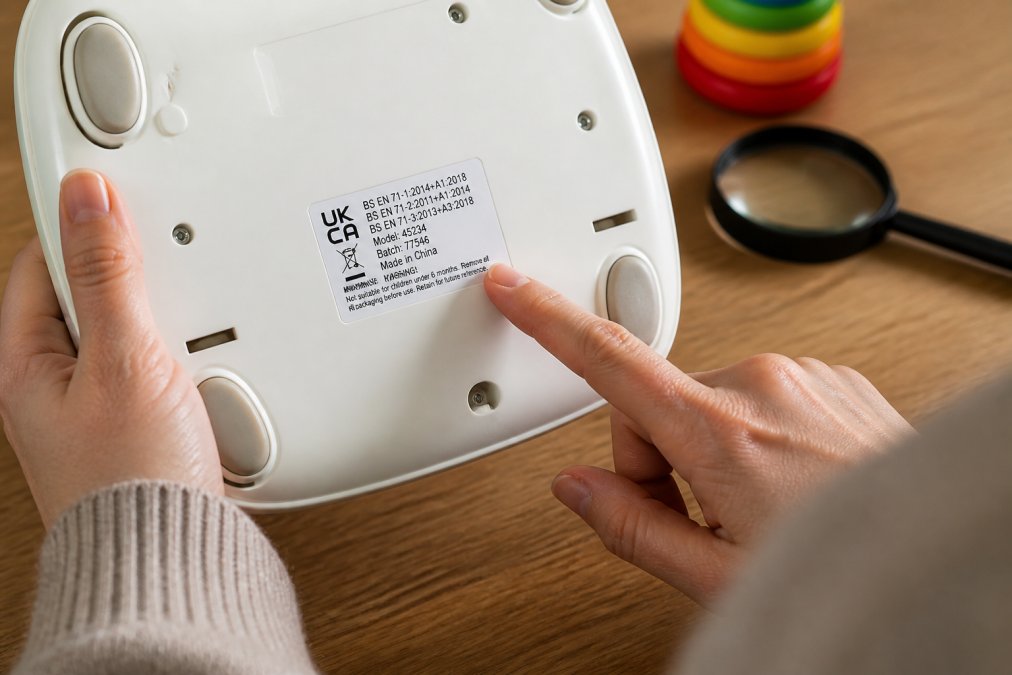
What the Markings Actually Mean
A conformity mark is a manufacturer's declaration that the product meets applicable legal requirements. It is not a guarantee of quality and is not issued by a government body, the manufacturer applies it, so a counterfeit or mislabelled mark is possible.
Check that the mark is legible, correctly proportioned, and permanent. A sticker that peels off in seconds is a warning sign. The official guidance on using the UKCA marking sets out the correct format, so it's worth a quick look if you're unsure what a genuine mark should look like.
Checking Labels and Safety Warnings
Labels carry the detail the mark alone doesn't: the manufacturer's name and address, the model or batch reference, applicable age ranges, and any warnings.
Missing contact details are a red flag. A legitimate manufacturer puts their name on the product because they stand behind it. If you can't identify who made the item, you have no route to a recall notice or a safety complaint.
How to Check for Product Recalls Before You Buy
Checking for recalls takes under two minutes and is the single highest-value step in the whole process. The Office for Product Safety and Standards (OPSS) publishes product recalls and safety alerts covering everything from cots to teethers. The OPSS product recall and safety alert database is free to search and updated regularly.
Using the OPSS Database and Consumer Alerts
Search by product type, brand, or model number rather than product name alone. Recalls are logged against a specific model or batch, so a generic search for "baby monitor" will bury the notice you need.
A few mechanics are worth knowing:
- Recalls versus safety alerts. A recall is a formal action requiring the product to be withdrawn, returned, or repaired. A safety alert is an earlier warning of risk. Only a recall obliges the seller to act, so search both terms.
- Batch and model specificity. Notices are tied to a production run, batch code, or model reference. Search your item's exact batch code, or the brand plus product category if there isn't one.
- Marketplace listings. Items sold through third-party marketplace sellers are often relisted under different titles after a recall. Search the brand and model, not the listing title, and check whether the seller is the manufacturer or an intermediary.
- Imported goods. A product recalled in another market may still be on sale here via a different supply chain. Check the recall register in the country of origin as well as the OPSS database.
Sign up for consumer alerts if you buy baby gear regularly, they arrive by email and cover new recalls as published. For second-hand purchases this matters even more, since you won't have a retailer's recall process behind you.
Building a Recall Check Into Your Buying Routine
A one-off check at purchase isn't enough, because recalls are issued months or years after a product goes on sale. A practical routine:
- Before buying: search the OPSS database by brand and model. Two minutes.
- At unboxing: photograph the label, model number, and batch code, and store the photo with your receipt.
- Quarterly: re-run the search for every baby product currently in your home. This catches notices published after your purchase.
- Before passing anything on: check the item again before selling, gifting, or donating it. Passing on a recalled item transfers the risk to another family.
What to Do If Your Product Is Recalled
If a search returns a match, stop using the product immediately, even if it looks fine. Then:
- Follow the remedy in the notice: usually a refund, repair, or replacement part.
- Contact the retailer or manufacturer using the details in the notice, not the general customer service line.
- Keep the product and packaging until the remedy is confirmed, in case the seller asks for proof of purchase or the batch code.
- If the seller is unresponsive, report it to the OPSS via the citizen reporting route on the same government site.
For second-hand items where the original seller is gone, the manufacturer named on the label is usually the correct point of contact. If the manufacturer no longer exists, dispose of the item rather than reselling it.
Second-Hand Baby Products: What to Check and What to Avoid
Second-hand baby gear can be excellent value, but some categories carry risks no inspection can remove. The general rule: the simpler and more structural the item, the safer it is to buy used. Used gear is where verification earns its keep, no retailer's recall process, no warranty, and often no history.
The Categories, Ranked by Risk
Buy used with confidence:
- Wooden cots with fixed sides and no drop mechanism
- Solid wooden high chairs with a fixed crotch post
- Baby carriers and slings with all buckles intact and no fraying
- Bath seats with intact suction cups and no cracks
Buy used only with a full inspection and confirmed history:
- Strollers and pushchairs, check the frame, brake, harness, and folding mechanism
- Baby monitors, check the cable for damage and confirm the model isn't subject to a recall
- Bedside cribs and co-sleepers, check the mesh, the locking mechanism, and the mattress fit
Avoid entirely:
- Any car seat that has been in a collision, or whose history you can't confirm
- Drop-side cots, which have been linked to entrapment deaths
- Cot mattresses, which lose firmness and can harbour mould
- Bottle teats and breast pump parts that contact milk
- Anything missing its instruction manual or with a cut harness
- Anything with a missing or illegible model number
How to Inspect a Second-Hand Item
Inspection is a procedure, not a glance. Work through these checks in order, under load, structural integrity shows up under stress, not in a photo.
1. Identify the item before you inspect it. Find the manufacturer's name, model number, and batch code. Search the OPSS database for that exact model. If the seller can't tell you the model, or the label is missing, walk away, you cannot verify what you cannot identify.
2. Test the structure under load.
- Cots: push down firmly on the base, then press sideways on each slat. Any flex, creak, or movement means the joints are failing.
- Strollers: load the basket with something heavy, apply the brake on a slope, and pull the harness tight. Check that the brake holds and the harness doesn't slip.
- High chairs: wobble the chair side to side, then press down on the crotch post. A fixed post should not move at all.
- Carriers: clip and unclip every buckle several times, then hang the carrier with a weight inside and check the seams.
3. Check the soft parts. Harness straps, mesh panels, and fabric covers degrade with washing and sunlight. Look for fraying at stitch lines, stretched elastic, and faded or brittle fabric, a strap that has lost its weave can fail.
4. Check the fasteners. Every screw, bolt, rivet, and clip should be present and tight. Missing fasteners are the most common defect in used furniture, bring a screwdriver to viewings if you can.
5. Confirm the accessories. Instruction manuals, harness pads, newborn inserts, and travel bags are often missing. Some are safety-critical, a newborn insert that changes the harness geometry, for example, cannot be substituted with a generic one.
Verifying History and Provenance
For items where a collision or fall matters, car seats above all, inspection is only half the job. The other half is history.
- Ask for the original receipt. It confirms the purchase date, retailer, and model, and a seller who can produce it is more likely to describe the item accurately.
- Ask directly about collisions and falls. A car seat in even a minor collision can have invisible structural damage. If the seller hesitates or the answer is vague, treat the seat as unusable.
- Check the expiry date. Car seats and some helmets carry a manufacturer's expiry date, typically six to ten years from manufacture, because the plastics degrade. An expired seat is not a safe seat.
- Check the recall status one more time. Search the model number immediately before you hand over money, a recall may have been issued since the seller bought it.
What to Do With Gear You're Passing On
If you're selling or donating, the same checks apply in reverse. Verify the item isn't subject to a recall, include the instruction manual if you have it, and disclose any damage or missing parts. Passing on a recalled or damaged item transfers the risk to another family, and may breach the recall notice.
Step-by-Step: How to Verify Baby Product Safety Before Purchase
Work through these steps before any purchase, new or used:
- Identify the manufacturer. Look for a name, address, and country of origin on the product or packaging.
- Check for the UKCA or CE mark. Confirm it's permanent, legible, and correctly proportioned.
- Search the OPSS database. Use the model or batch number, not the product name.
- Read the full label. Confirm the age range, weight limits, and assembly warnings match your intended use.
- Inspect for structural weaknesses. Test every joint, strap, and locking mechanism.
- Verify the model and serial numbers match the listing. Mismatches suggest a swapped or misrepresented item.
- Keep the receipt and packaging. You'll need both if a recall is issued or you need to return the item.
Checking Model and Serial Numbers
Model and serial numbers let manufacturers and regulators trace a unit to a production run. A recall often applies to one batch, not the whole product line, so the number on your item determines whether a notice affects you.
Write the model and serial number down when you buy and keep it with your receipt. If a recall is later issued, you'll know within seconds whether your item is covered, which is also why buying from a retailer that keeps purchase records matters.
Ongoing Safety: Maintenance and Digital Verification Tools
Verification isn't a one-time event. Products loosen, wear, and degrade, and a cot that was safe at six months may not be safe at eighteen. Build a simple maintenance routine:
- Tighten every screw and bolt on furniture and strollers monthly
- Check harness straps for fraying and buckle function every few weeks
- Inspect cot slats and mattress fit as your baby grows and moves more
- Re-check for recalls every few months, especially before a new baby arrives
Digital tools make this easier. Recall databases offer email alerts, some retailers send safety notices to purchase records, and manufacturer registration forms put you on a notification list. Registration cards aren't just marketing; they're your direct line to a recall notice.
At The Nook and Nurture Company, every item in our safety range is chosen with these checks in mind. Our 10x Door Safety Latches and 10x Silicone Table Corner Protectors are simple, structural products that hold up to close inspection, and both come with our 30-day risk-free trial.


| Check | What to Look For | How Often |
|---|---|---|
| Conformity mark | Permanent, legible UKCA or CE mark | At purchase |
| Recall search | Match on model or batch number | Before buying, then quarterly |
| Label details | Manufacturer name, address, age range | At purchase |
| Structural integrity | Tight joints, intact straps, stable base | Monthly |
| Model and serial numbers | Match listing and receipt | At purchase, keep on file |
Frequently Asked Questions
What safety marks should I look for on baby products in the UK?
Look for UKCA or CE marking on the product or packaging. UKCA marking is required for most goods sold in Great Britain, while CE marking is still accepted for some items. Check for the British Standard number, such as BS EN 1888 for pushchairs or BS EN 716 for cots. The marking should be clear, permanent, and include the manufacturer's name and address. If a product lacks these marks, treat it as unverified and avoid purchasing it for your baby.
How can I check if a baby product has been recalled?
Visit the Office for Product Safety and Standards (OPSS) website and search their product recall database. You can also sign up for email alerts from the OPSS or check the Chartered Trading Standards Institute website. For specific brands, check the manufacturer's own recall page. If you already own the product, stop using it immediately and follow the recall instructions, which usually involve a refund or replacement. Keep your product registration card or receipt to make this process easier.
Are second-hand baby products safe to use?
Some second-hand baby products are safe if you verify them carefully. Avoid second-hand car seats, cot mattresses, and breast pumps because these have hidden safety risks or hygiene concerns. For other items, check for UKCA or CE marking, look up the model and serial number for recalls, and inspect for damage, missing parts, or wear. Ask the seller for the original instructions and proof of purchase. If you cannot verify the product's history, it is safer to buy new.
How do I know if a baby product meets British Standards?
Check the product label or packaging for a British Standard number, such as BS EN 716 for cots or BS EN 1888 for pushchairs. These standards cover structural integrity, chemical safety, and performance requirements. You can verify the standard on the British Standards Institution (BSI) website. Reputable retailers will list the standard on the product page. If a product claims to meet a standard but does not show the number, contact the manufacturer for written confirmation before buying.
Every parent faces the same challenge: the products that keep your baby safe are only as good as the checks behind them, and those checks take time you don't always have. The Nook and Nurture Company takes that work off your hands by curating safety gear chosen with parents and babies in mind, backing every order with a 30-day risk-free trial, guaranteed next day shipping, and 100% secure payments. Get started with The Nook and Nurture Company and build a nursery you can trust.


