

Table of Contents
- What Makes Nursery Storage Safe for Babies?
- Small Nursery Storage Ideas That Actually Work
- Nursery Storage Without a Closet: Where Everything Goes
- Nursery Shelving Safety: Wall Fixings and Placement Rules
- Baby Changing Station Organisation: Keeping Supplies Within Reach
- Nursery Storage Solutions for Clothes, Toys, and Books
- Conclusion
- Frequently Asked Questions
Last Updated: October 12, 2026
What Makes Nursery Storage Safe for Babies?
At The Nook and Nurture Company, we see the same pattern: parents spend hours choosing a cot, then grab whatever storage is cheapest.
The Royal Society for the Prevention of Accidents guidance on furniture safety is clear that unanchored furniture causes serious injuries to young children every year, and most of those incidents happen in the home.
So here is our rule: fix it, check the finish, then fill it.
Nursery storage is the furniture, baskets, and containers used to hold baby clothes, nappies, bedding, toys, and books in a baby's room.
That second job is where most setups fail: once your baby can pull to standing, everything within reach becomes fair game.
Anti-tip fixing: what it actually means
An anti-tip kit is a strap, bracket, or wall plate that connects the top or back of a unit to the wall structure.
Most nursery chests of drawers and wardrobes include a kit, but it is only safe if fitted to something solid.
A practical check before you buy:
- Does the unit come with an anti-tip kit, or do you need to buy one separately?
- Does the kit fix into a stud or masonry, or does it rely on a plasterboard plug?
- Is the strap long enough to reach your skirting board and wall type?
If the answer to any of those is no, the unit is not ready for a nursery until you solve it.
Load limits and heavy items
Every shelf, drawer, and basket has a working load. Exceed it and the unit becomes unstable, even when anchored. The common mistake is putting nappies, wipes, and bedding in the top drawer because it is easiest to reach, that puts the heaviest items highest.
Heavy items go low. Light, soft items go high. A dropped muslin is not a hazard. A dropped box of nappies is.
Non-toxic finishes and materials
Baby-safe finishes are low-emission and free from substances that off-gas in a warm room. Look for water-based paints and finishes, and solid wood or low-emission engineered wood rather than heavily treated composites. Vague claims like "eco-friendly" mean little, ask for the specific finish, or seal unfinished solid wood yourself with a water-based product.
Age-appropriate access
Access changes as your baby grows. In the first months, safety is mostly about the furniture itself. Once your baby can roll, reach, and pull to standing, anything within arm's reach becomes a target; once they walk, floor-level baskets and low cubbies become their territory.
That progression is why storage should be planned in layers: adult-height for what you control, child-height for what they are allowed, and closed containers for anything small enough to fit in a mouth.
Fix it, check the finish, then fill it. If a unit cannot be anchored to something solid, it does not belong in a nursery.

Small Nursery Storage Ideas That Actually Work
Small nurseries fail for one reason: storage is spread across the floor instead of stacked up the wall. Vertical storage is the biggest win in a tight room, a tall, slim unit uses floor space a wide chest would waste.
Our picks for a small nursery:
- A 5-Cubby Bookshelf with 2 Storage Cabinets (£119.99). At 60 x 29 x 120 cm it is tall and shallow, so it fits beside a cot or in an awkward gap. Five open cubbies sit at a child's height, and two doors hide the clutter you do not want on show.
- A 9-Basket Storage Unit (£49.99). Nine removable baskets across three tiers, in a 30cm-deep frame. That depth matters in a small room.
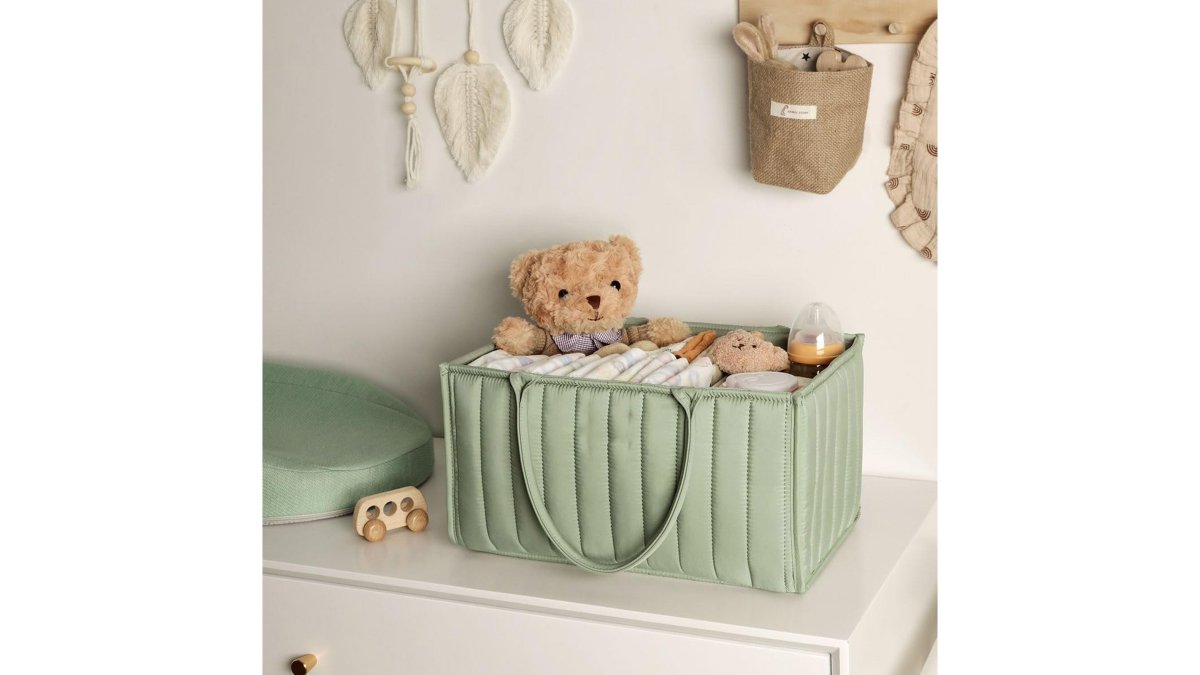
- A Nappy Caddy Organiser (£19.99). Portable storage beats fixed storage when the change happens in three different rooms.
The mistake we see most often is buying one big piece instead of several slim ones. A single bulky wardrobe eats the room. Three narrow units use the same wall and give you more usable storage.
Measure your wall before you buy, then subtract 10cm. Skirting boards, radiator pipes, and plug sockets quietly steal space from every "perfect fit" unit you order online.
Nursery Storage Without a Closet: Where Everything Goes
No built-in wardrobe is not a problem.
Here is how we would lay it out:
| What you are storing | Best container | Where it goes |
|---|---|---|
| Baby clothes and vests | Fabric baskets or drawers | Low unit, within your reach |
| Nappies and wipes | Nappy Caddy Organiser | Beside the changing mat |
| Bedding and towels | Large basket or deep drawer | Mid-height, out of baby's reach |
| Toys | Open-ended bins | Floor level, child height |
| Books | Low cubbies | Floor level, child height |
Two rules hold this together. Heavy things go low, so a unit cannot become top-heavy. Light, soft things go high, because a dropped muslin is not a hazard.

A wardrobe is not the only answer for hanging. A low rail inside an alcove, or a rail fixed under a shelf, gives you hanging space without the footprint.
Nursery Shelving Safety: Wall Fixings and Placement Rules
Wall-mounted shelving is only as safe as its fixing. A shelf holding 5kg of books can do real damage if it comes away, and plasterboard alone will not hold it. Match the fixing to the wall.
- Solid brick or block: use a masonry plug and screw, sized to the load.
- Plasterboard with a stud behind it: screw directly into the stud. Find it with a stud finder, not by tapping.
- Plasterboard with no stud: use a heavy-duty cavity fixing rated well above the weight you plan to put on the shelf.
- Dot-and-dab plasterboard: treat it as a cavity wall. Standard plugs will pull straight out.
Then think about what sits on the shelf. Anything your baby can reach will be pulled. Anything above the cot can fall.
NHS advice on preventing accidents in the home covers the wider picture, including why heavy items should never sit on high shelves above a child's sleep space.
Baby Changing Station Organisation: Keeping Supplies Within Reach
Changing station organisation comes down to one test: can you reach everything with one hand while the other stays on your baby?
The Shefa Kids 880 Baby Changing Unit (£144.49) solves this properly.

If you do not have space for a full unit, the Nappy Caddy Organiser does the same job on a smaller scale.
One thing to get right: keep the caddy or drawer contents shallow. If you have to dig, you have to look away.
Nursery Storage Solutions for Clothes, Toys, and Books
Clothes, toys, and books need different storage because they get used differently. Clothes are handled by you; toys and books are handled by your child, so they need to be reachable and safe to reach. Split them by who uses them, then by what your child can safely reach at each stage.
Clothes: adult-height, out of reach
For clothes, use drawers and baskets at your working height, and fold baby clothes vertically so you can see every item at a glance.
Keep clothing storage at adult height or in closed drawers. Baby clothes are not a choking hazard, but the drawers themselves are a climbing risk once your child is mobile, an open bottom drawer is a step.
Toys: child-height, but only the safe ones
For toys, open-ended bins work better than a single toy box. A deep box means everything gets dumped in and nothing gets found.
The AIYAPLAY Lion Toy Box (£44.99) handles the bulky end of the problem.
But not every toy belongs in a floor-level bin. Small parts, from building blocks to doll accessories, are a choking risk once your baby is mobile.
Books: low cubbies, rounded edges
For books, low open cubbies are the right answer. Your child can reach, choose, and return a book without help.
Board books are safe at floor level. Paper books with thin pages are not, until your child stops mouthing everything. Keep those higher until the mouthing phase passes.
The age-based access rule
Access should change as your baby grows. A simple way to plan it:
| Stage | What they can reach | What stays out of reach |
|---|---|---|
| Newborn to rolling | Nothing | Everything |
| Rolling to crawling | Floor-level soft toys, board books | Small parts, cords, bags, nappy sacks |
| Crawling to standing | Low cubbies, open bins, soft toys | Drawers above waist height, anything heavy |
| Walking to climbing | Child-height storage | Units that are not anchored, shelves above the cot |
Choking hazards and cords
Once your baby is mobile, anything small enough to fit in a mouth is a choking risk, hair clips, nappy sacks, dummy clips, small toy parts, and lotion bottle caps.
Labels matter more than you think. A picture label on each basket means a two-year-old can tidy up without being told where things go. That is when tidying stops being a fight.
Keep small items, from hair clips to nappy sacks, in closed containers at adult height. Once your baby is mobile, anything small enough to fit in a mouth is a choking risk, and open baskets at floor level put those items within reach.
Store by who uses it and what they can safely reach. Child-height for board books and soft toys, adult-height for small parts, cords, and anything heavy.
Conclusion
Getting nursery storage right is harder than it looks, because you are solving two problems at once: keeping the room usable and keeping it safe.
At The Nook and Nurture Company, every storage piece we stock is chosen with that balance in mind.
Start with the unit you will fix to the wall, then build out from there. Get started with The Nook and Nurture Company and build a nursery that works as hard as you do.
Frequently Asked Questions
How do I keep nursery storage furniture from tipping over?
Anchor every tall or heavy piece to the wall using the anti-tip kit supplied. The Shefa Kids 880 Baby Changing Unit includes an integrated anti-tip wall bracket, and the 5-Cubby Bookshelf with 2 Storage Cabinets comes with two anti-tip kits. Keep heavier items in lower drawers or baskets, and avoid placing tempting objects on top of furniture a toddler might try to climb. Check fixings every few months, and never rely on the weight of the furniture alone.
What storage is best for a small nursery?
Look for tall, slim pieces that use vertical space rather than floor area. The 5-Cubby Bookshelf with 2 Storage Cabinets measures 60 x 29 x 120 cm, so it fits beside a cot or in a narrow gap. The ZONEKIZ Storage Unit with 9 Removable Baskets is 60H x 63L x 30W cm and holds nine separate categories in a shallow footprint. Both keep the floor clear, which matters when space is tight.
How can I store baby clothes safely in a nursery?
Keep clothing in drawers or baskets low enough for you to reach without lifting a baby over your head. The Shefa Kids 880 Baby Changing Unit has three deep drawers for nappies, vests, and sleepsuits, all within arm's reach of the changing mat. Use dividers or labels to separate sizes, and store anything small, such as scratch mitts or socks, in a basket with no loose ties or cords near the cot.
Where should I store nappies and changing supplies?
Keep everything for a nappy change in one place, close to where you actually change your baby. The Nappy Caddy Organiser (£19.99) holds nappies, wipes, creams, bags, and a spare vest in separate compartments with removable dividers, and the handles let you carry it to any room. Storing supplies at the changing station rather than across the room means you never have to leave a baby unattended on a changing mat.
Are open shelves safe in a baby's room?
Open shelves are safe if they are fixed to the wall and nothing heavy or breakable sits within a baby's reach. The 5-Cubby Bookshelf with 2 Storage Cabinets includes anti-tip kits and a top shelf with raised edges for display items. Keep the lowest cubbies for board books and soft toys, put heavier or fragile items higher up, and check that no shelf sits directly above the cot where items could fall.


