

Table of Contents
- The Real Value of Developmental Toys for 1 Year Olds
- Benefits of Open-Ended Play for 1 Year Olds
- How to Choose Safe Toys for Toddlers
- Simple Learning Activities for 1 Year Olds
- Toy Rotation Strategies That Reduce Clutter and Boost Engagement
- Developmental Red Flags: When to Seek Advice
- Conclusion
- Frequently Asked Questions
Last Updated: September 18, 2026
The Real Value of Developmental Toys for 1 Year Olds
Are developmental learning toys for 1 year olds worth it? Yes, with one condition: they have to match what a one-year-old is actually doing. At twelve months, a child is typically pulling to stand, posting objects into containers, and testing cause and effect dozens of times a day. A toy that supports those urges earns its place; one that doesn't becomes clutter within a fortnight.
Benefits of Open-Ended Play for 1 Year Olds
Open-ended play is play without a fixed outcome: blocks that can be stacked, knocked down, sorted, or ignored in favour of the box. The benefits of open-ended play for 1 year olds come down to repetition and control. A toy with one correct answer gets solved once; one with no correct answer gets used a hundred ways.
What does that look like in practice?
- Fine motor skills develop through grasping, releasing, and posting objects
- Gross motor skills build when toys encourage crawling, cruising, or pushing
- Hand-eye coordination improves every time a hand aims at a target and adjusts
- Cognitive development grows through sorting, matching, and predicting
- Sensory stimulation comes from textures, sounds, and movement
How Open-Ended Play Builds Problem-Solving Skills
Problem-solving at this age looks like trial and error, repeated without embarrassment. A toddler who puts the biggest ring on top of a stacking toy, watches it topple, and tries a different order is doing genuine early engineering.
How to Choose Safe Toys for Toddlers
Knowing how to choose safe toys for toddlers comes down to three checks: age labelling, small parts, and materials. Under UK rules, toys sold for children under 36 months must carry a warning if they are not suitable, and they must meet the Toy Safety Regulations 2011 before they can legally be sold. The CE or UKCA mark on the packaging is your starting point, not an optional extra.
Run through this before you buy:
- Is there a minimum age on the packaging, and does it match your child?
- Can any part fit through a toilet roll tube? If yes, it is a choking risk
- Are there cords, straps, or loops longer than 22cm?
- Are edges smooth and joints tight when you twist them?
- Does paint or finish flake when scratched with a fingernail?
UK Safety Standards and Material Checks
The UKCA mark is the conformity marking required for most toys sold in Great Britain, replacing CE marking for this market. It signals the toy meets essential safety requirements, including limits on chemicals in materials children mouth.
Simple Learning Activities for 1 Year Olds
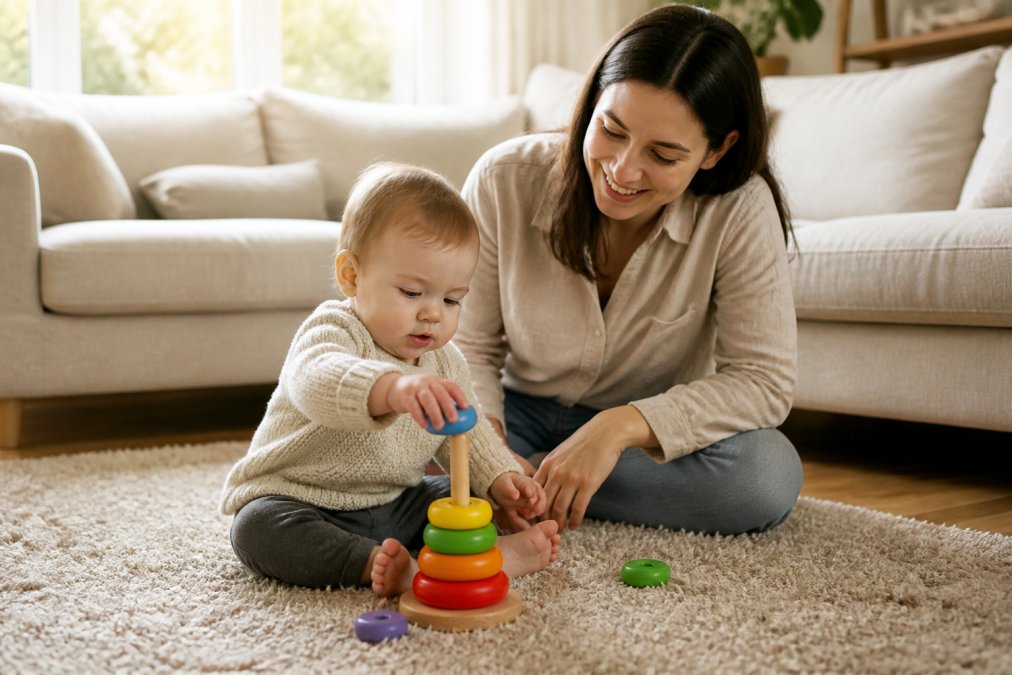
Simple learning activities for 1 year olds need no planning, no screens, and no special equipment. The best ones use what is already in the room and take under five minutes to set up. A bowl of scarves, a wooden spoon and saucepan, or a stack of rings will hold attention longer than most battery toys.
Everyday Play with Stacking, Sorting, and Sensory Toys
Stacking, sorting, and sensory toys cover most of what a one-year-old needs, each targeting a different skill without demanding a different play session.
| Toy type | Skill it builds | Example from our range | Price |
|---|---|---|---|
| Stacking rings | Fine motor skills, size sequencing | Baby's Colourful Stacking Rings | £9.99 |
| Shape sorter | Problem-solving, spatial awareness | Melissa & Doug Match & Roll Shape Sorter | £12.99 |
| Activity cube | Multiple skills in one object | Six-Sided Activity Cube | £30.99 |
| Sensory balls | Tactile exploration, grasping | Sensory Ball Pack | £9.99 |
| Xylophone | Auditory processing, hand-eye coordination | Children's Xylophone with Mallet | £9.99 |
| Rainmaker | Cause and effect, visual tracking | Rainbow Rainmaker Sensory Toy | £7.99 |
The 'Worth It' Cost-Benefit Test
This is the question most buying guides skip: a straight comparison between a purpose-built developmental toy and the household equivalent, using the same skill target.

| Skill | Purpose-built option | Typical cost | Household alternative | Cost |
|---|---|---|---|---|
| Posting and releasing | Shape sorter | £12.99 | Plastic tub with a lid and wooden spoons | £0 |
| Size sequencing | Stacking rings | £9.99 | Stack of plastic beakers or measuring cups | £0 |
| Cause and effect | Rainmaker | £7.99 | Empty bottle with dried rice, lid taped shut | £0 |
| Auditory processing | Xylophone | £9.99 | Saucepan and wooden spoon | £0 |
| Tactile exploration | Sensory ball pack | £9.99 | Bowl of dry pasta or scarves | £0 |
What You Do Not Need to Buy
Several categories marketed hard at this age add little. Electronic activity stations with lights and music often do the playing for the child rather than inviting the child to act, and many one-year-olds lose interest once the sounds lose novelty. Walkers with seats are not recommended for development and are best avoided. Flashcards and structured 'learning' programmes assume attention a one-year-old does not yet have.
Toy Rotation Strategies That Reduce Clutter and Boost Engagement
Toy rotation is the practice of keeping only a small number of toys available at once and swapping them every week or two. Most parents who try it find fewer toys on the floor means longer, deeper play, not less. The toys that disappear come back feeling new.
Baby's Colourful Stacking Rings Early →
A Rotation That Works With What You Already Own
- Divide toys into three or four groups by type, not by brand, for example: stacking and posting, sensory and tactile, music and sound, and larger movement toys
- Keep one group out and store the rest out of sight
- Swap groups every 7 to 14 days, or when interest visibly drops
- Keep two or three permanent favourites available at all times, the comfort object is not part of the rotation
- Wipe everything down as it comes back into rotation
A four-group rotation means each group is out roughly a week and away for three, long enough for the memory to fade, short enough that you are not constantly reorganising.
Storage That Actually Makes Rotation Work
The mechanism only works if out-of-rotation toys are genuinely out of sight. A clear plastic tub on the floor defeats the point; a lidded basket, a closed ottoman, or a shelf above your child's eye line all work. The test: if your child can see it, it is not rotated.
The Cost Argument for Rotating
Rotation also changes the economics of the 'worth it' question. If a £9.99 stacking ring set is out one week in four, it stays interesting for months rather than a fortnight, stretching the cost per week of engaged play far below what a £60 electronic activity station delivers, because the activity station is out every day and stops being novel within days.
When Rotation Stops Working
Rotation is not a fix for a toy that was wrong to begin with. If a toy is ignored in three consecutive rotations, it is not a rotation problem, it is a mismatch with your child's current stage, and the signal to pass it on. A toy that is too advanced may be perfect in three months, so it is worth one more cycle before you decide.
Developmental Red Flags: When to Seek Advice
Developmental red flags are signs a child may need extra support, not a diagnosis. Most one-year-olds hit milestones within a wide window, and a single missed milestone rarely means anything on its own. What matters is a pattern, or a loss of a skill your child previously had.
Worth raising with your health visitor:
- No pointing, waving, or other gestures by around 12 months
- Not bearing weight on legs when supported
- No interest in cause-and-effect toys after repeated demonstration
- Loss of skills your child previously had, at any age
- No response to their own name by 12 months
Conclusion
The honest answer to whether developmental toys for 1 year olds are worth it is that the right ones are, and the wrong ones were never going to be. A wooden shape sorter rolled across the floor forty times a week is worth every penny; a plastic tower that plays one song and gets abandoned is not, regardless of cost.
Frequently Asked Questions
Do 1-year-olds actually need educational toys to learn?
No, they don't need them. Children learn through everyday interactions, household items, and play with caregivers. However, well-designed developmental toys can offer specific benefits like fine motor practice, hand-eye coordination, and sensory stimulation in a safe, durable format. They are tools, not requirements. The key is balancing toys with real-world exploration and plenty of back-and-forth interaction with you.
How do developmental toys support toddler milestones?
Toys like shape sorters, stacking rings, and push walkers target specific skills: grasping, problem-solving, spatial awareness, and gross motor movement. For example, a shape sorter encourages trial and error, which builds cognitive development. A push walker strengthens gross motor skills. These toys give repeated practice in a playful way, which helps toddlers consolidate emerging abilities. They don't replace human interaction, but they can complement it effectively.
Are expensive learning toys better than simple household items?
Not necessarily. A wooden spoon and a plastic bowl can teach cause and effect just as well as a £30 activity cube. What matters is variety, safety, and how you use them. Simple items encourage creativity and open-ended play. That said, some specialised toys offer durability and design features that household items lack, like non-toxic finishes or rounded edges. The best approach is a mix: a few quality developmental toys plus safe household objects.
What should I look for when buying toys for a 1-year-old?
Check for the UKCA or CE mark, which shows the toy meets safety standards. Look for age recommendations, non-toxic materials, and no small parts that could be choking hazards. Choose toys that match your child's current skills but offer a slight challenge. Open-ended toys like stacking rings or shape sorters tend to last longer because they can be used in multiple ways. Also consider durability and ease of cleaning.
How can I encourage learning through play at home?
Get down on the floor and play with your child. Narrate what you're doing, ask simple questions, and respond to their attempts. Rotate toys every week or two to keep them novel. Use everyday routines like bath time or mealtime for sensory exploration. Sing songs, stack cups, and roll balls back and forth. The most powerful learning happens through your interaction, not the toy itself.


