

Table of Contents
- Start with a Hazard Assessment
- How to Secure Heavy Furniture to Walls
- Baby Proofing Furniture Corners and Sharp Edges
- Baby Proofing Electrical Sockets and Cable Management
- Best Baby Safety Gates for Stairs and Room Access
- Managing Blind Cords and Window Safety
- Removing Choking Hazards and Small Objects
- Creating a Safe Play Zone with Playpens
- Frequently Asked Questions
Last Updated: September 1, 2026
Start with a Hazard Assessment
Before buying safety products, spend 20 minutes on your hands and knees. This is the single most important step in learning how to baby proof living room effectively. Your perspective at ground level is completely different from standing height, and that's exactly where your child will be exploring.
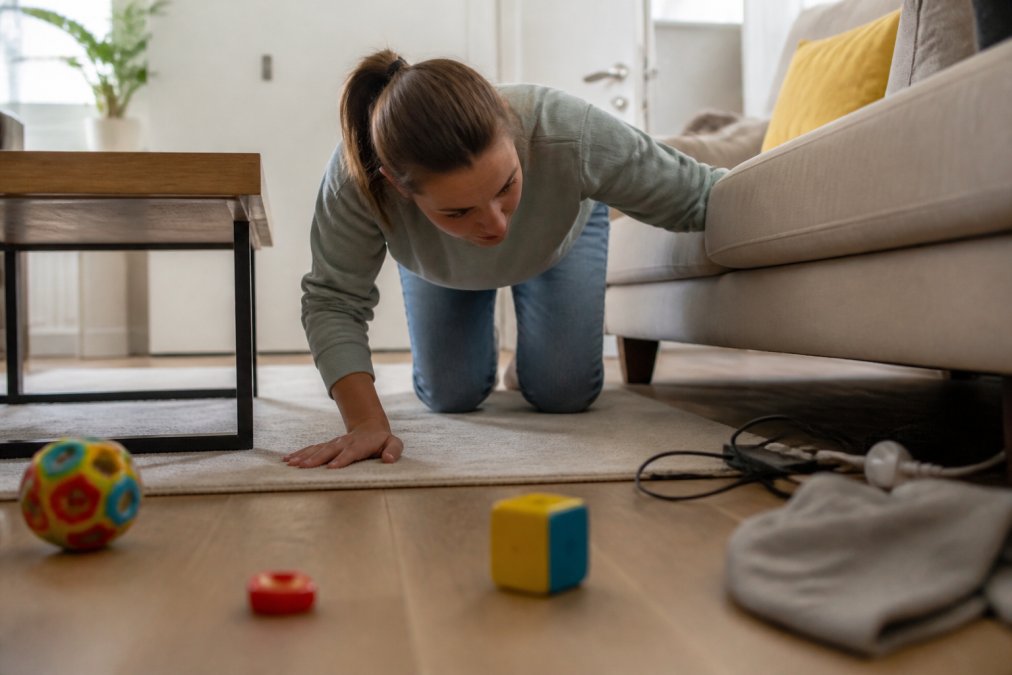
Look for what's actually reachable: trailing lamp cords, coffee table corners, gaps under sofas, electrical outlets at skirting board height. Make a list as you go. Pay attention to climb height, babies and toddlers use furniture as ladders to reach things you assumed were safe. Anything under 1.5 metres tall that's weighted at the top is a tip-over risk. Check for strangulation hazards specifically: blind cords, decorative strings, phone chargers draped across surfaces. Document sharp corners and edges on every furniture piece and decorative item.
How to Secure Heavy Furniture to Walls
Furniture tip-over is one of the leading causes of serious injury for young children (statistics on child injuries from furniture tip-overs). Any furniture taller than it is wide, or anything with weight concentrated at the top, needs anchoring. This includes tall bookcases, dressers, wardrobes, and entertainment centres.
You'll need furniture straps (also called furniture anchors or anti-tip straps). These metal or heavy-duty nylon straps attach to the back of the furniture and screw into wall studs. Use a stud finder to mark stud locations, then position the strap bracket so it screws directly into the stud. Never screw into drywall alone. The strap should angle slightly downward from the furniture to the wall, creating tension that resists forward tipping.
For external walls where you might hit cavity or insulation, use heavy-duty toggle bolts rated for your furniture's weight. Check your work by attempting to tip the furniture forward gently. It should feel immovable.
Baby Proofing Furniture Corners and Sharp Edges
Every sharp corner in your living room is a potential injury point. Toddlers fall frequently and toward hard surfaces. Corner guards and edge protectors are essential.
Silicone corner protectors are an effective option. The Nook and Nurture Company's 10x Silicone Table Corner Protectors at £7.99 provide cushioning for sharp edges where children most often make contact.

Installation is straightforward: clean the surface thoroughly with a dry cloth before applying, then press firmly for 30 seconds. Focus on corners in your child's natural play path, coffee table corners and fireplace surrounds are priorities.
Baby Proofing Electrical Sockets and Cable Management
Electrical outlets represent a direct electrocution hazard. Toddlers are naturally curious about small holes and will probe them with fingers or objects. If your home has standard outlets, you need covers.
Outlet plug protectors (plastic inserts) are the simplest solution. For cables, gather them behind furniture using cable ties or clips. For cables running across the floor, use cable covers, plastic channels that protect the cord and prevent tripping. Route cables behind furniture where possible rather than across open floor space.
Surge protector boxes manage multiple cords from a single power point. Phone chargers and USB cables are particular hazards because they're often left plugged in at child height. Route these behind furniture or use cord shorteners to keep excess cable out of reach.
Best Baby Safety Gates for Stairs and Room Access
Safety gates create physical barriers that prevent access to dangerous areas. For stairs, a gate at the top and bottom is essential. There are two main types: pressure-mounted gates (which use tension) and hardware-mounted gates (which screw into the wall or stair frame).
Pressure-mounted gates are easy to install and move, but they're not suitable for stairs where a fall would be dangerous. Hardware-mounted gates are permanent installations but absolutely essential for stairs, they won't budge when a child leans on them.
Look for gates with rounded edges and no gaps larger than 6mm. The gate should be at least 600mm tall to prevent climbing and swing both directions easily while closing automatically. Position a gate at the bottom of stairs to prevent access to the stairs themselves, and at the top to prevent falls if a child gets past the bottom gate.
Managing Blind Cords and Window Safety
Blind cords pose strangulation hazards. A looped cord around a child's neck can cause serious injury in seconds. The safest approach is to eliminate the hazard entirely by replacing corded blinds with cordless options: cordless roller blinds, vertical blinds with wand controls, or motorised blinds.
If you're keeping existing corded blinds, cord shorteners are essential. These plastic clips mount on the wall above the window and gather excess cord out of reach. Never tie cords in a knot or loop, this creates exactly the strangulation hazard you're trying to prevent. Check your window coverings monthly as cords degrade and clips loosen.
Windows themselves present fall hazards. Install window locks that limit how far the window can open to no more than 100mm. This prevents a child from opening the window enough to fall through while allowing ventilation. For ground-floor windows, consider window guards that prevent opening beyond a safe distance.
Removing Choking Hazards and Small Objects
Choking hazards are objects small enough to fit entirely in a child's mouth: coins, button batteries, small toys, nuts, and hard sweets. The rule is simple: if an object is smaller than a toilet paper tube (approximately 32mm diameter), it's a choking hazard.
Create a "low zone" rule: anything below 1 metre height that's small enough to choke on needs to be removed or secured. Couch cushions are notorious hazard zones where coins, buttons, and small toys accumulate. Check cushions weekly and remove anything small.
Remote controls and electronic devices often contain button batteries, which are extremely dangerous and can cause internal burns if swallowed. Store remotes in a drawer or on a high shelf. Small toy pieces are a constant hazard, if your child has toys with removable parts, store them in a locked container.
Implement a regular "floor sweep" at your child's level. Do this daily during the early years when choking risk is highest. You'll be surprised what you find.
Creating a Safe Play Zone with Playpens
A playpen creates a defined safe space where your child can play without constant supervision. This isn't about confinement, it's about creating a zone where you've already removed hazards.
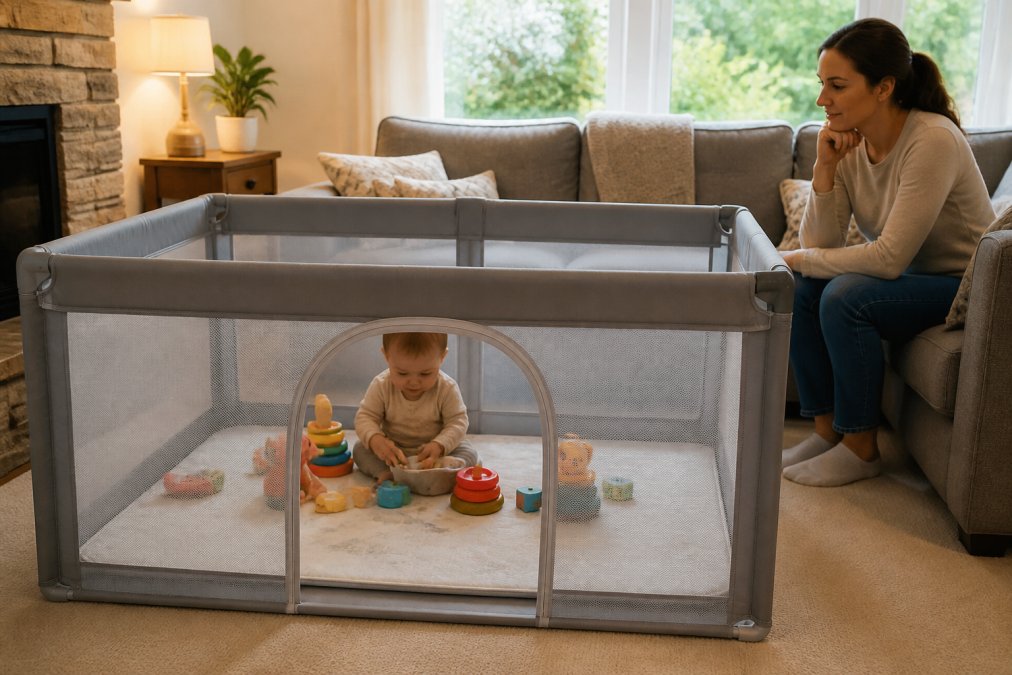
The JOY Collapsible Playpen from The Nook and Nurture Company at £59.99 offers a space-efficient option for smaller living rooms. It collapses for storage and sets up in seconds. For larger play spaces, the All Stars Playpen at £99.99 provides more room for movement, which is important for older toddlers.


Position the playpen where you can see it from other parts of the living room. Stock it with age-appropriate toys only, removing anything with small parts, sharp edges, or strangulation hazards. Rotate toys regularly to maintain interest. Use the playpen realistically as a tool for creating safe, independent play time, not as a replacement for supervision.
Securing your living room is an investment in your peace of mind. Start with your hazard assessment, work through each area systematically, and use products like The Nook and Nurture Company's safety range to create layers of protection. The goal isn't a sterile, child-proof environment, it's a space where your child can develop and explore while you can breathe a little easier.
Frequently Asked Questions
Q: At what age should you start to baby proof your living room?
A: Begin baby proofing before your child becomes mobile, typically around 4-6 months. Once babies start rolling, crawling, or pulling themselves up, they can reach hazards quickly. The earlier you secure furniture, cover outlets, and remove choking hazards, the safer your living room becomes. If you have a toddler already mobile, start immediately with the most critical items: furniture anchors, corner protectors, and outlet covers.
Q: How can I baby-proof my couch and prevent my baby from falling?
A: Use corner guards on coffee tables and side tables near your couch. Place a playpen nearby to contain your child during supervised playtime. Consider a foam floor mat underneath and around seating areas to cushion falls. Remove or secure any loose cushions that could pose a suffocation risk. Keep the sofa area clear of small objects, remote controls, and cords that could become strangulation hazards.
Q: What are the most important items to secure in a living room?
A: Prioritise: heavy furniture (televisions, bookcases, cabinets) with anchor straps to prevent tip-over accidents; electrical outlets with tamper-resistant covers; sharp furniture corners with silicone protectors; blind cords secured out of reach; and small objects that pose choking hazards. A safety gate for stairs or room access is essential if your living room connects to hazardous areas. Our [10x Silicone Table Corner Protectors](https://thenookandnurturecompany.com/products/10x-silicone-table-corner-protectors) (£7.99) and [10x Door Safety Latches](https://thenookandnurturecompany.com/products/10x-door-safety-latch) (£12.99) address common hazards.
Q: How do I hide electrical cables safely in my living room?
A: Use cable management boxes or surge protector covers to contain cords and prevent chewing. Secure cables behind furniture using adhesive clips or cord shorteners. Keep cables away from the perimeter where babies crawl. Never let cables hang loosely where they could become strangulation hazards. Bundle excess cord length and tape it out of reach. Use outlet covers on all accessible sockets, and consider furniture placement to block access to wall outlets entirely.
This article was written using GrandRanker


