

Table of Contents
- Check Your Consumer Rights for Faulty Goods
- Assess the Damage and Document Everything
- Contact Customer Support Within the Return Window
- Understand Refund, Replacement, and Repair Options
- Using a Template Letter for Returning Faulty Goods
- Returning Baby Items Without a Receipt
- Handle Postage and Shipping Costs
- Escalate if Your Return Is Rejected
- Frequently Asked Questions
Last Updated: September 29, 2026
Check Your Consumer Rights for Faulty Goods
Your statutory rights protect you when you buy faulty baby products. Under the Consumer Rights Act 2015, goods must be of satisfactory quality, fit for purpose, and as described (Consumer Rights Act 2015). If a baby item arrives damaged or defective, you have the right to return damaged baby products for a refund, replacement, or repair.
Assess the Damage and Document Everything
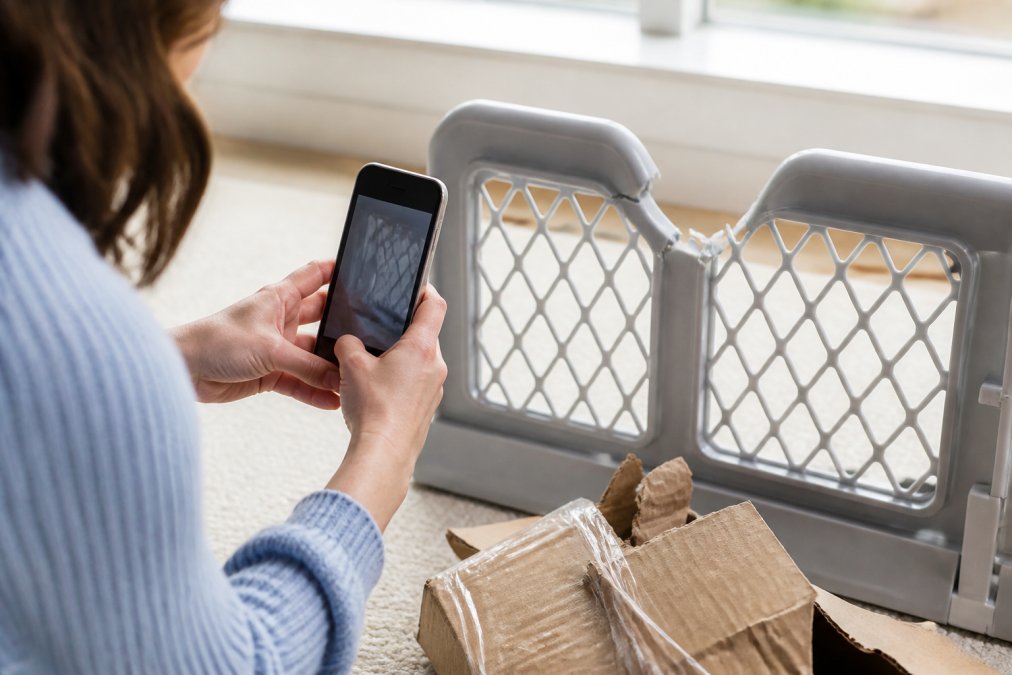
Before contacting customer support, examine the product carefully and take clear photographs of every angle. For baby products, also verify whether the damage relates to a known safety issue or manufacturer recall.
Check for safety recalls before documenting
Check the Office of Product Safety and Standards (OPSS) product recall database or the manufacturer's website (Product Safety Alerts, Reports and Recalls). If your item matches a recalled product, the return process may be expedited and the retailer may be obligated to remove it from circulation immediately.
Photograph the damaged item and packaging with a structured protocol
Follow this protocol: (1) Photograph the box as it arrived, capturing exterior damage. (2) Photograph protective materials if insufficient or damaged. (3) Photograph the defect from three angles, wide, medium, and close-up. (4) For safety-critical components (car seat shells, harness points, pushchair frame joints, brake mechanisms), photograph clearly. (5) Include a ruler or coin for scale in close-ups. (6) Capture manufacturing defects (misaligned seams, missing components, poor welds) clearly.
Understand which baby products have hygiene-specific return constraints
Some baby products cannot be returned once opened or used due to hygiene and safety regulations:
Non-returnable or restricted items:
- Breast pumps and parts (once opened): Hygiene regulations prohibit resale of used pumps or tubing that contact breast milk or skin.
- Bottle sterilisers and steam sterilisers (once used): These cannot be resold if they've been filled with water or used.
- Dummies and teething toys (if used): Once a baby has used them, they're considered non-returnable for hygiene reasons.
- Cot mattresses and fitted sheets (if used): These are often non-returnable if they've been slept on, even if faulty.
- Car seats (if installed): Once a car seat has been installed in a vehicle, it may be non-returnable due to safety concerns about unknown impacts or damage.
- Bath seats and support rings (if used): These contact the baby's skin and cannot be resold once used.
Returnable even if used:
- Cots and cot frames (structural defects)
- Pushchairs and buggies (mechanical or frame defects)
- High chairs (safety harness or structural issues)
- Changing tables (stability or assembly defects)
- Monitors and safety devices (electrical or functional defects)
Keep your proof of purchase
Your proof of purchase is essential: email receipt, order confirmation, credit card statement, or physical receipt. Save the order number and any packing slip. Store all documentation in one folder on your phone or computer.
Contact Customer Support Within the Return Window
Contact the retailer within 30 days of delivery to return damaged baby products. Email is best as it creates a written record. Include your order number, purchase date, and a clear description of the damage (e.g., "The cot rail arrived cracked down the middle"). Attach photographs and mention you're claiming under consumer rights for faulty goods. Follow up if you don't hear back within 5 working days.
Understand Refund, Replacement, and Repair Options
Retailers typically offer three solutions: refund (money back, though you may need to return the item first), replacement (fastest option; retailer arranges collection and ships a replacement), or repair (less common for baby products). You have the right to choose. If the retailer refuses your choice, escalate.
Using a Template Letter for Returning Faulty Goods
A formal letter strengthens your claim. Use this template:
[Your Name] | [Address] | [Email] | [Phone] | [Date]
To: [Retailer Name] Customer Service
Dear [Retailer Name],
Yours faithfully, [Your Name]
Send by email with photographs attached. Keep a copy.
Returning Baby Items Without a Receipt
Losing your receipt doesn't mean you've lost your rights. Provide your order number (if bought online) or ask the retailer to look up the transaction using your card details. For in-store purchases, bring your bank card and ask staff to search by card number and date. If the retailer requires a receipt despite the law not demanding it, escalate and explain you're claiming under consumer rights for faulty goods, which don't depend on a receipt.
Handle Postage and Shipping Costs
If the retailer's packaging was inadequate or the item was damaged in transit, they should cover return postage. Most retailers provide a prepaid returns label. If they refuse, ask why, under consumer rights law, the cost falls to the retailer. For bulky items, the retailer typically arranges collection.
Escalate if Your Return Is Rejected
If the retailer refuses your claim, escalate. You have multiple options with specific procedures and timelines.
Step 1: Formal complaint to the retailer's complaints department
Request a response from the retailer's complaints department. Email their main support address and mark your message "formal complaint." Reference your original claim and order number, explain why their refusal is unfair, state your requested outcome, and set a 10 working day deadline. Keep your tone professional. If they refuse again, ask them to confirm in writing. This written confirmation is essential for the next escalation step.
Step 2: Contact the retailer's Alternative Dispute Resolution (ADR) scheme
Escalate to an independent mediator through an Alternative Dispute Resolution (ADR) scheme. Most online and high street retailers are registered with one. Common schemes include Trustpilot, CEDR, Ombudsman Services, and Which? Dispute Resolution. Check the retailer's website footer under "complaints" or email customer service to find their registered scheme. File a complaint with the scheme, providing your order number, purchase date, photographs, receipts, and correspondence.
Step 3: Chargeback through your credit or debit card provider
If you paid by credit or debit card, you can request a chargeback. This is a formal dispute process where your card provider investigates the transaction and may reverse the charge.
When to use chargeback:
- The retailer has refused your return claim in writing
- You have evidence (photos, receipts, correspondence) supporting your claim
- The amount is significant enough to justify the effort
- You've exhausted other options or want to pursue them in parallel
How to request a chargeback:
- Contact your card provider (call the number on the back of your card)
- Explain that you received a faulty item and the retailer has refused to resolve it
- Request a "chargeback" or "dispute"
- Your card provider will ask for evidence: order confirmation, photos of the damage, and copies of your correspondence with the retailer
- Submit everything within the timeframe they provide (usually 30 days)
Step 4: Small claims court (for higher-value items)
For items worth more than £500 or if other escalation paths fail, you can take the retailer to small claims court. This is a formal legal process, but it's designed to be accessible to consumers without legal representation.
When to consider small claims:
- The item cost £500 or more
- The retailer has definitively refused your claim in writing
- You have strong evidence (photos, receipts, correspondence)
- You're willing to invest time in the process
How to file a small claim:
- Visit the HM Courts & Tribunals Service website (gov.uk/courts-tribunals)
- Locate the "Money Claims Online" service
- Complete the online form with your claim details
- Pay the court fee (typically £25-£335 depending on the claim amount)
- Submit your evidence: photos, receipts, correspondence, and a written statement of your case
Document everything throughout escalation
Keep a record of every step:
- Dates and times of calls or emails
- Names of staff members you speak to
- Copies of all correspondence
- Screenshots of online chats or messages
- Your photographs and receipts
This documentation is your evidence if you need to escalate further. If you reach ADR, small claims court, or a chargeback dispute, this record will be your strongest tool.
Frequently Asked Questions
What are my consumer rights for faulty goods under the Consumer Rights Act 2015?
Under the Consumer Rights Act 2015, you have the right to reject faulty goods within 30 days of purchase and receive a full refund. After 30 days, you can still claim repair or replacement if the fault develops within six months (or five years for some goods). The retailer must prove the fault wasn't caused by misuse. For damaged baby products, safety defects are taken seriously and often qualify for immediate replacement or refund regardless of how long you've owned the item.
Do I need the original packaging to return a damaged baby product?
Original packaging is not always required to return a damaged baby product, especially if the damage occurred during delivery or the item arrived faulty. However, keeping packaging helps prove you haven't used the product. If the item is genuinely faulty, retailers must accept the return even without original packaging. For safety-sensitive items like car seats or cots, packaging condition is less important than the product's safety and functionality. Always check the retailer's specific return policy first.
How long do I have to report a faulty baby product to the retailer?
You should report damage or faults as soon as you discover them, ideally within 30 days of purchase for a full refund under consumer rights. For items that arrive visibly damaged, report within 48 hours if possible to strengthen your claim. If you discover a defect later (within six months), you can still claim repair or replacement, though the retailer may investigate whether the damage is a manufacturing fault or resulted from use. Document the fault immediately with photographs and keep all correspondence with the retailer.
Who pays for return postage when sending back a faulty baby product?
When a baby product is faulty or damaged due to a manufacturing defect, the retailer should cover return postage costs. This is part of your statutory consumer rights. However, if the item is being returned for a change of mind rather than a fault, you may be charged a postage fee or asked to cover costs. Always clarify this with customer support before returning the item. For safety-critical products like damaged car seats or cots, retailers typically cover postage without question since faulty baby safety gear poses a risk.


