

Table of Contents
- Why a Minimalist Approach Works for Small Nurseries
- Space-Saving Nursery Furniture That Actually Functions
- How to Organise Toddler Toy Clutter in Compact Spaces
- Non-Toxic Nursery Decor and Minimalist Aesthetics
- Layout and Floor Plan Optimisation for Small Nurseries
- Essential Items Only: Decluttering Your Nursery from the Start
- Shared Room Nursery Ideas When Space Is Truly Limited
- Conclusion
Last Updated: August 22, 2026
Why a Minimalist Approach Works for Small Nurseries
A minimalist nursery setup for small spaces isn't about deprivation, it's about intentionality. When you're working with limited square footage, every item needs to earn its place. This forces you to ask the hard question: does this actually serve my baby, or am I just filling space out of habit?
The psychological benefit here matters more than people realise. Cluttered nurseries create visual noise that overstimulates infants and toddlers (peer-reviewed research). A calm, ordered environment supports better sleep patterns and reduces parental stress. You're not just saving space; you're creating a functional sanctuary.
At The Nook and Nurture Company, we believe that parents who start with a minimalist mindset make better purchasing decisions overall. They buy once, buy well, and avoid the cycle of accumulation that leaves nurseries looking like storage units. The result is a room that actually functions, not one that looks pretty in a magazine but falls apart in daily use.
Small spaces demand ruthless prioritisation. You cannot afford redundancy. That changing table that doubles as a dresser? Essential. That decorative mobile that serves no developmental purpose? Gone. This clarity extends beyond furniture into every category: toys, bedding, storage, decor. Each piece must justify its footprint.
Space-Saving Nursery Furniture That Actually Functions
Convertible Cribs and Multi-Functional Pieces
Convertible cribs are the foundation of any minimalist nursery setup for small spaces. A crib that transforms from newborn bed to toddler bed to full-size bed eliminates the need to buy three separate beds over the next five years. You're not just saving money; you're saving the space that would otherwise house multiple pieces.
The best convertible cribs use simple rail removal systems rather than complex hardware. Look for models where the conversion takes minutes, not hours. This matters because you'll actually use the conversion feature if it's frictionless. Cribs that are difficult to reconfigure often stay in one configuration indefinitely, defeating the purpose.
Multi-functional furniture extends beyond cribs. A dresser that serves as a changing surface eliminates the need for a separate changing table. A storage unit with removable baskets can migrate from the nursery to a playroom as your child grows. The Nook and Nurture Company's ZONEKIZ Storage Unit with 9 Removable Storage Baskets (£49.99) exemplifies this approach, it organises toys now and transitions to bedroom storage later.

When selecting multi-functional pieces, verify that each function genuinely works. A changing table that's too narrow for safe nappy changes defeats the purpose, no matter how compact it is. Test the height, stability, and usability of each function before committing.
Wall-Mounted Solutions and Vertical Storage
Vertical storage is non-negotiable in a small nursery. Wall-mounted shelves, hooks, and organisers free up floor space while keeping essentials within arm's reach. The key is mounting them at the right height, accessible to you during nighttime changes, but out of reach of curious toddlers.
Floating shelves work well for lightweight items: folded blankets, board books, decorative baskets. Avoid overloading shelves; a crowded shelf looks cluttered and creates safety concerns if items fall. A good rule is leaving 30% of shelf space empty (the American Academy of Dermatology).
Wall-mounted organisers designed for nappies, wipes, and creams keep changing supplies consolidated. Rather than scattered across multiple surfaces, everything lives in one spot. This reduces the mental load during 3am nappy changes when you're half-asleep.
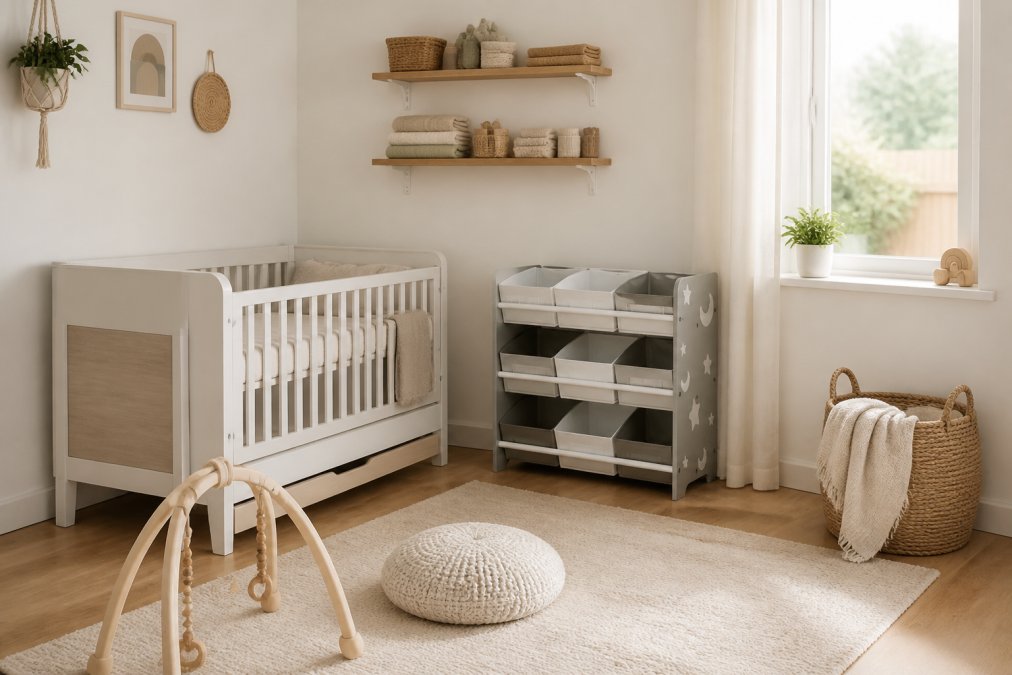
Seagrass baskets work beautifully for wall-mounted or shelf storage. The Natural Seagrass Storage Basket Set (£13.95) from The Nook and Nurture Company provides three sizes that nest together when not in use, then separate for organisation. Seagrass is durable, non-toxic, and has a calming aesthetic that supports a minimalist aesthetic without feeling cold.
The Storage Unit with 6 Water Hyacinth Drawers (£149.95) offers another approach, a compact dresser that provides serious storage capacity without consuming much floor space. Water hyacinth is sustainable, breathable, and doesn't off-gas chemicals like some synthetic materials.
How to Organise Toddler Toy Clutter in Compact Spaces
Rotation Systems for Gear and Toys
Toy rotation is the secret weapon of minimalist nurseries. Rather than displaying every toy simultaneously, you keep a curated selection available while storing the rest. Every few weeks, you swap out toys. Your child experiences the novelty of "new" toys without actually buying anything new.
A rotation system works like this: divide your toys into four groups. Keep one group accessible, store three groups. Every two weeks, swap. Your child stays engaged because toys feel fresh, and your visible toy count stays manageable.
The key is honest assessment. Most families accumulate far more toys than children actually use. A toddler with 20 toys available will play with perhaps three of them on any given day. The rest create visual clutter and decision fatigue. Rotating to five or six toys at a time maintains engagement without overwhelming the space.
Storage for rotated toys needs to be accessible but out of sight. Labelled bins in a hallway closet work well. Clear plastic allows you to see contents without opening every container. Opaque bins feel neater but require labelling and memory.
Storage Under the Crib and Hidden Spaces
The space beneath a crib is prime real estate in a small nursery. A shallow storage drawer or rolling bins slide underneath, storing seasonal items, extra bedding, or overflow toys. The Portable Baby Crib Storage Bag (£14.99) from The Nook and Nurture Company mounts directly to the crib's headboard, providing accessible storage for nappies, wipes, and nighttime essentials without consuming any floor space.

Under-bed storage works only if you can actually access items without moving the crib. Shallow rolling bins are better than deep boxes, you can reach items at the back without contortion. Label everything clearly so you know what's stored where.
Closet space in a nursery often goes underutilised. A hanging organiser on the back of the door stores off-season clothing, extra blankets, or backup supplies. Over-door hooks hold frequently used items like a sleep sack or changing mat. These vertical solutions free up every inch of horizontal space.
Non-Toxic Nursery Decor and Minimalist Aesthetics
A minimalist aesthetic naturally supports non-toxic choices. Fewer items means fewer potential sources of off-gassing chemicals or harmful substances. A room with white walls, natural wood furniture, and soft textiles in neutral tones creates a calming environment without requiring toxic finishes or synthetic materials.
Paint choice matters. Low-VOC paints release fewer volatile organic compounds, supporting air quality in a space where your baby spends significant time. Soft neutrals, whites, creams, warm greys, provide a backdrop that feels spacious without requiring bold colours.
Natural materials create visual warmth without clutter. Wood furniture, linen bedding, cotton clothing, and wool rugs all have inherent character. You don't need printed decor or patterned wallpaper to make the room feel intentional; the materials themselves carry aesthetic weight.
Lighting design affects how the space feels. Soft, warm lighting (around 2700K colour temperature) creates a calming atmosphere compared to bright white light (the CDC). A dimmable ceiling fixture and a small bedside lamp give you flexibility for different times of day without requiring multiple lighting pieces.
Resist the urge to decorate walls. A single piece of artwork or a simple wooden name sign is enough. Every additional item is visual noise. In a small space, simplicity reads as elegance.
Layout and Floor Plan Optimisation for Small Nurseries
Creating Nursery Zones in Limited Footprint
Even a tiny nursery functions better when zones are defined. Sleeping area, changing area, and storage area don't need to be in separate rooms, but they should be mentally distinct. Furniture placement, lighting, and colour can create these zones without walls.
The sleeping zone should feel separate from activity areas. Position the crib away from the changing table and toy storage. If possible, angle the crib so it's not directly visible from the door, this creates a sense of separation even in a small room.
The changing zone needs clear access and good lighting. A changing surface near a window provides natural light for nappy changes. Keep supplies within arm's reach, nothing worse than discovering mid-change that wipes are across the room.
Storage should be organised by frequency of use. Daily items (nappies, wipes, sleep clothes) live in the most accessible locations. Seasonal items and backup supplies go higher or deeper. This hierarchy prevents clutter from accumulating in high-traffic zones.
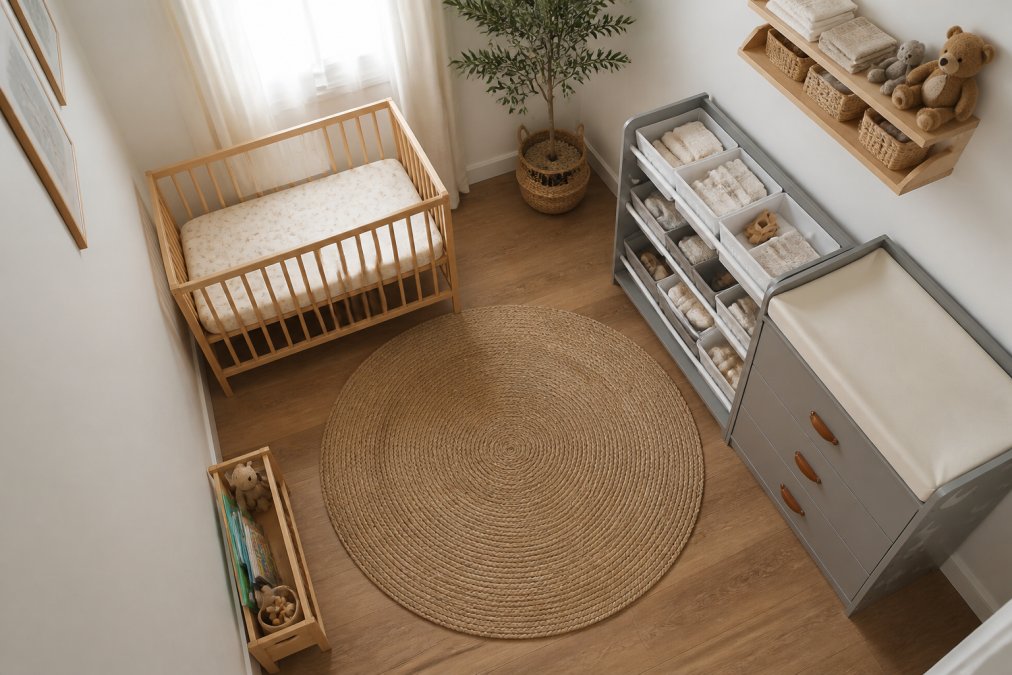
Ergonomic Flow and Safety Considerations for High-Density Storage
Safety intensifies when storage density increases. Wall-mounted items must be securely fastened, not just to look neat, but to prevent falls if a toddler pulls on them. Heavy items belong on lower shelves; lighter items higher up.
Storage baskets and bins should be lightweight and easy to remove, but stable when in place. A basket that tips easily when a toddler reaches for a toy creates hazards. Test stability before filling with items.
Cords, hooks, and hanging systems need careful placement. Anything within a toddler's reach that could wrap around a neck is a strangulation hazard. Wall-mounted organisers should be mounted high enough that reaching them requires adult help.
Flooring in a minimalist nursery should be easy to clean and safe. Hard flooring (wood or laminate) with a washable rug works better than wall-to-wall carpet in a space with frequent spills. A rug defines the play zone while remaining practical.
Airflow matters in a compact space. Ensure storage solutions don't block vents or create dead zones where moisture accumulates. Open shelving allows air circulation better than closed cabinets.
Essential Items Only: Decluttering Your Nursery from the Start
Most new parents buy far more than they need. A minimalist nursery setup for small spaces forces clarity about what's actually essential. This list might surprise you with what doesn't make the cut.
Essential items for a newborn nursery:
- One safe sleep surface (crib or bassinet)
- Fitted sheets and waterproof mattress protector
- Sleepwear appropriate to room temperature
- Nappies and wipes
- Basic changing supplies
- A few toys for visual stimulation
- Storage for the above
Everything else is optional. That elaborate mobile? Your baby sees it for seconds before sleep. The themed bedding set? Unnecessary when simple fitted sheets work fine. The decorative wall stickers? They contribute nothing to your baby's development.
Before purchasing any item, ask: will my baby use this regularly, or am I buying it because it looks cute? Will it still be useful at age two, or will it be outgrown? Is there a multi-functional alternative that serves the same purpose?
This ruthlessness at the start prevents the accumulation cycle. You're not depriving your child; you're being intentional. A minimalist nursery teaches early that spaces function better when they're not overstuffed.
Shared Room Nursery Ideas When Space Is Truly Limited
When a nursery shares space with a sibling's bedroom or a parent's room, minimalism becomes essential rather than optional. Every square inch must serve multiple purposes.
A compact crib or bassinet takes up far less space than a full-size crib. Some families use a bedside sleeper that attaches to the parent's bed, eliminating a separate sleep surface entirely. This works well for newborns but requires transition planning as babies grow.
Storage must be ruthlessly consolidated. One dresser serves both the nursery and the shared room. Toys live in a single compact unit rather than scattered across multiple surfaces. Clothing gets pared to essentials only, what fits the current season and size.
Zoning becomes more important in shared spaces. A room divider, curtain, or strategic furniture placement creates visual separation between the nursery area and the rest of the room. This helps everyone, the baby sleeps better with separation from activity, and older siblings can play without disturbing the baby.
Lighting flexibility is crucial. A dimmer on the main light and a separate, soft light for the nursery area allow you to manage different needs simultaneously. The baby sleeps while an older child reads or plays quietly.
Noise management matters in shared spaces. White noise machines, soft furnishings, and strategic placement of the crib away from the door help isolate sleep from activity. Heavy curtains reduce light and sound.
When space is truly limited, accept that the nursery will be functional rather than beautiful. Focus on safety, cleanliness, and organisation. Beauty comes from order, not decoration.
Conclusion
A minimalist nursery setup for small spaces works because it removes the noise, both literal and psychological, that interferes with good parenting and good sleep. You're not sacrificing comfort or functionality; you're achieving both by eliminating what doesn't matter.
The Nook and Nurture Company makes this easier with thoughtfully designed storage solutions that do more with less. The ZONEKIZ Storage Unit (£49.99) and Natural Seagrass Baskets (£13.95) prove that minimal doesn't mean sparse; it means intentional. Start with these essentials, resist the urge to accumulate, and watch your small space become genuinely functional.

Frequently Asked Questions
What are the essential items for a minimalist nursery?
A minimalist nursery needs a safe crib or cot, a firm mattress with fitted sheets, a changing surface (wall-mounted or compact dresser), storage for nappies and clothing, blackout blinds, and a safe place for feeding. Skip the decorative extras, focus on items that serve a function. Everything else is optional. This approach reduces overwhelm for new parents and keeps your nursery footprint small and manageable.
How can I maximise storage in a tiny baby room?
Use vertical storage with wall-mounted shelves and pegboards to keep the floor clear. Add storage baskets under the crib, utilise wardrobe space efficiently, and consider multi-functional furniture like changing tables with drawers. The ZONEKIZ Storage Unit with 9 removable baskets (£49.99) works well in compact spaces because it keeps items visible and accessible whilst containing clutter. Rotate seasonal gear and toys rather than storing everything at once.
What safety standards should I consider for nursery furniture?
All cots must meet the British Standard BS EN 716, which covers safety requirements for baby cots. Ensure wall-mounted shelves are securely anchored to prevent tipping, especially if storing heavier items. Storage units should be stable and unable to topple. Avoid furniture with sharp edges or small parts that could be hazards. Keep storage baskets and containers lightweight so you can safely reach high shelves whilst holding your baby.
Is it better to use a cot or a crib in a small nursery?
A compact cot is typically the better choice for small spaces because it takes up less floor area than a full-size crib. Standard cots measure around 120cm by 65cm, whilst cribs can be larger. Convertible cots that transition from newborn to toddler bed offer long-term value in limited space. Choose one that fits your room's dimensions and allows clearance for safe movement around it.
This article was written using GrandRanker


