

Table of Contents
- Cleaning vs Disinfecting: What Parents Actually Need to Know
- How to Clean Baby Toys: A Step-by-Step Method
- How to Clean Wooden Toys Without Damaging Them
- How to Wash Soft Toys and Plush Comforters
- How Often to Clean Baby Toys (and What Changes With Age)
- Safe Non-Toxic Cleaning Solutions You Can Mix at Home
- Bath Toys, Mold and Drying: The Part Most Guides Skip
- Common Toy Cleaning Mistakes to Avoid
- Frequently Asked Questions
Last Updated: October 9, 2026
Cleaning vs Disinfecting: What Parents Actually Need to Know
Most parents reach for the strongest product they can find. That instinct is understandable, but it is also where things go wrong.
At The Nook and Nurture Company, we hear the same worry from parents every week.
Cleaning removes dirt, saliva, food and most germs from a surface using soap and water. Disinfecting kills germs on a surface using a chemical agent.
The NHS guidance on cleaning your home makes the same point: soap and water handles most routine situations, and disinfectant is for specific moments rather than daily use.
That single shift in thinking saves you time, money and worry. Below, we break down exactly how to clean every type of toy in your home, without harsh chemicals.
When to Clean and When to Disinfect
Clean toys on a routine schedule, and disinfect only when there is a real reason to.
Reach for a disinfectant when:
- A child in the house has been unwell
- A toy has been shared at a playgroup or nursery
- A toy has been in contact with blood, vomit or faeces
- A toy has been dropped in a public space
For everything else, warm water and a little soap will do the job. Your child's immune system benefits from ordinary exposure to everyday germs, not from a sterile home.
How to Clean Baby Toys: A Step-by-Step Method
Learning how to clean baby toys properly takes about ten minutes once you have a routine. Here is the method we recommend.
- Check the label first. Most baby toys carry cleaning guidance from the maker. Follow it before anything else.
- Remove batteries from any electronic or battery-operated toys.
- Fill a bowl with warm water and add a small amount of mild soap.
- Wipe or soak the toy, depending on its material.
- Rinse well with clean water to remove all soap residue.
- Air-dry completely on a clean towel or drying rack.
- Wipe down the storage bin before putting toys back.
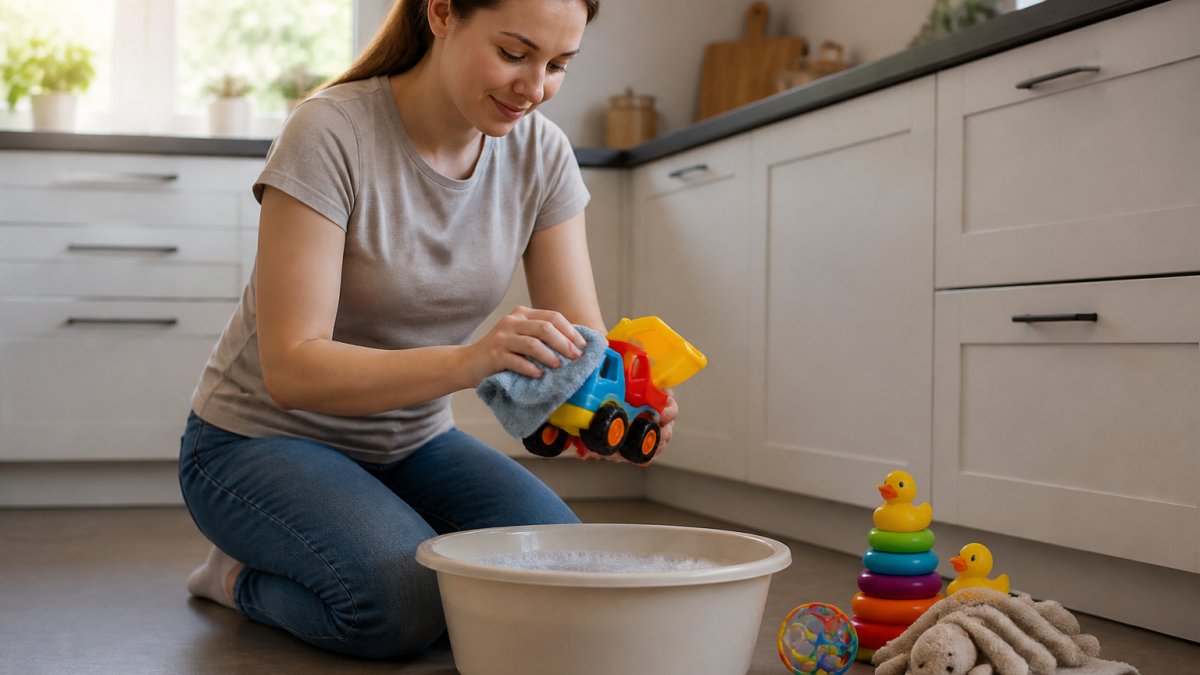
Rinsing matters more than most parents realise. Soap left on a teething ring ends up in your baby's mouth.
How to Clean Wooden Toys Without Damaging Them
Learning how to clean wooden toys is different from cleaning plastic, and the stakes are higher. Wood absorbs water, so soaking is out.
Use this method instead:
- Wipe with a damp cloth and a tiny amount of mild soap
- Wipe again with a clean damp cloth to rinse
- Dry straight away with a soft towel
- Let the toy air-dry fully before play
Never put wooden toys in the dishwasher or leave them soaking in the sink. Both will warp the wood and crack any paint or seal.
What to Avoid on Painted or Sealed Wood
Painted and sealed wooden toys need extra care. Avoid vinegar on painted surfaces, as the acid can dull or lift the finish over time. Skip anything abrasive, including scouring pads and strong all-purpose cleaners. And never use bleach on wood: it damages the surface and leaves residue behind.
If a painted toy is chipped and the paint is flaking, retire it. Small flakes are a choking risk.
How to Wash Soft Toys and Plush Comforters
Learning how to wash soft toys depends on what is inside them. Check the care label before anything goes near water.
For most plush toys:
- Place the toy in a pillowcase and tie it closed
- Wash on a gentle cycle with mild detergent
- Use cool or lukewarm water, never hot
- Air-dry fully, ideally in sunlight
For toys with electronic parts, surface-wipe only. For very delicate or vintage plush, hand-wash in a bowl of warm soapy water and squeeze gently.
A common mistake is putting a plush toy in the tumble dryer. Heat shrinks fibres, melts glued-on eyes, and can damage the filling. Air-drying takes longer, but it keeps the toy in one piece.
How Often to Clean Baby Toys (and What Changes With Age)
Knowing how often to clean baby toys comes down to one question: does it go in the mouth? Everything else follows from that.
A common pattern among parents is to clean everything on the same schedule, then feel guilty when they miss a day.
Tier 1: Mouthing toys. Anything your baby puts in their mouth, teethers, rattles, silicone chews, small plastic figures, needs cleaning daily.
Tier 2: Frequently handled toys. Toys your baby holds, throws, or crawls after but does not mouth, stacking cups, soft blocks, push-along toys, need a wipe-down every few days.
| Age or situation | Cleaning frequency |
|---|---|
| Newborn to 6 months, mouthing everything | Daily for mouthing toys; every few days for handled toys |
| 6 to 18 months, crawling and mouthing | Daily for favourites; weekly for the rest |
| Toddlers, no longer mouthing | Weekly, plus after illness |
| Bath toys | After every use |
| Soft toys and comforters | Every one to two weeks |
| Toys shared at nursery or playgroup | After every session |
| During household illness | Daily for all toys in use |
A few situations override the schedule entirely:
- Illness in the house. If a child or adult has been unwell, clean and disinfect all toys the child has handled. Once the illness has passed, return to the normal routine.
- Shared toys. Toys used at a playgroup, nursery or childminder setting should be cleaned after every session, because you cannot know what they have been in contact with.
- Visible dirt or saliva. If you can see it, clean it. Do not wait for the scheduled day.
- New toys. Wipe down new toys before first use. They have been handled in shops and warehouses.
Once your child stops mouthing toys, the schedule relaxes. Until then, treat anything that goes in the mouth as a daily job.
Safe Non-Toxic Cleaning Solutions You Can Mix at Home
You can make a safe toy cleaning solution from two or three cheap kitchen items. Here are the ones we trust.
Mild soap and warm water. The workhorse. Safe for almost every material and effective at lifting dirt and germs.
White vinegar solution. Mix one part white vinegar with one part water in a spray bottle. Good for hard plastic and bath toys. Do not use it on wood, painted surfaces or anything metal.
Bicarbonate of soda paste. Mix bicarbonate of soda with a little water to make a paste. Useful for scrubbing sticky residue off hard plastic.
Avoid bleach on children's toys. It leaves residue, irritates skin and eyes, and is easy to over-dilute or under-dilute at home.
Dilution, Contact Time and Rinsing
Three details decide whether a homemade cleaner works or causes a problem.
Dilution. Follow the ratio exactly. A stronger mix is not a better cleaner; it just leaves more residue.
Contact time. Vinegar and soap need a moment to work. Wipe, then wait a few seconds before rinsing.
Rinsing. Always rinse with clean water. This is the step parents skip most often, and it is the one that matters for a baby who mouths everything.
Bath Toys, Mold and Drying: The Part Most Guides Skip
Bath toys are the biggest mould risk in any toy collection. Water gets inside through the squeaker hole, sits there, and turns black within weeks.
Most guides tell you to squeeze toys out after bath time. That helps, but it does not solve the problem.
Prevention is the first line of defence:
- Squeeze out all water after every bath, then shake the toy to dislodge trapped water.
- Store toys where air can reach them, not in a sealed tub. A mesh bag or a slatted basket works well.
- Skip toys with holes you cannot drain. If you cannot get a finger or a cloth inside, you cannot clean it.
- Choose bath toys with a single large opening rather than a small squeaker hole, or choose solid toys with no openings at all.
- Rotate bath toys so each one has time to dry fully between uses.
Inspection and disposal:
Check bath toys weekly. Squeeze them and look at what comes out. If the water is cloudy, discoloured, or smells musty, mould is already inside.
If you can see mould inside a bath toy, throw it away.
Drying is the whole game here. A toy that dries fully between baths will not grow mould. A toy that stays damp will.
If you are replacing mouldy bath toys, look for ones that are easy to drain and dry. Solid silicone toys, toys with a single large drain hole, and toys that can be taken apart for cleaning are all better choices than sealed squeakers.
Common Toy Cleaning Mistakes to Avoid
Most toy cleaning problems come from a handful of repeat mistakes.
- Soaking battery-operated toys. Water gets inside and ruins the electronics.
- Using bleach or harsh chemicals. Residue ends up in your child's mouth.
- Skipping the rinse. Soap left behind irritates skin and eyes.
- Tumble-drying plush toys. Heat shrinks and damages them.
- Storing bath toys wet. This is the fastest route to mould.
- Ignoring the maker's instructions. Every toy is tested for a specific cleaning method.
- Cleaning less often than your child mouths toys. Daily is the rule until mouthing stops.
None of this is complicated. It just needs a routine you will actually keep.
That is where we can help. The Nook and Nurture Company curates baby, parent and home essentials chosen with parents and babies in mind, from safety gear to storage that makes toy rotation easier. Every order comes with a 30-day risk-free trial, guaranteed next-day shipping, and 100% secure payments with SSL encryption.
Keeping a home clean without harsh chemicals takes a little planning, and a lot of small decisions add up. A simple routine, the right materials and a clear idea of when to clean versus disinfect will cover almost everything your child plays with.
Frequently Asked Questions
What is a safe and non-toxic cleaner for toys?
Warm water with a small amount of mild washing-up liquid handles most everyday toy cleaning. For a non-toxic option, mix white vinegar with equal parts water in a spray bottle, or use a diluted bicarbonate of soda paste on stubborn marks. Always wipe the toy with clean water afterwards and let it air-dry completely before your child plays with it again. Avoid bleach and harsh chemicals on anything your baby mouths.
Can you use vinegar to clean toys?
Yes, white vinegar is one of the most useful natural cleaners for toy surfaces. Dilute it with equal parts warm water, wipe the toy, then rinse with a clean damp cloth. Vinegar works well on hard plastic and sealed wooden toys, but skip it on painted wood, fabric and anything with metal parts, as the acid can dull finishes or cause corrosion. Never mix vinegar with bleach.
How do you wash soft toys and plushies?
Check the manufacturer's label first. Most plush toys survive a gentle machine wash at 30°C in a pillowcase or laundry bag, on a low spin. For toys with glued-on eyes or battery packs, surface-wash instead with a damp cloth and mild soap. Air-dry thoroughly, ideally in direct sunlight, and check seams and stuffing are completely dry before returning the toy to your child.
How often should children's toys be cleaned?
Toys that go in your baby's mouth need wiping daily, and a full wash once or twice a week. Toys for older children can be cleaned every two to four weeks, or sooner if a child in the house has been unwell. Bath toys should be squeezed out and dried after every use, with a deeper clean weekly, because trapped water is where mold grows fastest.


