

Table of Contents
- Mother's Haven vs Boutique Baby Stores: The Real Difference
- Quick Comparison: What Each Retailer Offers
- Why Independent Boutiques and Curated Collections Win
- Quality, Ethical Manufacturing, and Sustainable Fashion
- How to Save Money on Baby Gear Without Sacrificing Quality
- Best Independent Baby Boutiques UK: What to Look For
- Value for Money and Post-Purchase Support Compared
- The Verdict: Which Baby Retailer Should You Choose?
- Frequently Asked Questions
Last Updated: September 7, 2026
Choosing between Mother's Haven and boutique baby stores comes down to one question: do you want a transactional purchase or a curated experience? Boutique baby stores are independent retailers that hand-pick their inventory, focusing on quality, ethical manufacturing, and unique finds rather than stocking every mass-produced item available. This guide from The Nook and Nurture Company breaks down the real differences.
The gap between these two shopping models is wider than most parents expect. A big retailer gives you convenience and volume, while an independent boutique offers a curated collection built around premium quality and thoughtful design. For parents asking "how to save money on baby gear" without sacrificing standards, the boutique model often delivers better long-term value.
Below, we'll compare what each retailer offers, where pricing differences hide, and why ethical manufacturing and post-purchase support should factor into your decision.
Mother's Haven vs Boutique Baby Stores: The Real Difference
The core difference between Mother's Haven and boutique baby stores is the business model itself. Mother's Haven operates as a larger retailer that stocks a broad range of newborn clothing, baby essentials, and nursery furniture from many brands. An independent boutique, by contrast, works with a small number of ethical manufacturing partners and carries a deliberately limited selection of items that meet specific quality standards.
That curation changes everything about the shopping experience. When you walk into a boutique, every item on the shelf has been touched, assessed, and approved by someone who understands childrenswear. Instead of a wall of identical babygrows, you find small-batch production pieces, vintage-inspired designs, and scandi style staples you will not see on every other child.
Mass-market retailers compete on price and shelf space. Independent boutiques compete on taste, quality, and the retail experience itself. The trade-off is real: you pay more per item at a boutique, but you buy fewer, better things that last through multiple children.
Quick Comparison: What Each Retailer Offers
| Feature | Mother's Haven | Independent Boutique |
|---|---|---|
| Product range | Broad, mass-produced | Curated, hand-picked |
| Ethical manufacturing | Varies by brand | Often core focus |
| Personalised service | Limited | High, one-to-one |
| Price point | Lower per item | Higher per item |
| Unique finds | Rare | Frequent |
| Post-purchase support | Standard returns | Personal follow-up |
| Community offering | Minimal | Classes and events |
A straight price comparison misses the point. Yes, a boutique babygrow costs more than a supermarket equivalent, but it is usually made from organic cotton, produced in small batches, and chosen because it will wash well and last. That is the price-to-quality ratio working in your favour.
Why Independent Boutiques and Curated Collections Win
Independent boutiques win for one simple reason: someone has already done the filtering work for you. A curated collection means every product has been tested against real criteria, from fabric quality to safety standards, before it ever reaches the shelf. That saves you hours of comparing newborn clothing options that all look similar but vary wildly in quality.
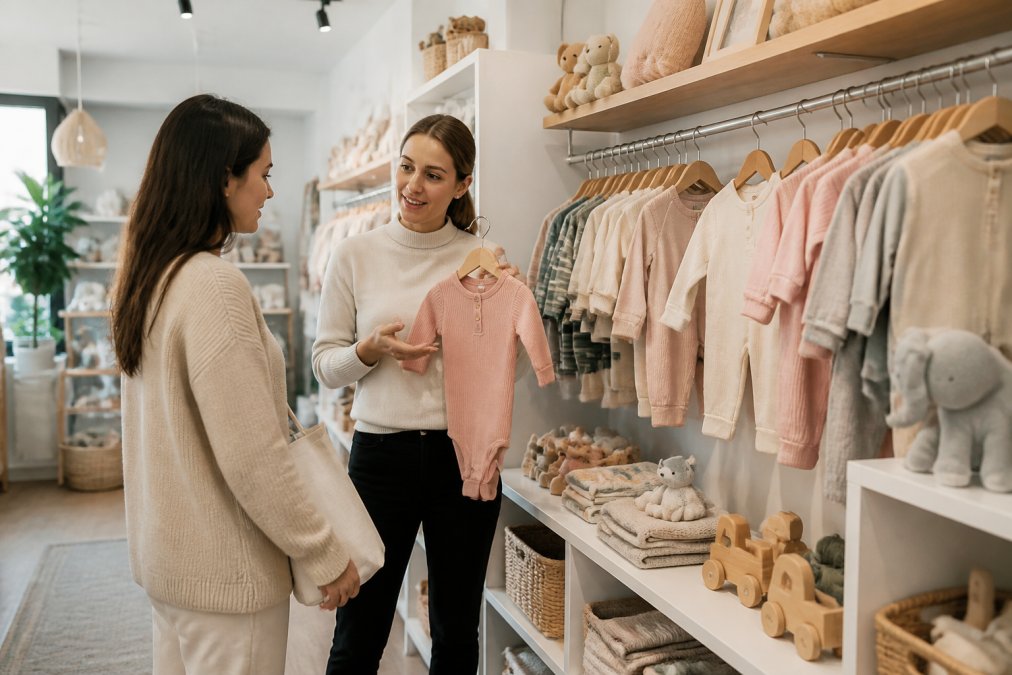
Staff in independent shops typically know their stock inside out because they chose it themselves. They can tell you which knitted baby clothes survive repeated washing, which brands run small, and what you actually need for a newborn versus what is nice to have. That personalised service is impossible to replicate on a warehouse floor.
For new parents drowning in choice, this guidance is the real value. A boutique narrows your options to a handful of genuinely good products, making decisions easier and reducing the chance of regret.
Quality, Ethical Manufacturing, and Sustainable Fashion
Quality in childrenswear is not about the label. It is about how the garment was made, what materials went into it, and whether the people producing it were treated fairly. Boutique baby stores tend to prioritise ethical manufacturing because their business model depends on repeat custom and trust.
Sustainable fashion in the baby sector means choosing organic cotton over conventional, supporting zero-waste production, and buying fewer items that last longer. A well-made babygrow from a boutique might cost more upfront, but it will survive the wash cycle, the crawling phase, and a second child. That durability is a form of saving money on baby gear that mass-market retailers cannot offer.
Thoughtfully made clothing also tends to be safer. Boutiques that focus on natural materials can tell you exactly where a garment was produced and under what conditions, transparency worth the premium for parents concerned about what touches their baby's skin.
How to Save Money on Baby Gear Without Sacrificing Quality
Saving money on baby gear does not mean buying the cheapest option. It means buying the right item once, rather than the wrong item repeatedly. The most useful way to think about this is cost-per-wear.
The Cost-Per-Wear Calculation
A £12 supermarket babygrow might seem like the sensible buy against a £28 boutique version (ons.gov.uk). But run the numbers on how each item actually performs:
- Mass-market babygrow: £12 upfront. After 10 washes, the fabric pills, the poppers pull, and the colour fades. It lasts one child for one season. Cost-per-wear: roughly £0.40 per wear.
- Boutique organic cotton babygrow: £28 upfront. After 30 washes, the fabric softens but holds its shape, the poppers stay aligned, and the colour remains true. It lasts one child for a full season and then passes to a sibling. Cost-per-wear: roughly £0.15 per wear.
The boutique item costs more at the till but delivers better value across its usable life. This is the mechanism behind the 'buy less, choose well' philosophy that independent retailers champion.
Practical Strategies That Work with Boutique Shopping
- Build a capsule wardrobe of newborn clothing, Aim for 7-10 mix-and-match pieces rather than 20 standalone outfits. A capsule of neutral tones and versatile layers means every item gets worn, and nothing sits in a drawer unworn.
- Buy ahead in sales but stick to your curated list, Boutique sales events (typically January and July) offer 20-30% off (statista.com). Know what you need for the next size up before the sale starts, and resist impulse buys that derail your capsule plan.
- Choose gender-neutral colours for future siblings, Cream, oat, sage, and mustard work for any child. This single choice can double the lifespan of your wardrobe investment.
- Ask about shipping policies and return windows before you commit, A boutique that offers free returns or a risk-free trial removes the financial gamble of buying online. If a retailer charges £4.95 for returns, factor that into the true cost of the item.
- Register for gifts at a boutique, Friends and family often prefer buying a meaningful, quality gift over another plastic toy. A gift registry at an independent store channels that goodwill into pieces that will actually last.
The Hidden Cost of a Bad Purchase
The real cost of a bad purchase is not the price tag. It is the time spent boxing it up, the shipping cost to send it back, and the weeks of living with clutter while you sort it out. Curated retailers that offer risk-free trials remove that hidden cost entirely.
The Nook and Nurture Company lets you test items like the Explorers Storage Units with 6 Boxes at £49.99 with a full refund if they do not work for your space. That removes the gamble from buying nursery furniture online and protects your budget if something does not fit.
:::tip Cost-per-wear in practice Before you buy any baby item, divide the price by the number of times you realistically expect to use it. If the cost-per-wear is under £0.20, it is probably a sound investment, regardless of whether you buy it from a boutique or a larger retailer.
Best Independent Baby Boutiques UK: What to Look For
The best independent baby boutiques UK parents recommend share several traits. Here is a practical checklist you can apply to any boutique, whether on the high street or online.
The Five-Point Boutique Checklist
1. Transparency about ethical manufacturing
A genuine boutique can tell you where its organic cotton is grown, which factory sews its garments, and what certifications back those claims. Look for specific mentions of GOTS (Global Organic Textile Standard) certification for organic textiles, or OEKO-TEX Standard 100 for safety-tested materials (oeko-tex.com). A boutique that says 'ethically sourced' without naming a standard or a supplier is not doing the work.
2. A genuinely curated range, not a mini-catalogue
Ask how many brands the boutique carries. A true curator works with 10-20 carefully chosen brands, not 200. If a shop claims to be a boutique but stocks every brand available at the nearest retail park, it is a small shop with a big catalogue, not a curated experience.
3. Staff who can answer the hard questions
Test the boutique before you buy. Ask: 'Which of these knitted baby clothes survives repeated washing best?' or 'Which brand runs small for a 6-month-old?' A well-trained boutique owner can answer immediately because they have handled the garments, washed them, and heard feedback from customers. If the response is 'I am not sure, let me check the website,' you are not getting the curation premium.
4. A clear post-purchase support policy
Before you commit, check the returns page. A boutique that offers a 14-day or 30-day return window, free returns on faulty items, and a responsive customer service channel is investing in your trust. Be wary of boutiques that hide their returns policy or charge excessive restocking fees.
5. Community offerings that go beyond retail
Boutiques that host baby classes, feeding support groups, or new-parent evenings are building a relationship with you, not just processing a transaction. These 'third space' offerings, the term sociologists use for places that are neither home nor work, signal genuine community investment.
Red Flags to Avoid
- No information about materials or sourcing, If the product page does not say what the garment is made from or where it was produced, the boutique is not prioritising transparency.
- Stock photos instead of real product images, A boutique that has not photographed its own products probably has not handled them either.
- No physical address or phone number, Legitimate UK businesses must display a registered address. Its absence is a warning sign.
- Pressure tactics or 'limited time only' urgency, Curated retailers let the quality speak for itself; they do not need artificial scarcity to close a sale.
How to Vet an Online Boutique
For online boutiques, examine the post-purchase support before you enter your card details. Clear shipping policies, responsive customer service, and a fair return process matter more than a pretty website. The Nook and Nurture Company pairs its curated home and baby essentials with guaranteed next day shipping and 100% secure payments with SSL encryption, so you are not left wondering where your order is or whether your card details are safe.
:::warning The curation test If you can find the exact same item at three different 'boutiques' at three different prices, none of them are truly curating. A genuine boutique carries items you cannot easily find elsewhere, that exclusivity is part of what you are paying for.
Value for Money and Post-Purchase Support Compared
Value for money is not the same as a low price. It is the total cost of owning an item divided by how well it serves you. A £149.95 storage unit like the Padstow with six water hyacinth drawers costs more than a plastic alternative, but it looks like furniture, lasts for years, and turns tidying into a system your child can manage.

Post-purchase support is where large retailers often fall short and boutiques shine. When you buy a nursery setup from a curated retailer, you should be able to ask questions after the sale, get honest advice, and return items without a fight. The value-for-money analysis shifts dramatically when a retailer stands behind its products with a genuine refund policy.
The real cost of a bad purchase is not the price tag. It is the time spent boxing it up, the shipping cost to send it back, and the weeks of living with clutter while you sort it out. Curated retailers that offer risk-free trials remove that hidden cost entirely.
The Verdict: Which Baby Retailer Should You Choose?
Choose Mother's Haven if you need a specific mass-market brand, want the widest possible selection, and are happy to do your own product research. Choose a boutique baby store if you value curation, ethical manufacturing, and guidance from someone who has already done the filtering.
For most parents, the boutique model wins on the things that matter after the purchase: quality that lasts, support when you need it, and products that fit your values. The Nook and Nurture Company brings that curated experience online, with every item chosen to support family life, backed by a 30-day risk-free trial and next day shipping.
Get started with The Nook and Nurture Company and build a nursery that works as hard as you do.
Frequently Asked Questions
Are boutique baby stores more expensive than standard retailers?
Not always. While independent boutiques often stock premium quality items with a higher upfront cost, they typically offer better value over time. A thoughtfully made babygrow from an independent boutique lasts through multiple children, while cheaper mass-market alternatives often wear out quickly. Look for sales and bundle deals to keep costs down.
How do return policies compare between independent boutiques and larger baby stores?
Larger retailers often have more flexible return windows, but independent boutiques usually offer more personalised service. Many curated stores, including The Nook and Nurture Company, provide a 30-day risk-free trial with full refunds if you are not satisfied. Always check the specific returns page before purchasing, as policies vary between shops.
What are the benefits of shopping at independent baby boutiques?
Independent boutiques offer a curated collection you will not find in mass-market retailers. They focus on quality, ethical manufacturing, and sustainable fashion, often sourcing from small-batch producers. You also get personalised service and expert advice from people who know their products inside out, making it easier to find unique, stylish baby essentials.
How do curated baby stores differ from larger retail chains?
Curated baby stores select every item they stock, which means fewer choices but higher quality. Instead of thousands of products, they offer a hand-picked range of newborn clothing, toys, and nursery essentials. This saves you time researching what is safe and durable. Large chains stock everything, leaving you to judge quality yourself.
What should I look for when choosing a baby gear retailer?
Prioritise transparent shipping policies, a clear returns process, and honest customer reviews. Check whether the retailer provides details on ethical manufacturing and materials, such as organic cotton. A good retailer offers a curated selection that helps you identify what you actually need versus what is nice to have, and stands behind their products with a simple returns policy.


